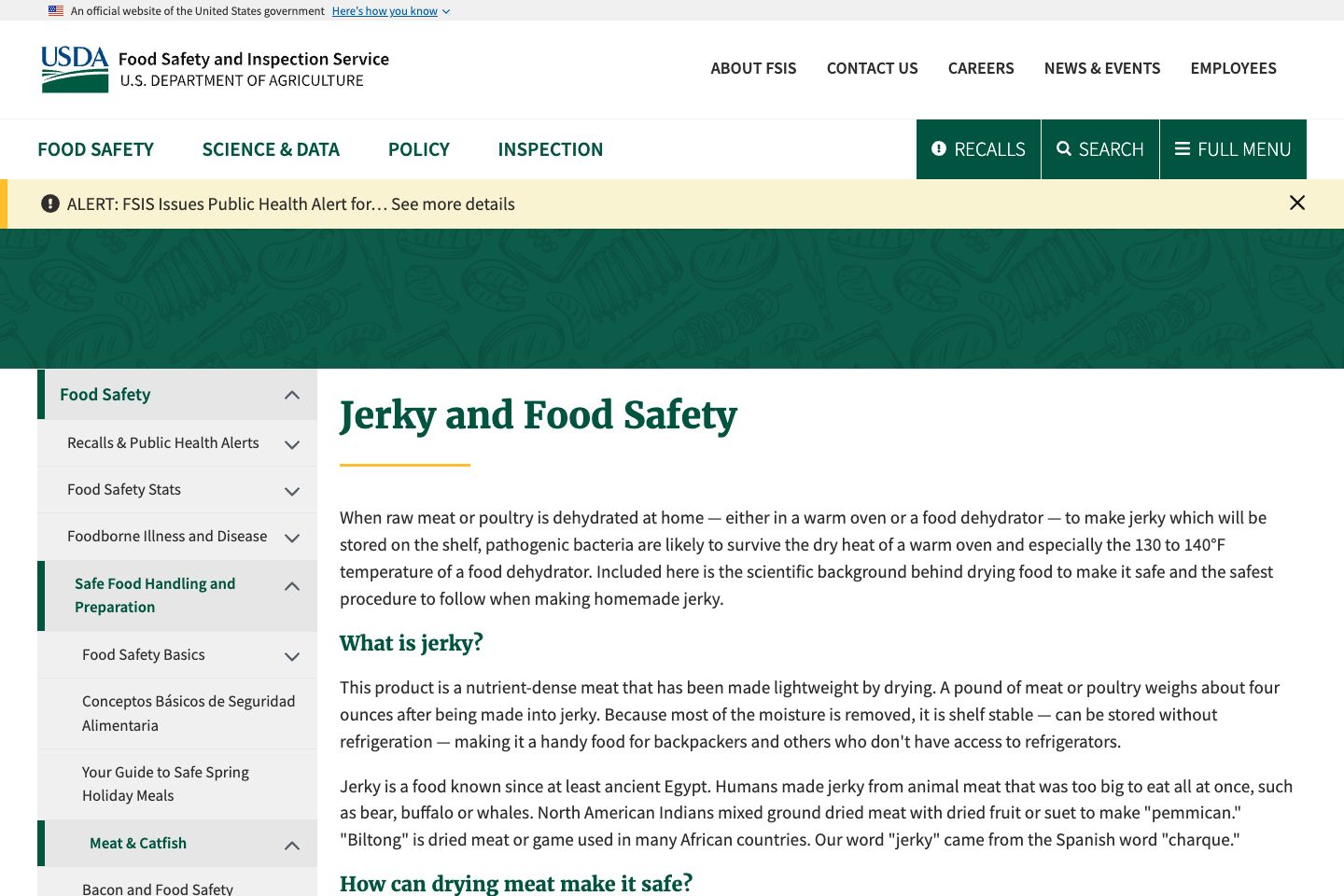
USDA FSIS’s Jerky and Food Safety page is the temperature bible for homemade venison jerky: heat meat to 160°F before dehydrating, then hold a dehydrator at 130-140°F so drying finishes before spoilage organisms grow (U.S. Department of Agriculture). FSIS warns that most dehydrator manuals skip the preheat and that dehydrators alone may never cook meat to 160°F (U.S. Department of Agriculture). During drying, evaporating moisture keeps meat cool until late, so bacteria become more heat resistant if you never pre-cooked (U.S. Department of Agriculture). Research FSIS cites found pathogenic E. coli surviving up to 10 hours at up to 145°F on inoculated venison (U.S. Department of Agriculture). Marination alone did not significantly reduce pathogens compared with unmarinated slices in that research summary (U.S. Department of Agriculture). Penn State Extension likewise lists jerky among foods that should reach 160°F before drying and stores home-dried jerky about one to two months (Penn State Extension). Oven drying follows the same lethality-then-dry logic: finish a thermometer-verified 160°F wet-heat step, then dry at a controlled low heat rather than guessing by color (U.S. Department of Agriculture; Penn State Extension).
Key Takeaways
- Preheat to 160°F before drying (U.S. Department of Agriculture; Penn State Extension).
- Dehydrator hold 130-140°F (U.S. Department of Agriculture).
- Venison trial: E. coli survived 10h/145°F without proper process (U.S. Department of Agriculture).
- Marinate only refrigerated; do not reuse marinade (U.S. Department of Agriculture).
- Home-dried storage about 1-2 months (U.S. Department of Agriculture; Penn State Extension).
- Keep raw meat ≤40°F before processing (U.S. Department of Agriculture).
Why the two-temperature stack exists
160°F wet heat kills vegetative pathogens; 130-140°F drying removes water so survivors cannot grow (U.S. Department of Agriculture). Skipping the first number is the failure mode FSIS keeps describing (U.S. Department of Agriculture).
Oven versus dehydrator
Either appliance works if you can verify the preheat with a thermometer and then maintain a steady dry below roasting temperatures (U.S. Department of Agriculture). Sun drying is not recommended for meat jerky because of unstable heat and contamination risk (U.S. Department of Agriculture).
Is your dehydrator really hot enough?
Don’t trust the dial. NDSU says to measure the dehydrator’s actual temperature with a calibrated thermometer, with a dial thermometer stem set between trays or through a side opening (NDSU Extension). If the knob says 160 and the stem reads well under your drying range, fix the unit before deer strips go in. Jot down the set point and the measured tray temp for each batch so you know how your unit runs.
Wild-game starting load
FSIS notes venison can carry heavy fecal contamination depending on wound location and often sits warmer longer than commercial beef, which raises the value of preheat (U.S. Department of Agriculture).
Cure mixes help after heat
Ground-beef jerky studies FSIS summarizes showed curing mix plus preheat gave the highest kill; heat still came first (U.S. Department of Agriculture).
Thermometer placement
Verify the 160°F preheat in the thickest strip before racks go into the dehydrator; FSIS insists on a food thermometer rather than color (U.S. Department of Agriculture). PSU likewise ties jerky safety to 160°F before drying (Penn State Extension).
Hand and board hygiene around strips
Wash hands before and after meat work and keep boards clean so dried sticks are not recontaminated after the lethality step (U.S. Department of Agriculture; Penn State Extension).
Storage clock
Plan to eat home-dried sticks within 1-2 months; commercial packs may last up to 12 months under FSIS’s comparison (U.S. Department of Agriculture; Penn State Extension).
Commercial versus home process honesty
FSIS notes commercial jerky is monitored in federally inspected plants and may be cured or uncured, smoked or unsmoked, air or oven dried (U.S. Department of Agriculture). Home dehydrators do not inherit that inspection system, which is why the Hotline preheat-to-160°F step and 130-140°F dry hold are non-negotiable for homemade venison sticks (U.S. Department of Agriculture). Keep raw strips refrigerated at 40°F or slightly below and use or freeze ground product within two days before you even cut jerky strips (U.S. Department of Agriculture).
Bottom line
Steam or roast venison to 160°F, dry at 130-140°F, and treat color as decoration rather than a safety test (U.S. Department of Agriculture; Penn State Extension).
The other side of it
Plenty of hunters have dried jerky for years without a preheat and will tell you steamed strips come out worse. They have a point that the E. coli survival finding came from deliberately inoculated venison, and the cure-mix results were from ground beef, so neither is a perfect picture of a clean backstrap. Still, your deer wasn’t handled in a federally inspected plant. And ‘Grandpa never got sick’ is a sample size of one very lucky grandpa.
Keep reading
Latest deer news
Comments