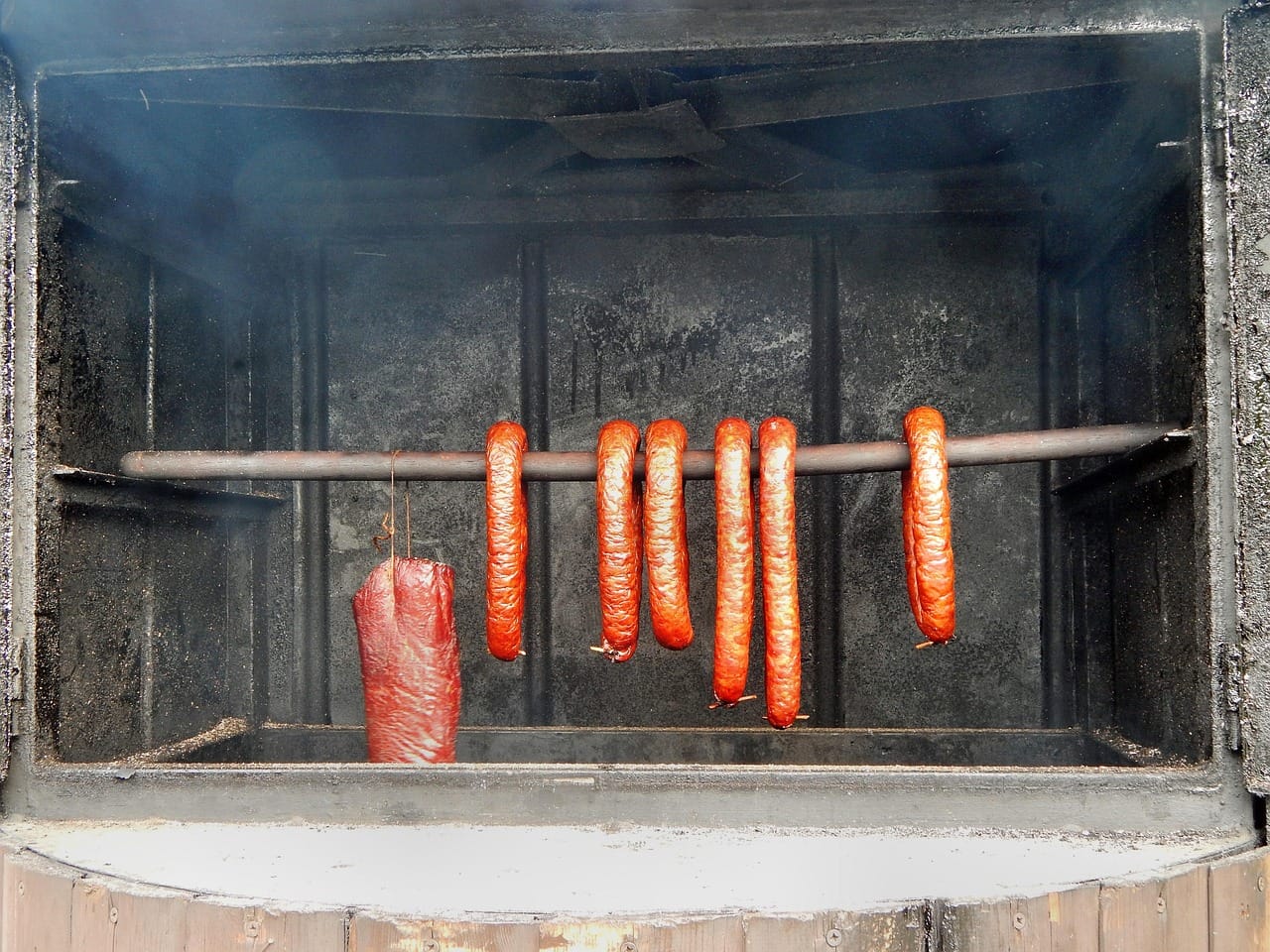
How long to smoke venison sausage depends on the sausage, the casing and your smoker, but extension schedules for smoked links and summer sausage run about four hours in stages. The finish line is a temperature, not a time. The University of Connecticut’s sausage guide says “sausage cooking must be regulated by temperature and not by time” (UConn Home Sausage Making). RAD’s house rule for venison is 160°F internal.
Key Takeaways
- NDSU Extension’s smoking schedules run about four hours: one hour, one more hour, then two hours at a higher setting.
- Stop when the internal temperature is reached, not when the clock runs out.
- RAD cooks venison to 160°F, citing Penn State Extension.
- Smoked sausage needs cure. Montana State says sodium nitrite “inhibits production and growth of botulism toxins.”
- Venison is lean, so most recipes add pork or pork fat.
How long to smoke venison sausage: two extension schedules
North Dakota State University Extension gives two step-up schedules in its sausage guide (NDSU Extension).
For smoked links such as Polish sausage, it says: “Smoke at 120 F for one hour, 150 F for one more hour, then at 170 F for two hours or until an internal temperature of 141 F is reached.”
For summer sausage: “smoke at 140 F for one hour, 160 F for one more hour, then at 180 F for two hours or until the internal temperatures reach 155 F.”
Both add up to about four hours of smoker time. Those internal targets are NDSU’s figures for its recipes. For venison, RAD uses 160°F, so keep the last stage going until the probe reads 160°F. That can mean more time in the final stage than NDSU’s two hours. UConn explains why the clock can’t be trusted: “As sausage diameters may vary, sausage cooking must be regulated by temperature and not by time.” It also says “Most sausages are considered fully cooked when they reach an internal temperature of 160” degrees F.
| Stage | NDSU smoked links | NDSU summer sausage |
|---|---|---|
| Hour 1 | 120°F | 140°F |
| Hour 2 | 150°F | 160°F |
| Hours 3 to 4 | 170°F | 180°F |
| NDSU internal target | 141°F | 155°F |
| RAD venison target | 160°F | 160°F |
Why the target is 160°F
Penn State Extension says to “Cook venison, including jerky, to a minimum internal temperature of 160°F to reduce the risk of food-borne illness” (Penn State Extension). Other sources use lower finishing temperatures for sausage. Montana State University Extension says “Cooked smoked sausage is fully cooked to an internal temperature of 155°F and smoked during the process,” and tells home cooks to smoke “according to smoker directions (usually 155°F)” (Montana State University Extension). Field & Stream’s sausage recipe says to “Hot-smoke the sausages until a meat thermometer poked into the middle reads 155 degrees” (Field & Stream). RAD sticks with 160°F for venison.
A calibrated probe matters more than any schedule. See smoker probe thermometer calibration offsets.
Cure is not optional for smoked sausage
Montana State says “A cure (sodium nitrite) is needed for smoked products as it inhibits production and growth of botulism toxins.” It adds that “Directions need to be followed for specific cure formulations” and that “Federal regulations permit a maximum of 0.25 oz of sodium nitrite per 100 pounds of chopped meat.” Follow the directions on your cure package. For more, see nitrite cure levels for venison summer sausage.
Before the smoker
NDSU’s link procedure starts this way: “After stuffing in hog casings (pre-flushed), let hang and dry.” It also says to “Keep meat as cold as possible (40 F or lower) during processing.”
Venison needs fat. UConn says game meat is processed like pork or beef “except for the fat,” that “a sausage made without any fat will be dry and unpalatable,” and that “The sausage should have 15 to 20 percent fat content to achieve a desirable texture and flavor.” It adds that “It is common to use pork shoulder butt as a source of fat for game sausages.”
After the smoker
NDSU says to cool smoked links quickly: “Remove from smokehouse and spray with hot water for 15 to 30 seconds. Follow with cold shower or dip in a slush tank until internal temperature reaches 100 F. Let dry for one to two hours. Place in a cooler.” For summer sausage, it says to “follow the same procedure as for polish sausage.” See venison summer sausage cold water shock steps.
Smoking does more than add flavor
NDSU explains why the heat matters: “Sausage is smoked and heated in order to pasteurize it and extend its shelf life, as well as to impart a smoky flavor and improve its appearance.” Not every sausage needs a smoker. NDSU notes that “liquid smoke can be added to give the smoky flavor desired.” Cold smoking is a different process with its own risks; see cold smoking venison safety.
Storage
NDSU’s table says cooked smoked sausage should be kept refrigerated and to “Consume within 7 days after opening vacuum package.” For uncooked smoked sausage, it says to “Cook thoroughly before eating. Consume within 7 days or freeze.”
FAQ
How many hours do you smoke venison summer sausage? NDSU’s schedule is about four hours: an hour at 140°F, an hour at 160°F, then up to two hours at 180°F. Finish by internal temperature, which RAD sets at 160°F for venison.
What smoker temperature should I start at? NDSU starts links at 120°F and summer sausage at 140°F, then steps up.
Do I need cure to smoke venison sausage? Montana State says cure is needed for smoked products to control botulism.
Can I smoke venison sausage without pork? You can, but UConn says sausage with no fat “will be dry and unpalatable.”
The other side of it
Some sausage makers say a step-up schedule is fussy and that a smoker set at one temperature works fine. Plenty of good sausage gets made that way, and the extension guides themselves stop the clock as soon as the internal target is hit. But the tested extension procedures step the heat up, and following a tested procedure beats guessing. The guy who cranks the smoker to 250 and pulls the links when the beer runs out isn’t smoking sausage. He’s timing beer.
Keep reading
Latest deer news
Sources
- The Art and Practice of Sausage Making (FN176), North Dakota State University Extension
- Home Sausage Making, Second Edition, University of Connecticut, Department of Animal Science
- "Meat Preservation: Jerky, Sausage, and Meat Sticks", Montana State University Extension
- Canning and Freezing Venison, Penn State Extension
- How to Make Venison Sausage, Field & Stream
Comments