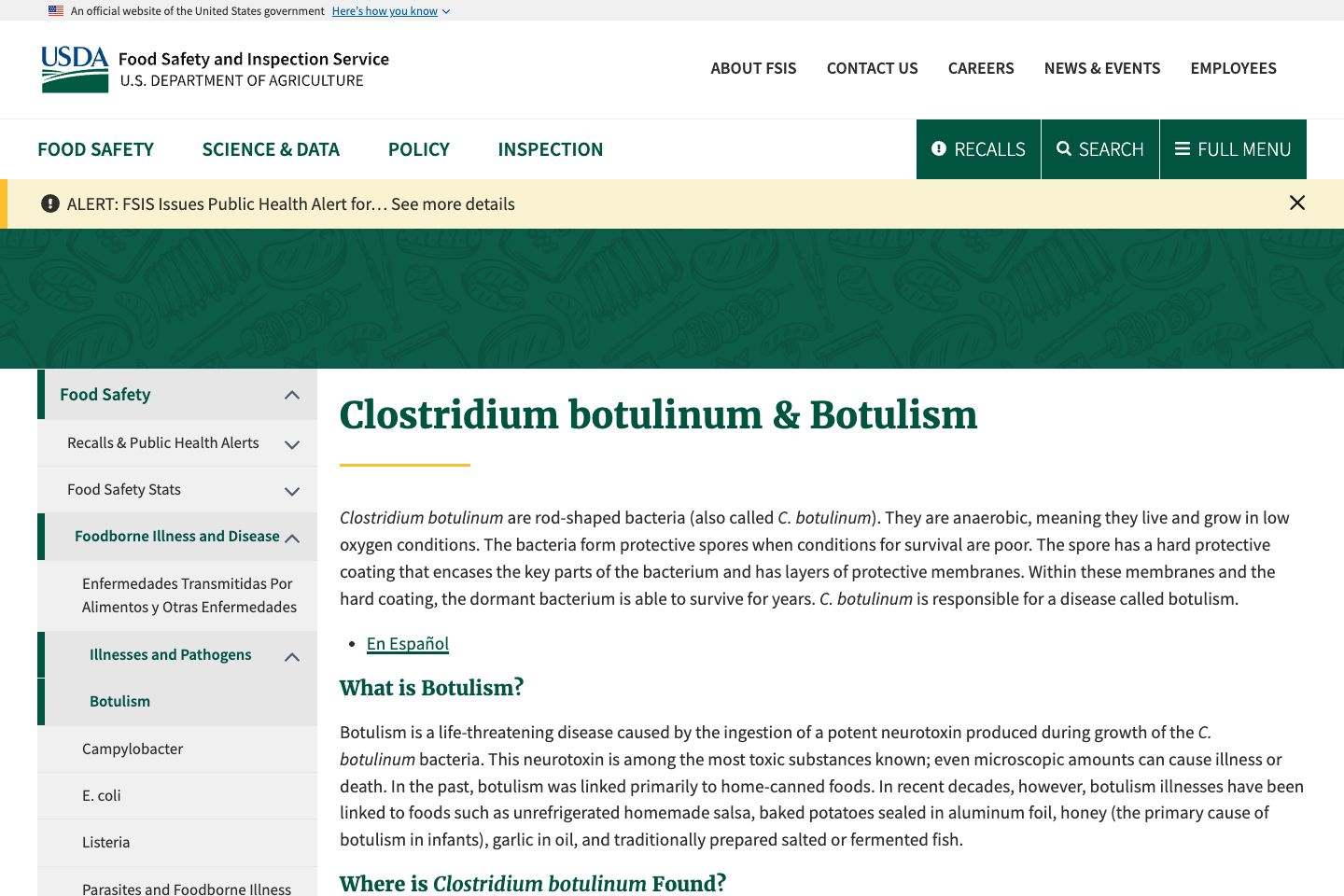
Venison summer sausage sits at the intersection of cure chemistry and cook validation. Oregon State University Extension warns home sausage makers never to exceed nitrite or nitrate amounts in up-to-date recipes, because overdose is harmful and underdose fails the botulism barrier (Oregon State University Extension). Nitrite preserves cured color and flavor and inhibits Clostridium botulinum, the organism behind botulism food poisoning (Oregon State University Extension; U.S. Department of Agriculture). FSIS notes USDA authorized nitrite in meat and poultry beginning in 1925 specifically to restrain C. botulinum spore growth in cured products (U.S. Department of Agriculture). Wisconsin DHS still tells hunters not to rely on curing or smoking alone to make game meat safe and requires cooking wild game to at least 160°F (Wisconsin Department of Health Services). Penn State Extension says aging is unnecessary when meat is headed for sausage, and it keeps kitchen processing cold and clean (Penn State Extension).
Key Takeaways
- Use commercial preblended cure; never freestyle pure nitrite (Oregon State University Extension).
- Nitrite inhibits C. botulinum in cured meats (Oregon State University Extension; U.S. Department of Agriculture).
- Refrigerated cure hold at least 24 hours per OSU (Oregon State University Extension).
- Cook stuffed summer sausage to at least 160°F internal (Oregon State University Extension; Wisconsin Department of Health Services).
- Curing alone is not a wild-game kill step (Wisconsin Department of Health Services).
- Keep meat at 40°F or below while grinding and mixing (Penn State Extension; Oregon State University Extension).
Why nitrite is in the mix at all
OSU lists three historic jobs for sodium or potassium nitrite and nitrate in cured meats: preserve red color, build cured flavor, and inhibit C. botulinum (Oregon State University Extension). FSIS describes C. botulinum as anaerobic spore-formers that grow best in low-oxygen niches such as stuffed casings and sealed packs, which is exactly the environment summer sausage creates (U.S. Department of Agriculture). Spores are common in soils; toxin forms when spores germinate in improperly held low-acid foods (U.S. Department of Agriculture). That is why cure rate and cold handling matter as much as spice blends (Oregon State University Extension; U.S. Department of Agriculture).
Measuring cure without guessing milligrams
OSU repeats that extreme caution is required when adding nitrate or nitrite and that home sausage makers should never use more than amounts in current recipes (Oregon State University Extension). Commercial cures such as Prague Powder style blends are diluted so you can weigh practical spoon or tablespoon amounts instead of milligrams of pure nitrite (Oregon State University Extension). Follow the package for that specific blend; do not borrow rates from a different brand or from a recipe that assumed a different nitrite percentage (Oregon State University Extension). OSU also notes that less nitrite is used commercially today because of nitrosamine concerns, which is another reason not to improvise upward (Oregon State University Extension).
Cold grind, fat blend, and the 24-hour cure hold
OSU’s standard summer-sausage style mix often pairs about four pounds of ground venison or turkey with one pound of ground pork so the stick has enough fat to slice and smoke without crumbling (Oregon State University Extension). Keep the meat as cold as possible through grinding and mixing (Oregon State University Extension; Penn State Extension). After spices and cure are kneaded in, OSU refrigerates the mix in a covered bowl or freezer bag for at least 24 hours and kneads once during that hold (Oregon State University Extension). Penn State notes aging is unnecessary when meat is destined for sausage, so skip warm hang time that only grows bacteria (Penn State Extension).
Cook validation beats smoke color
OSU requires the internal temperature of the sausage to reach at least 160°F whether you finish in an oven or smoker, and it wants an oven thermometer check at the end of cooking (Oregon State University Extension). Wisconsin DHS aligns on cooking all wild game meats to at least 160°F with a thermometer and rejects curing or smoking alone as safety methods (Wisconsin Department of Health Services). CDC’s Toxoplasma chart likewise puts ground meat at 160°F with no rest required (Centers for Disease Control and Prevention). Probe the center of the thickest stick, not the smokehouse air (Oregon State University Extension; Penn State Extension).
Can encapsulated acid stand in for fermentation?
Some commercial sausage mixes include encapsulated acid. It drops the pH in a controlled way, so you get the tang without a long fermentation room (NDSU Extension). It does not make raw deer safe by itself. Follow that mix’s label and still cook to a thermometer number. NDSU’s own venison summer sausage is cured, held in the cooler 3 to 5 days, stuffed, then smoked and cooked. A warm closet is not part of it.
The two extension guides don’t agree on the finish temperature. NDSU’s recipe takes summer sausage to 155°F internal (NDSU Extension). Oregon State says at least 160°F (Oregon State University Extension), and Wisconsin DHS also says 160°F for wild game. If you want the higher margin, go to 160°F.
Anaerobic packs after the cook
FSIS botulism guidance is why leftovers and sealed low-acid packs must be refrigerated within 2 hours, or within 1 hour if air is above 90°F (U.S. Department of Agriculture; U.S. Department of Agriculture). Cool cooked sticks promptly, then refrigerate or freeze; vacuum bags are convenient but are still low-oxygen niches if the cook step failed (U.S. Department of Agriculture). Wash hands, grinders, stuffers, and boards with warm soapy water before and after meat contact (Penn State Extension; Oregon State University Extension).
Bottom line
Buy a commercial nitrite cure, follow its label, refrigerate the cure hold, and prove 160°F in the stick before you call venison summer sausage safe (Oregon State University Extension; Wisconsin Department of Health Services; U.S. Department of Agriculture).
The other side of it
Old-school sausage makers will point out that the title promises fermentation and the guidance never really gets there. Everything here is built on a cooked stick that hits 160°F, so if your family recipe is a tangy, hung-and-dried sausage, these sources don’t validate it either way. That’s a gap, not a green light. And the uncle whose recipe calls for a heaping spoonful of cure because nobody ever got sick is running a study with no control group.
Keep reading
Latest deer news
Sources
- Summer sausage and deli-style meats | OSU Extension Service
- U.S. Department of Agriculture (fsis.usda.gov)
- Risk of Toxoplasmosis from Game Meat
- Proper Care and Handling of Venison from Field to Table
- Centers for Disease Control and Prevention (cdc.gov)
- U.S. Department of Agriculture (fsis.usda.gov)
- The Art and Practice of Sausage Making | NDSU Agriculture
Comments