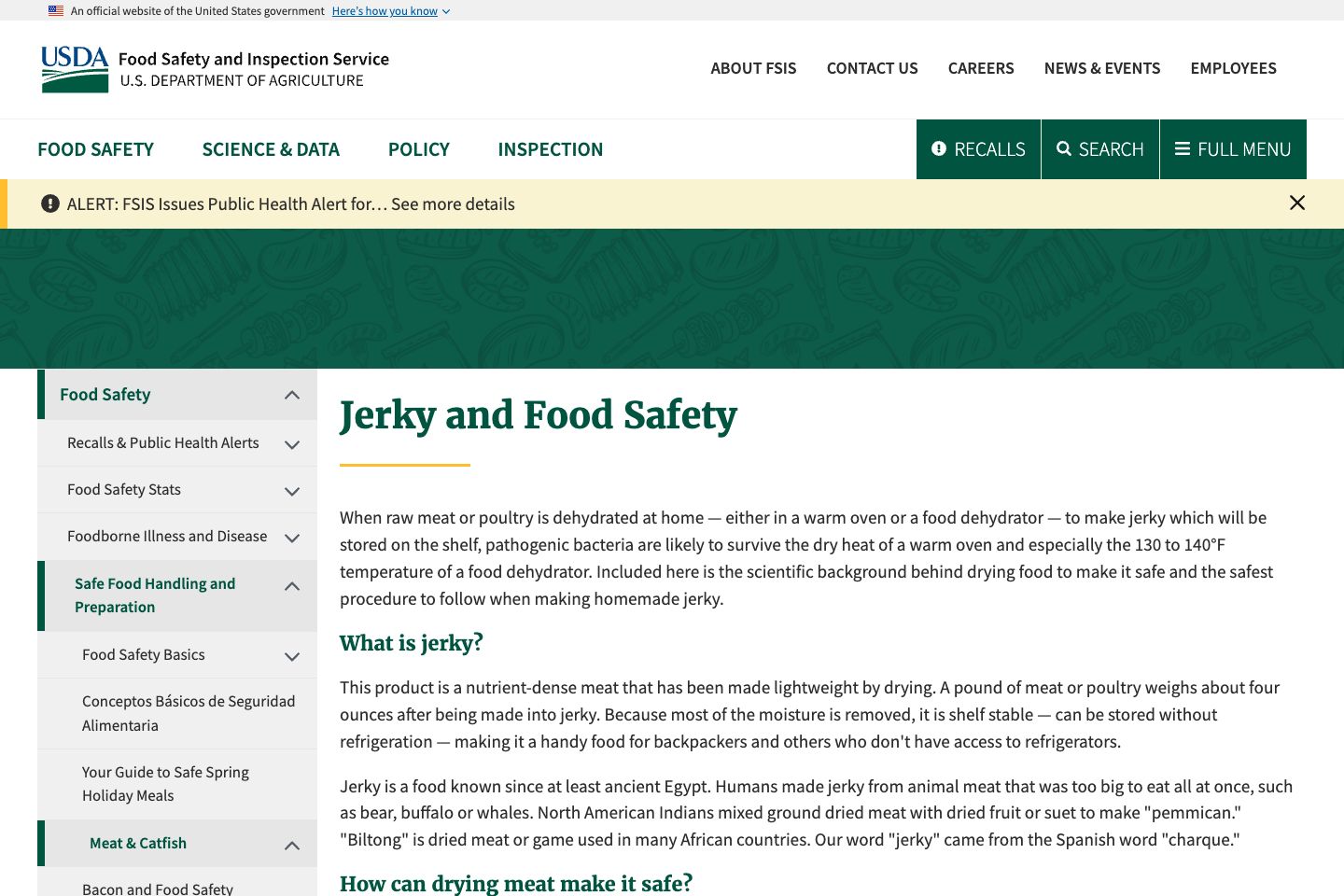
Cold smoke without a prior kill step leaves pathogens alive; USDA FSIS jerky guidance is the clearest federal temperature stack hunters can reuse for smoked or dried venison sticks. FSIS recommends heating meat to 160°F before dehydrating so wet heat destroys bacteria, then maintaining a dehydrator at 130-140°F to dry fast enough that microbes cannot grow (U.S. Department of Agriculture). FSIS notes that most dehydrator instructions skip the 160°F preheat and that dehydrators may not reach temperatures high enough to cook meat alone (U.S. Department of Agriculture). After drying begins, evaporating moisture absorbs heat so meat temperature rises late, after bacteria have become more heat resistant (U.S. Department of Agriculture). University of Georgia work cited by FSIS found pathogenic E. coli could survive drying up to 10 hours at up to 145°F on inoculated venison, which is why preheat matters (U.S. Department of Agriculture). Marination alone did not significantly reduce pathogens compared with unmarinated slices in the research FSIS summarizes (U.S. Department of Agriculture). Penn State Extension separately lists jerky among products that should reach 160°F (71°C) before drying and says home-dried jerky stores about one to two months (Penn State Extension). Cold smoking below those lethality temperatures is a flavor step, not a safety step; finish to a validated internal temperature or pre-cook before a cold smoke (U.S. Department of Agriculture; Penn State Extension).
Key Takeaways
- Preheat meat to 160°F before drying per FSIS Hotline (U.S. Department of Agriculture).
- Dehydrator hold: 130-140°F during drying (U.S. Department of Agriculture).
- Venison jerky trials: E. coli survived 10 hours / 145°F without proper preheat (U.S. Department of Agriculture).
- Marination alone is not a kill step (U.S. Department of Agriculture).
- PSU: jerky to 160°F before drying; home-dried storage 1-2 months (Penn State Extension).
- Cold smoke is not a substitute for the 160°F lethality step (U.S. Department of Agriculture).
Why cold smoke alone fails
FSIS explains that in a low-temperature dryer, moisture evaporation keeps meat cool until late in the cycle, so bacteria dry into a more heat-resistant state (U.S. Department of Agriculture). Cold smoke chambers that stay well below 160°F inherit that problem and can add a false sense of safety because the meat looks finished (U.S. Department of Agriculture).
Safe process order
Trim and chill venison, marinate under refrigeration, steam or roast strips to 160°F measured with a thermometer, then dry at 130-140°F or apply smoke only after that lethality step (U.S. Department of Agriculture; Penn State Extension). Keep raw meat refrigerated at 40°F or slightly below; use or freeze ground meat within 2 days and whole red meats within 3 to 5 days (U.S. Department of Agriculture). Do not save marinade to reuse (U.S. Department of Agriculture).
Wild-game contamination context
FSIS quotes research noting venison can be heavily contaminated with fecal bacteria depending on hunter skill and wound location, and that deer carcasses often sit at ambient temperatures longer than commercial beef (U.S. Department of Agriculture). That raises the value of the preheat step for homemade smoked sticks (U.S. Department of Agriculture).
Cure mixes help but do not replace heat
FSIS summarizes ground-beef jerky work showing curing mix plus preheat gave the highest bacterial destruction; heat still came first (U.S. Department of Agriculture).
Storage after a safe dry
FSIS cites about 1 to 2 months for home-dried jerky versus up to 12 months for commercial packs; PSU agrees on one to two months for home-dried product (U.S. Department of Agriculture; Penn State Extension).
Bottom line
Never treat cold smoke as the kill step: preheat venison to 160°F, dry at 130-140°F, and store home-dried sticks only 1-2 months unless a validated commercial process says otherwise (U.S. Department of Agriculture; Penn State Extension).
The other side of it
Almost every number here comes from jerky and dehydrator research, so it fits sliced, dried strips better than every cold-smoked product a hunter might make. The article’s own source found cure mixes added real kill when paired with heat, which suggests the honest question for traditional smokers is how much heat, not whether smoke is useless. That nuance gets lost in a flat rule. And the guy whose grandpa never preheated anything should know grandpa’s survival is not a peer-reviewed study.
Keep reading
Latest deer news
Comments