Both copper monoliths and lead-core hunting bullets can take deer ethically when the design matches the shot. Federal’s bullet-selection guide separates lead soft points (cup-and-core and bonded) from copper monoliths such as Trophy Copper and Barnes TSX, and it warns that full metal jackets do not belong on big game (Federal how to select the right rifle bullet). The National Deer Association has published a first-person copper-hunting account that also summarizes a North American Non-Lead Partnership range demonstration comparing lead fragment recovery to a copper-alloy bullet that retained its full weight (Deer Association copper bullets).
Key Takeaways
- Federal describes cup-and-core soft points (example: Power-Shok) as aggressive expanders suited to medium, lightly built game such as deer (Federal bullet guide).
- Federal describes bonded lead-core bullets (Fusion, Terminal Ascent, Trophy Bonded Tip) as retaining weight better on heavy bone (Federal bullet guide).
- Federal describes copper monoliths (Trophy Copper, Barnes TSX, Power-Shok Copper) as single-piece bullets with almost 100 percent weight retention (Federal bullet guide).
- Federal notes copper can need more velocity to expand than lead designs, especially at very long ranges (Federal bullet guide).
- Deer Association author Hank Forester reports choosing copper for deer meat and cites a demo where a lead soft point shed 35.3 grains while an 80-grain Hornady GMX copper-alloy bullet retained 80 grains (Deer Association copper bullets).
What Federal says lead soft points do on deer
Federal’s guide calls lead soft points the historical bread-and-butter of big-game hunting: accurate, consistent, and less expensive, with terminal performance that covers most hunter distances and species (Federal bullet guide). Inside that family it separates cup-and-core designs from bonded designs. Cup-and-core bullets such as Federal Power-Shok enclose a lead core in a pre-formed copper jacket and expand aggressively, which Federal calls ideal for deer and antelope (Federal bullet guide). Bonded designs fuse jacket to core so they are less likely to break apart on heavy bone; Federal names Fusion for the whitetail crowd and Terminal Ascent and Trophy Bonded Tip as deeper-penetrating bonded options (Federal bullet guide).
What Federal says copper monoliths do
Copper projectiles such as Federal Trophy Copper, Barnes TSX, and Federal Power-Shok Copper are a single piece rather than jacket-plus-core, which Federal says yields almost 100 percent weight retention (Federal bullet guide). Federal also cautions that copper bullets do not expand as easily as lead counterparts and that very long shots where velocity falls off can expose that difference (Federal bullet guide). That is a maker-stated trade, not a ban on copper for deer; it is a reason to stay inside impact velocities the bullet maker publishes.
What a Deer Association copper hunter reports
Hank Forester writes that he has almost exclusively used copper for big game for about 15 years and that he prefers not to shoot food animals with lead because lead is a neurotoxin (Deer Association copper bullets). He recounts a North American Non-Lead Partnership demonstration using a .243 Winchester: a factory 100-grain Winchester Power Point lead soft point shed 35.3 grains (recovered weight 64.7 grains) as numerous fragments, while an 80-grain Hornady GMX copper-alloy bullet still weighed 80 grains and penetrated farther (Deer Association copper bullets). He also notes copper bullets of equal weight are typically longer than lead-core bullets, so hunters often step slightly lighter in copper than in lead, and that modern tipped copper lines (Barnes TTSX and LRX, Federal Trophy Copper, Hornady GMX/CX, Nosler E-Tip) have improved on early designs (Deer Association copper bullets).
Choosing for a deer season without ideology
If your state or public unit requires non-lead ammunition, copper or other approved non-lead designs are the legal path. If lead is legal, Federal’s taxonomy still helps: cup-and-core soft points for ordinary deer shots, bonded lead when you expect heavy bone or want more weight retention, copper when you want near-total weight retention and accept the expansion-velocity caveat (Federal bullet guide). In all cases Federal states full metal jackets have no business on big game because they do not expand (Federal bullet guide). Match the hunting SKU to your rifle’s groups and to the farthest shot you will actually take.
What does lead do to the meat?
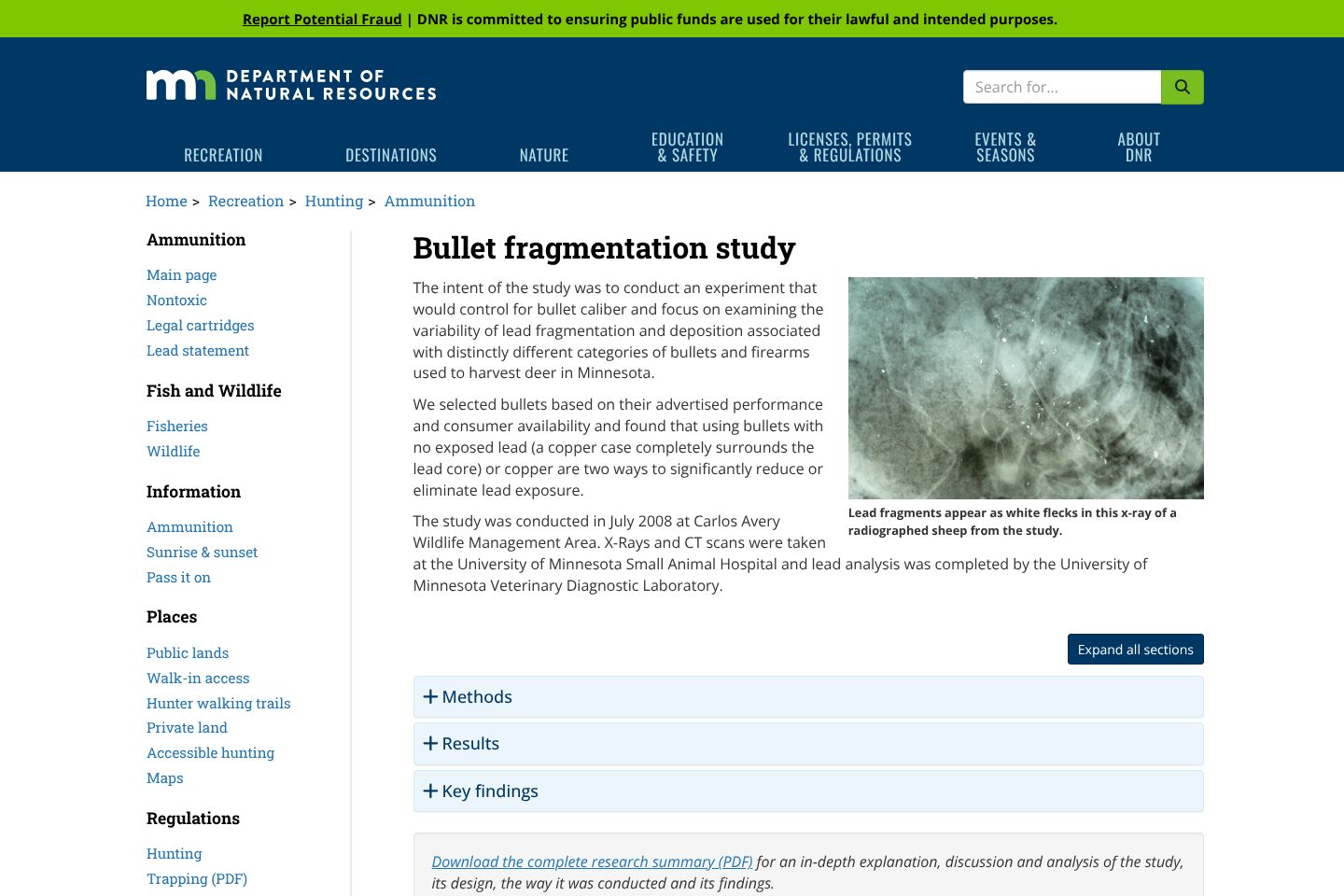
Minnesota DNR shot sheep as deer stand-ins and X-rayed them. Rapid-expansion lead bullets left about 86 to 141 fragments on average, and lead showed up in muscle as far as 18 inches from the exit in some samples. Copper bullets left only a few pieces near the exit (MN DNR fragmentation study). The DNR says fragments are often too small to see or feel when you chew, so it won’t promise a trim distance that gets them all (MN DNR hunter tips). Grinding is the big risk because it mixes stray fragments through the whole batch (MN DNR lead info). If you shoot lead, trim wide and don’t grind the trim. More detail is in our guide to lead fragments in venison.
On the deer, expect copper to pass through more often. A DNR feature notes hunters sometimes say copper “just zips through,” so plan on exit-side blood and look hard before you call it a miss. It also notes many .30-caliber hunters drop from a 165-grain lead bullet to about 150 grains in copper (MN Conservation Volunteer).
Bottom line
Copper versus lead for deer is a construction choice with maker-documented tradeoffs: lead soft points (especially cup-and-core) expand readily and cost less; bonded lead holds together better on bone; copper monoliths retain nearly all their weight but may need more velocity to open (Federal bullet guide; Deer Association copper bullets). Pick a hunting design from those categories, confirm zero, and ignore FMJ for deer.
Practical buying order for a deer season
Decide legality first (non-lead units force copper or other approved non-lead). Then decide shot profile: ordinary broadside woods shots favor Federal’s cup-and-core soft-point description; steep bone or shared larger-game tags favor bonded; weight-retention priority and non-lead rules favor copper monoliths (Federal bullet guide). Buy one hunting SKU, confirm groups, and leave FMJ for the bench as Federal advises (Federal bullet guide). If you switch to copper, consider Forester’s note that equal-weight copper bullets run longer than lead-core bullets, so a slightly lighter copper weight than your old lead load is a common starting point (Deer Association copper bullets).
Side-by-side decision table in prose
Lead cup-and-core (Federal Power-Shok class): aggressive expansion, lower cost, more fragmentation risk on bone (Federal bullet guide). Lead bonded (Fusion / Terminal Ascent / Trophy Bonded Tip): expansion plus higher weight retention (Federal bullet guide). Copper monolith (Trophy Copper / Barnes TSX / Power-Shok Copper): almost 100 percent weight retention, possible higher velocity need to open (Federal bullet guide). Deer Association demo anecdote: lead soft point shed 35.3 grains; copper-alloy GMX shed none (Deer Association copper bullets). Use that taxonomy when reading a box label, then verify groups in your rifle before the opener.
The other side of it
The strongest evidence for copper here is one range demo with a single .243 load, told by a hunter who already prefers copper, and the rest comes from a company that sells both. A guy who shoots cheap cup-and-core soft points at woods distances has a fair case that his deer die just as dead. Of course, the hunter who swears any soft point will do is usually the one who hasn’t checked his zero since his first truck.
Keep reading
Latest deer news
Sources
- How To Select The Right Rifle Bullet
- Deer Association copper bullets (deerassociation.com)
- Bullet fragmentation study | Minnesota DNR
- Lead information for deer hunters | Minnesota DNR
- STUDY RESULT KEY MESSAGES
- The Case For Copper | September–October 2013 | Minnesota Conservation Volunteer | Minnesota DNR
Comments