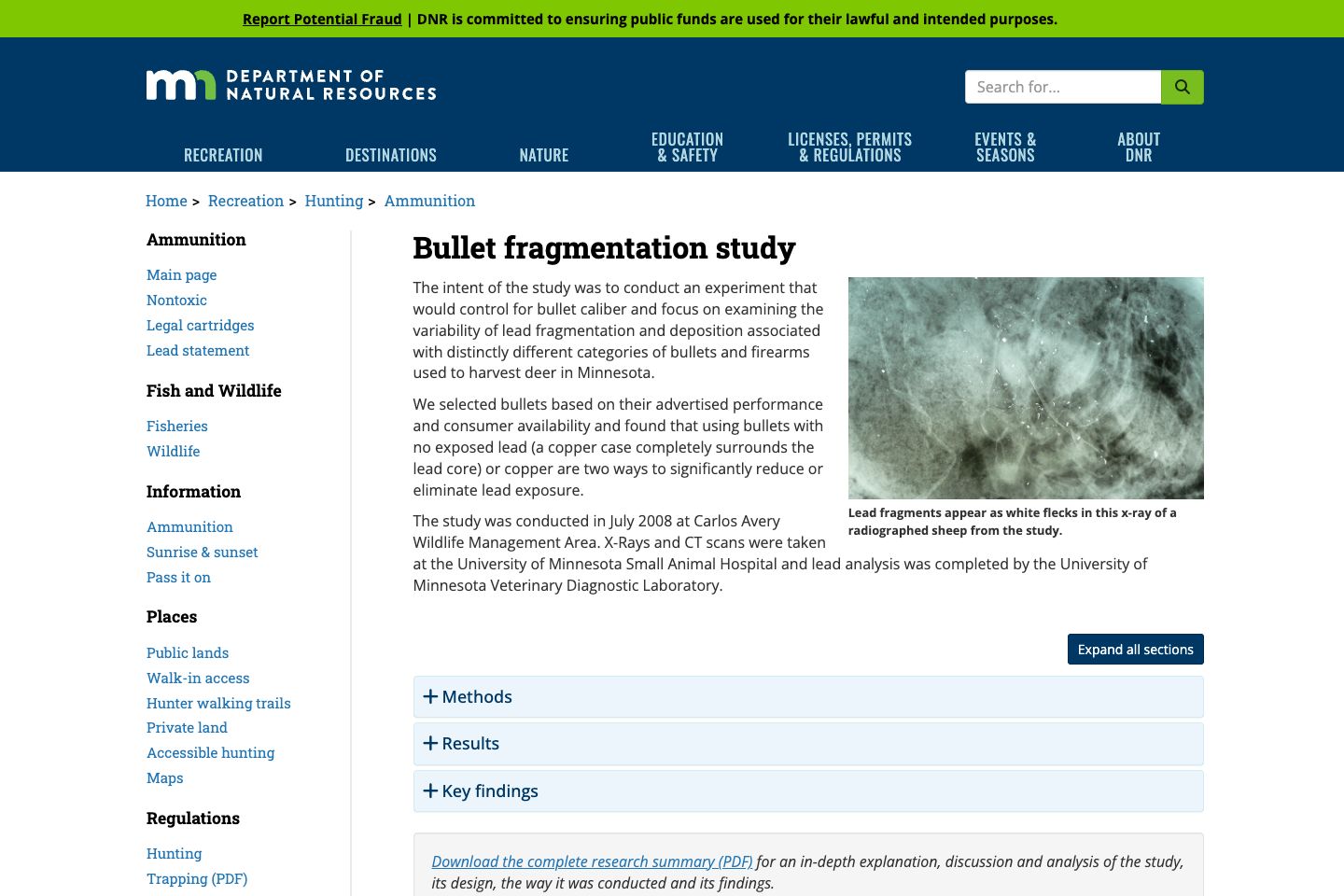
Radiographs and CT work on deer and sheep show that lead-core rifle bullets can shed many metal fragments far from the wound channel - including into meat people grind and eat - while copper and other lead-free designs sharply cut that contamination (Minnesota DNR bullet fragmentation; Minnesota DNR lead info; Hunt et al. fragmentation study; Wisconsin DHS lead in venison).
Key Takeaways
- Lead bullets can leave dozens to hundreds of fragments; Minnesota imaging found lead as far as about 18 inches from an exit wound (MN DNR short summary).
- Ground venison mixes fragments through packages (MN DNR; WI DHS).
- Copper / lead-free bullets greatly reduce or eliminate radiographic lead (MN DNR; Hunt et al.).
- If you still use lead, trim generously around the wound channel and think twice about grinding trim (WI DHS; CT DEEP lead fragments).
- CDC-linked field work found a small average blood-lead increase among North Dakota game consumers using lead ammo (CT DEEP summary).
What the imaging showed
Minnesota DNR’s public summary of its fragmentation study reports widespread lead deposition from conventional bullets and documents fragments well away from the primary wound, including up to roughly 18 inches from an exit (MN DNR short summary). Peer-reviewed radiography/CT comparisons in white-tailed deer and domestic sheep likewise found extensive lead fragment clouds from lead-core designs versus minimal metal from copper bullets (Hunt et al.). Those fragments are often too small to feel when trimming, which is why visual “clean meat” checks fail (MN DNR; WI DHS).
Ground meat risk
When processors or home grinders mix trim from along the wound channel, fragments disperse through burger and sausage (MN DNR; WI DHS). Food-shelf and donation programs have had to confront that pathway; several states publish hunter advisories specifically because packaged ground venison can hide lead that steaks might leave behind in a trimmed edge (CT DEEP; WI DHS).
Human exposure context
Connecticut DEEP’s hunter briefing on lead fragments cites CDC collaborative work in North Dakota showing a statistically significant but small average rise in blood lead among people eating wild game shot with lead ammunition (CT DEEP). Wisconsin DHS likewise treats lead-in-venison as a real exposure pathway worth mitigation, especially for children and pregnant people who are more sensitive to lead (WI DHS). These are public-health caution notes, not claims that every lead-shot deer creates clinical poisoning.
Practical mitigation
- Switch to copper or other lead-free big-game loads where terminal performance meets your hunt (MN DNR; Hunt et al.).
- If using lead, cut a wide margin of meat around the wound channel and discard fragment-suspicious tissue (WI DHS; CT DEEP).
- Avoid grinding meat from along bullet paths (MN DNR).
- Ask commercial processors what ammo and trim protocols they require for donated or custom meat (CT DEEP).
- Follow any state-specific lead advisories tied to wildlife or ground venison (WI DHS; MN DNR).
Bullet choice without the marketing fog
Minnesota’s messaging pairs fragmentation facts with ammunition options rather than banning discussion of lead (MN DNR lead info). Copper bullets that stay mostly intact leave little radiographic metal in the Hunt et al. comparisons (Hunt et al.). Traditional cup-and-core lead designs that shed jackets and cores are the high-fragmentation class the radiographs flag (MN DNR short summary). Match bullet to game and range, then match metal to your household’s risk tolerance.
Bottom line
Lead-core rifle bullets can pepper venison with tiny fragments far from the wound; copper alternatives and aggressive trimming are the evidence-based fixes (MN DNR; Hunt et al.; WI DHS).
Related: copper vs lead deer bullets and ground venison safety.
The other side of it
A hunter who’s eaten lead-shot venison his whole life can point to the article’s own human data: the North Dakota rise in blood lead was small on average, and the agencies frame it as caution, not clinical poisoning. Some of the imaging also came from domestic sheep, and copper still has to perform on the animal you’re actually hunting. Still, the fellow who says he’d notice a fragment in his burger probably skipped the part about most of them being too small to feel.
Keep reading
Latest deer news
Comments