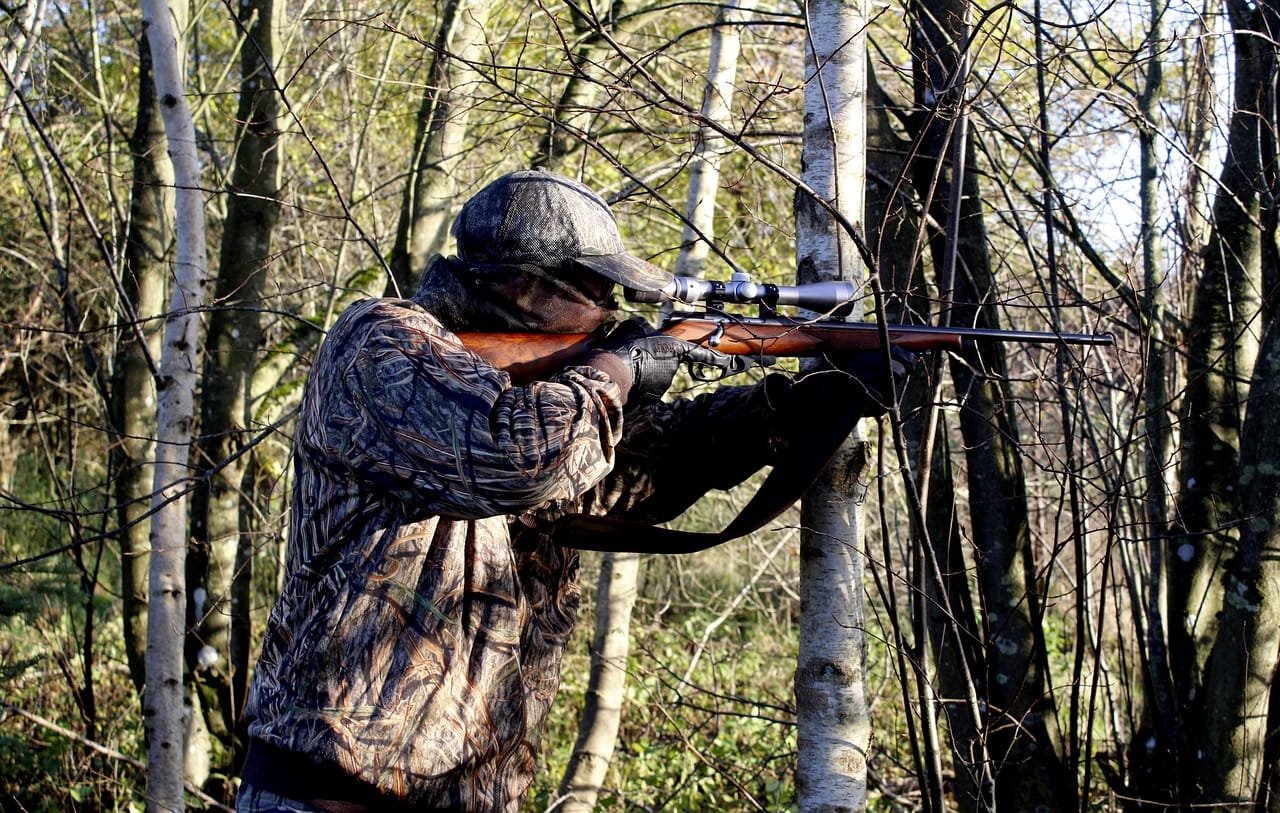
How to use a rifle scope comes down to setting it up right once and then keeping it simple in the stand. Set the eye relief, level the scope, focus the reticle, set parallax if your scope has the adjustment, and sight it in with the ammo you’ll hunt with. Then pick a magnification that fits the cover you hunt. Most of this comes straight from Leupold’s owner’s manual and support pages, plus NRA’s Shooting Illustrated on what the clicks on your turrets mean. Before you touch anything, Leupold’s manual says to “Always check and be certain that” the “firearm is unloaded before working on it.”
Key Takeaways
- Eye relief first. Set the scope at its highest power and slide it until the full image fills the eyepiece.
- Level the scope to the rifle so the reticle isn’t canted.
- Focus the reticle against a light-colored background.
- Bore-sight, then confirm at the range. Leupold says “Bore-sighting alone is not sufficient to sight-in a scope.”
- Know your click value. Many scopes move 1/4 MOA per click, and 1 MOA at 100 yards is 1.047 inches.
- Lower magnification gives a wider field of view for close, moving deer.
Step 1: Set eye relief
Eye relief is how far your eye sits behind the eyepiece. Leupold’s support page says it’s “Typically, this is 3-4 inches from the eyepiece lens depending on the riflescope model” (Leupold support). If you see a black ring, “you are either too close or too far from the scope.”
Leupold’s steps:
- “Turn the scope up to its maximum magnification, where eye relief is usually at its shortest and most critical.”
- “Shoulder the rifle in the position you will shoot in the most.”
- Slide the scope in the rings “until it is as far away from your eye as possible while still having a full field of view.”
Its blog adds a good trick: shoulder the rifle with your eyes closed, then open them. “You want to tailor the scope to your natural point of aim, not the other way around” (Leupold). Mark the tube with a pencil once it’s right. Leupold also says “Do not let someone else mount your scope without you being present to confirm eye-relief.”
Step 2: Level the scope
A canted reticle throws shots off. Leupold says “Leveling the scope to the rifle’s action is extremely important for precise shot placement.” Its method uses a level on the base and a second on top of the scope, rotating the scope until the two match. Then tighten the ring tops “in a star pattern,” watching the level as you go. Use the torque spec for your rings.
Step 3: Focus the reticle
This is the step most hunters skip. Leupold’s manual says to “Safely point the scope at a light colored background,” then “Rotate the eyepiece and recheck focus until the reticle is sharp” (Leupold manual). It says to “Look away every so often to relax your eye between focus checks.”
Step 4: Set parallax, if your scope has the knob
Many hunting scopes have fixed parallax. Leupold says “Most Leupold scopes are parallax free at 150 yards.” If yours has a side focus or adjustable objective, focus the reticle first, then “Move your head slightly up and down while turning the side parallax dial or adjustable objective ring until the reticle does not move in relation to the target.”
Step 5: Sight in
Leupold says to bore-sight first, then go to the range, and to “always fire from a rested position.” The key rule: “You must make final adjustments by shooting the firearm using the same ammunition you use in the field.”
The routine:
- “Establish your sight-in distance.”
- “Fire a three-shot group to identify your shot pattern.”
- Adjust windage and elevation to move the group to center.
- “Fire another three-shot group to confirm.”
The letters on the dials help. Leupold: they “refer to the direction that the point-of-impact of the bullet will move when an adjustment is made.”
What the clicks mean
Your turrets move in MOA or mils. Shooting Illustrated’s Richard Mann explains: “While 1 MOA at 100 yards equals 1.047 inches, at 200 yards it equals 2.094 inches” (Shooting Illustrated). For mils, “one mil equals 3.6 inches at 100 yards.”
Leupold notes its CDS dials “move point of impact 1/4-MOA or 1 cm per click based on the model.” Check your scope’s manual for its click value. With 1/4 MOA clicks, moving a group about one inch at 100 yards takes about four clicks.
For hunting scopes with a zero stop, see our page on riflescope turret zero stop specs.
Using the scope in the field
Pick the power for the cover. Scope maker Konus explains that “As magnification increases, the field of view decreases,” and that “for wooded environments, moving targets and low-medium range shooting you choose an optics with reduced magnifications” (Konus). In thick woods, keep it turned down. You can always zoom in on a deer that’s standing still.
Know your reticle. If your scope has holdover marks, check whether it’s a first or second focal plane design. Konus says a second focal plane reticle’s ballistic references work “only at a precise value of the zoom factor.” Our guide to SFP vs FFP reticles for woods deer ranges covers which suits deer hunting.
Recheck your zero. Leupold’s troubleshooting page tells hunters to “Check that all fasteners are properly torqued on both the rifle (action screws), and scope mount.” A bumped scope or loose ring is worth a few shots at the range before opening day.
FAQ
How do you sight in a rifle scope? Bore-sight, then fire three-shot groups from a rest at your chosen distance with your hunting ammo, adjusting until the group is centered.
How far should a rifle scope be from your eye? Typically 3 to 4 inches, per Leupold, but it varies by model.
How many clicks is 1 inch at 100 yards? About four on a 1/4 MOA scope, since 1 MOA is 1.047 inches at 100 yards.
What magnification should I use for deer? Lower power in thick cover for a wider field of view; more power for longer, steady shots.
The other side of it
Some old hands will say all this is overkill for a 100-yard deer rifle, and that a quick bore-sight and a couple of shots will do. Plenty of deer have been killed that way, and in thick timber the shot is often close enough that a few clicks won’t decide it. But Leupold’s own manual says “Bore-sighting alone is not sufficient to sight-in a scope,” and it’s an afternoon of work. The hunter who skips it is usually the one blaming the scope on opening morning.
Keep reading
Latest deer news
Sources
- Riflescope Owner's Manual, Leupold & Stevens (manufacturer)
- Riflescope Support, Leupold & Stevens (manufacturer)
- How To Adjust Your Riflescope, Leupold & Stevens (manufacturer)
- Mil, MOA or inches?, Shooting Illustrated (NRA; Richard Mann, Feb 18, 2011)
- How a riflescope works, Part 1, Konus (manufacturer)
Comments