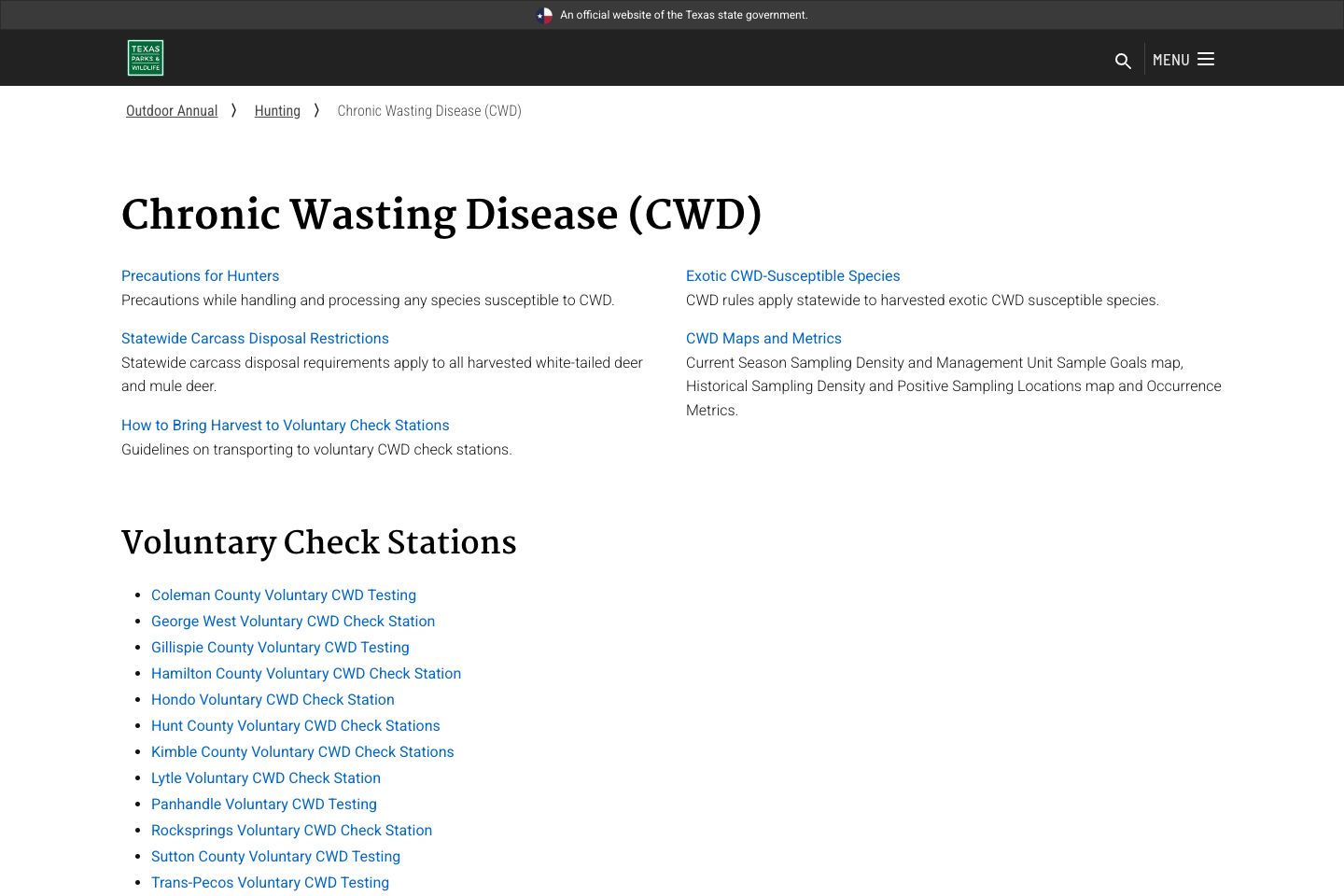
Texas CWD carcass rules sit in the Outdoor Annual CWD chapter and the statewide carcass-disposal requirements for white-tailed and mule deer. Infectious prions concentrate in brain, spinal cord, eyes, lymph nodes, and spleen, so TPWD requires proper disposal of unused parts whenever a carcass leaves the harvest property (TPWD CWD; TPWD after harvesting a deer; TPWD Outdoor Annual PDF). Import into Texas from places where CWD has been detected is limited to listed low-risk parts under Texas Admin. Code carcass-entry rules mirrored in Outdoor Annual guidance (TPWD Outdoor Annual PDF).
Key Takeaways
- Statewide carcass disposal applies to white-tailed and mule deer parts transported away from the harvest property (TPWD after harvesting a deer; TPWD CWD).
- Unused parts must go to commercial trash service, return to the harvest property, or burial at least three feet deep with three feet of cover (TPWD after harvesting a deer).
- Processors and taxidermists may receive whole carcasses or heads and must dispose of unused parts (TPWD after harvesting a deer).
- Deboned whole-muscle meat may leave the property if bags stay separated by deer and proof of sex/tag travels with the meat (TPWD Outdoor Annual PDF).
- Quarters may leave the property, but unused high-risk parts still need lawful disposal (TPWD Outdoor Annual PDF).
Statewide disposal when you leave the ranch
If you transport a white-tailed or mule deer carcass or parts away from the kill site, unused parts - anything not kept for cooking, storage, or taxidermy - must be disposed of as soon as practicable by (1) commercial trash service or a TCEQ-permitted landfill path described in regulation, (2) return to the harvest property, or (3) burial at least three feet below the natural surface covered with at least three feet of earthen material (TPWD after harvesting a deer; TPWD Outdoor Annual PDF). Rendering is not a lawful disposal method under the deer carcass movement rule (TPWD Outdoor Annual PDF). Parts not disposed of immediately must be protected from scattering, scavenging, or removal until disposal happens (TPWD Outdoor Annual PDF).
Deboning and quartering rules
Hunters may debone at any location if meat is left as whole muscles (not ground, chopped, or sliced), meat from multiple deer stays in separate bags or containers during transport, and proof of sex plus tagging requirements stay with the meat until a final destination (TPWD Outdoor Annual PDF). Quarters - two fronts, two hinds, backstraps, and trimmings - may leave the property, but unused parts still follow the disposal list (TPWD Outdoor Annual PDF). Coolers may hold multiple deer only if each animal’s meat remains bagged separately (TPWD Outdoor Annual PDF).
Commercial processors and taxidermists
Taking a harvested deer or a deer head to a commercial processor or taxidermist remains lawful; those businesses must dispose of unused carcass parts properly (TPWD after harvesting a deer; TPWD Outdoor Annual PDF). That path is the usual route when you cannot bury or return parts to the ranch the same day (TPWD after harvesting a deer).
Import from CWD-detected places outside Texas
No person may transport into Texas or possess parts of a CWD-susceptible species from a state, province, or place outside Texas where CWD has been detected, except listed low-risk forms: cut-and-packaged meat; quarters with no brain or spinal tissue; cleaned hide without skull soft tissue; cleaned skull or skull plate with antlers; finished taxidermy; cleaned teeth; or lab-bound diagnostic tissue (TPWD Outdoor Annual PDF). Heads from those origins bound for Texas taxidermy must have brain, soft tissue, and unused portions disposed of under the Outdoor Annual / TAC pathway before or at a TCEQ landfill in Texas (TPWD Outdoor Annual PDF).
Hunter precautions TPWD publishes
TPWD tells hunters never to eat meat from a sick-looking animal and never to eat brain, eyeballs, spinal cord, spleen, or lymph nodes from CWD-susceptible species (TPWD Outdoor Annual PDF). CDC notes no strong evidence of human CWD infection and still recommends testing susceptible species; TPWD points hunters to voluntary check stations and the CWD page for zone updates (TPWD CWD; TPWD Outdoor Annual PDF). Report symptomatic CWD-susceptible animals to a game warden or wildlife biologist (TPWD white-tailed deer; TPWD CWD).
Bottom line
Texas CWD carcass compliance is statewide disposal of unused deer parts after you leave the harvest property, lawful deboning/quartering with separated bags and proof of sex, processor/taxidermist handoff when needed, and strict low-risk-only import from CWD-detected places outside Texas (TPWD after harvesting a deer; TPWD CWD; TPWD Outdoor Annual PDF).
The other side of it
These are statewide rules, and the article sends hunters to TPWD’s CWD page for zone updates without spelling out what someone hunting inside a CWD zone owes on top of them. That gap is worth closing before you load a cooler. Check stations are voluntary, and CDC’s note that there’s no strong evidence of human infection is exactly why plenty of hunters skip a test the agencies still recommend.
Keep reading
Texas's biggest bucks in the record book →
Latest deer news
Comments