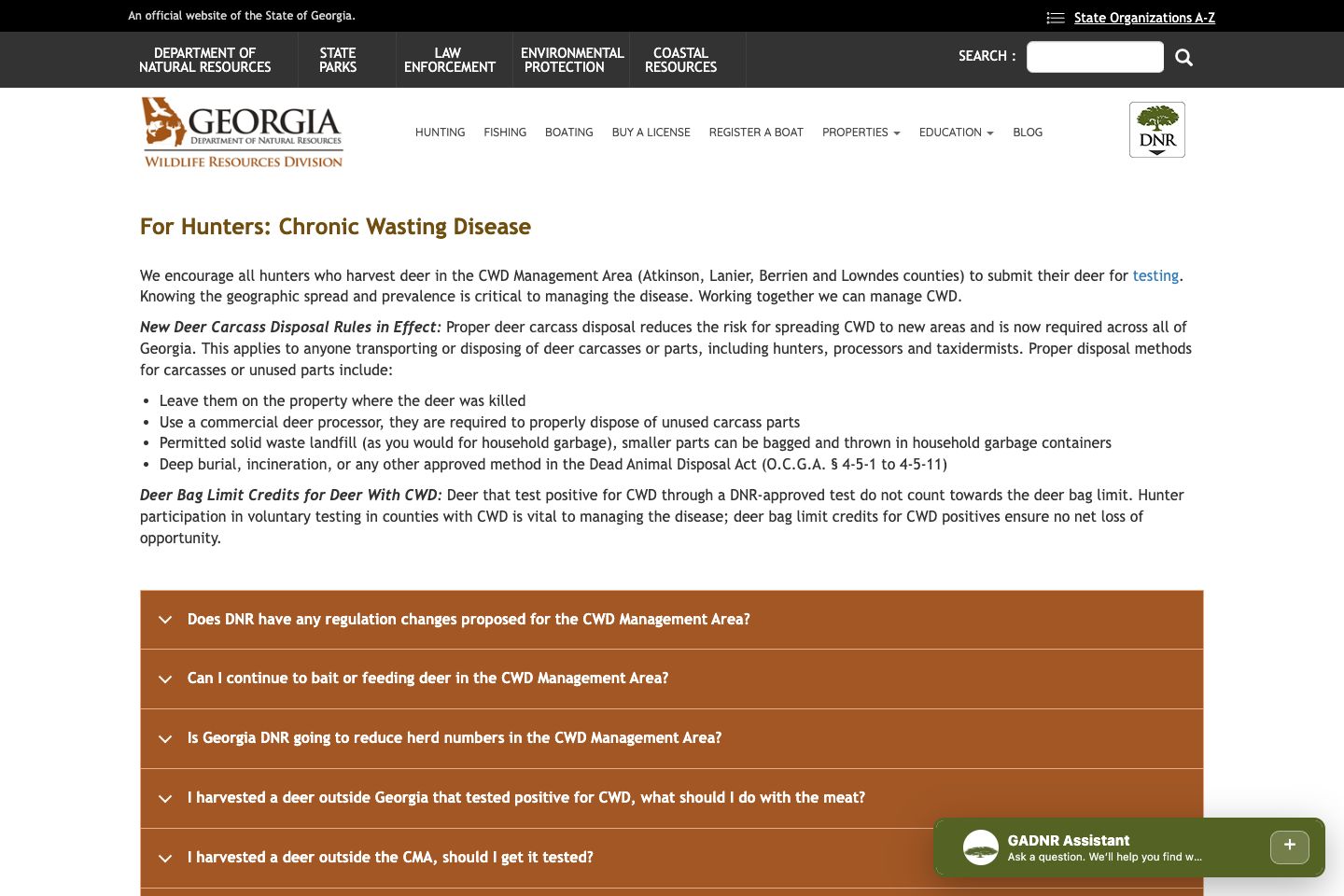
Georgia’s CWD carcass transport rules come down to three things for the 2026-27 season: dispose of every deer carcass properly anywhere in the state, bring only approved parts home from a deer killed outside Georgia, and get deer tested if you hunt the CWD Management Area. As of Nov. 13, 2026, that area covers six counties, after Georgia DNR reported four new positive tests and the first detection in Coffee County (Georgia WRD CWD page).
Key Takeaways
- The CMA grew on Nov. 13, 2026. It now includes Atkinson, Lanier, Berrien, Lowndes, Coffee and Cook counties (Georgia WRD).
- Proper carcass disposal is required statewide, for hunters, processors and taxidermists alike (Georgia WRD hunter info).
- From out of state, only certain parts can come home: boned-out meat, hides, cleaned skulls or skull caps with antlers, jawbones with no soft tissue, elk ivories and finished mounts (Georgia WRD).
- A CWD-positive deer doesn’t count against your bag limit when it tests positive through a DNR-approved test (Georgia WRD hunter info).
- No baiting ban in the CMA. DNR has proposed no baiting restrictions or regulation changes there (Georgia WRD hunter info).
What changed in Georgia’s CWD Management Area this week?
Georgia DNR posted new information on Nov. 13, 2026: “Four new positive CWD test results have been identified in and around the CWD Management Area (CMA).” Those results include the first detection in Coffee County, and both Coffee and Cook counties are being added to the CMA (Georgia WRD CWD page).
The CMA works on a simple radius rule. It takes in the county where a positive sample was found and any county touching a 5-mile radius around that spot (Georgia WRD CWD page). That is how a single positive near a county line can pull a neighboring county in with it. The current list is Atkinson, Lanier, Berrien, Lowndes, Coffee and Cook (Georgia WRD).
For context, CWD was first found in Georgia in January 2025 (Georgia WRD CWD page). It is a fatal disease of the brain and nervous system in deer, elk and moose, and there is no vaccine or treatment.
Where do I dispose of a deer carcass in Georgia?
Anywhere in the state, you have to dispose of carcasses and unused parts properly. Georgia WRD says proper disposal “is now required across all of Georgia” and applies to “anyone transporting or disposing of deer carcasses or parts, including hunters, processors and taxidermists” (Georgia WRD hunter info).
These are the approved options on that same page:
| Disposal option | What WRD says |
|---|---|
| Leave it where the deer died | Leave carcass parts on the property where the deer was killed |
| Commercial processor | Processors are required to properly dispose of unused carcass parts |
| Landfill or household trash | Use a permitted solid waste landfill; smaller parts can be bagged and put in household garbage containers |
| Burial or incineration | Deep burial, incineration or any other method approved in the Dead Animal Disposal Act (O.C.G.A. § 4-5-1 to 4-5-11) |
Source: Georgia WRD hunter info.
What isn’t on that list is the ditch down the road. Tossing a carcass somewhere other than the kill property, a landfill or another approved method is exactly how prions get moved to new dirt.
Can I bring a deer killed in another state back to Georgia?
Yes, but not the whole deer. Georgia WRD says it is illegal to bring deer carcasses into Georgia from out of state unless certain conditions are met, citing O.C.G.A. 27-5-2.1 (Georgia WRD). If you hunt out of state, you may only bring home:
- boned-out meat,
- hides,
- skulls or skull caps with antlers attached and all soft tissue removed (velvet antlers are okay),
- jawbones with no soft tissue,
- elk ivories,
- finished taxidermy mounts.
“All other carcass parts must be left behind,” the agency says (Georgia WRD). Live deer are a separate and older rule: importing live deer of any species from other states has been prohibited in Georgia since 2005 (Georgia WRD).
If a deer you killed outside Georgia comes back positive, WRD says to contact your local Game Management office about disposal. It adds that the CDC recommends not eating deer that test positive (Georgia WRD hunter info).
Do I have to test my deer if I hunt Coffee or Cook County?
Georgia frames CMA testing as a strong request. WRD says, “We encourage all hunters who harvest deer in the CWD Management Area (Atkinson, Lanier, Berrien, Lowndes, Coffee and Cook counties) to submit their deer for testing” (Georgia WRD hunter info). The point is mapping how far the disease has spread and what share of deer carry it.
There is a bag-limit incentive. Deer that test positive through a DNR-approved test “do not count towards the deer bag limit” (Georgia WRD hunter info). Outside the CMA, WRD says testing isn’t necessary, but processors and taxidermists around the state collect samples for hunters who want one (Georgia WRD hunter info). Drop-off locations are listed on WRD’s CWD testing page, and hunters can also self-process and then drop samples at processors, taxidermists or self-serve freezers (Georgia WRD hunter info).
What about venison already in my freezer from a newly added county?
That question just became real for Coffee and Cook County hunters. WRD says there is currently “no reliable, approved food-safety test for meat,” and the approved CWD tests use lymph nodes or brain tissue (Georgia WRD hunter info). If you aren’t comfortable eating meat from last season, DNR staff can advise on disposal at CWD@dnr.ga.gov.
On processors, WRD’s position is that hunters decide whether to use one and assume any cross-contamination risk. It passes along the CDC advice to ask that your deer be processed individually (Georgia WRD hunter info).
Will Georgia ban baiting or cut the herd in the CMA?
Not right now. “Georgia DNR does not have any proposed baiting restrictions or regulation changes for the CWD Management Area,” according to WRD, which says its priority is finding the geographic extent and the prevalence rate (Georgia WRD hunter info). If you bait or feed in the CMA, WRD recommends broadcasting feed over 500-plus square feet, avoiding troughs, gravity feeders and ground piles, moving sites periodically and feeding only when you are actively hunting.
On herd reduction, WRD says other states have used significant reductions but that Georgia DNR “does not believe it is an appropriate management strategy in our state” (Georgia WRD hunter info).
Related: Georgia Deer Hunting License Cost and Requirements | Georgia Legal Deer Rifle Calibers | Georgia Public Land Deer Hunting Map Guide
The other side of it
Georgia’s approach leans on voluntary testing and no new baiting limits, and the agency says plainly that the goal is keeping landowner and hunter cooperation. That only works if hunters in the six counties actually turn in samples, and four more positives this fall suggest the map is still being drawn. Rules here can change fast, so check georgiawildlife.com/cwd before you haul a deer anywhere.
Keep reading
Georgia's biggest bucks in the record book →
Latest deer news
Comments