What state has the best public land deer hunting? No dataset can honestly crown one, so we won’t. What we can do is rank states on one thing a federal dataset measures for every state: how many acres of public land are open to the public. On that measure, Minnesota, Michigan, Wisconsin, Pennsylvania and New York lead every state outside the West. By share of land, only New Jersey tops Pennsylvania and Michigan. Deer numbers, hunting pressure and tags are a different story, and we’ll show you where the comparison breaks.
Key Takeaways (acreage tabulated by RAD from USGS PAD-US 4.1, published March 31, 2025; verified 2026-11-05)
- Method first: acres that the USGS Protected Areas Database (PAD-US) codes as “Open” access, National Park Service land removed, divided by Census land area. That’s open land, not land confirmed open to deer hunting.
- The West wins on raw acres. All ten of the biggest totals are western states, led by Nevada at about 47.2 million open acres, almost all federal.
- Outside the West, Minnesota (6.39 million acres), Michigan (6.24 million) and Wisconsin (5.46 million) top the list.
- By share of land, New Jersey (23.5%), Pennsylvania (17.5%) and Michigan (17.2%) lead, but New Jersey’s total leans on local land that may not allow hunting.
- Texas has the eighth-most open acres outside the West but only 1.7% of its land. TPWD’s own public hunting program is smaller still.
- Harvest can’t be compared. We found no agency dataset that splits deer harvest by public and private land the same way in every state, so harvest isn’t part of this ranking.
How did we rank the states?
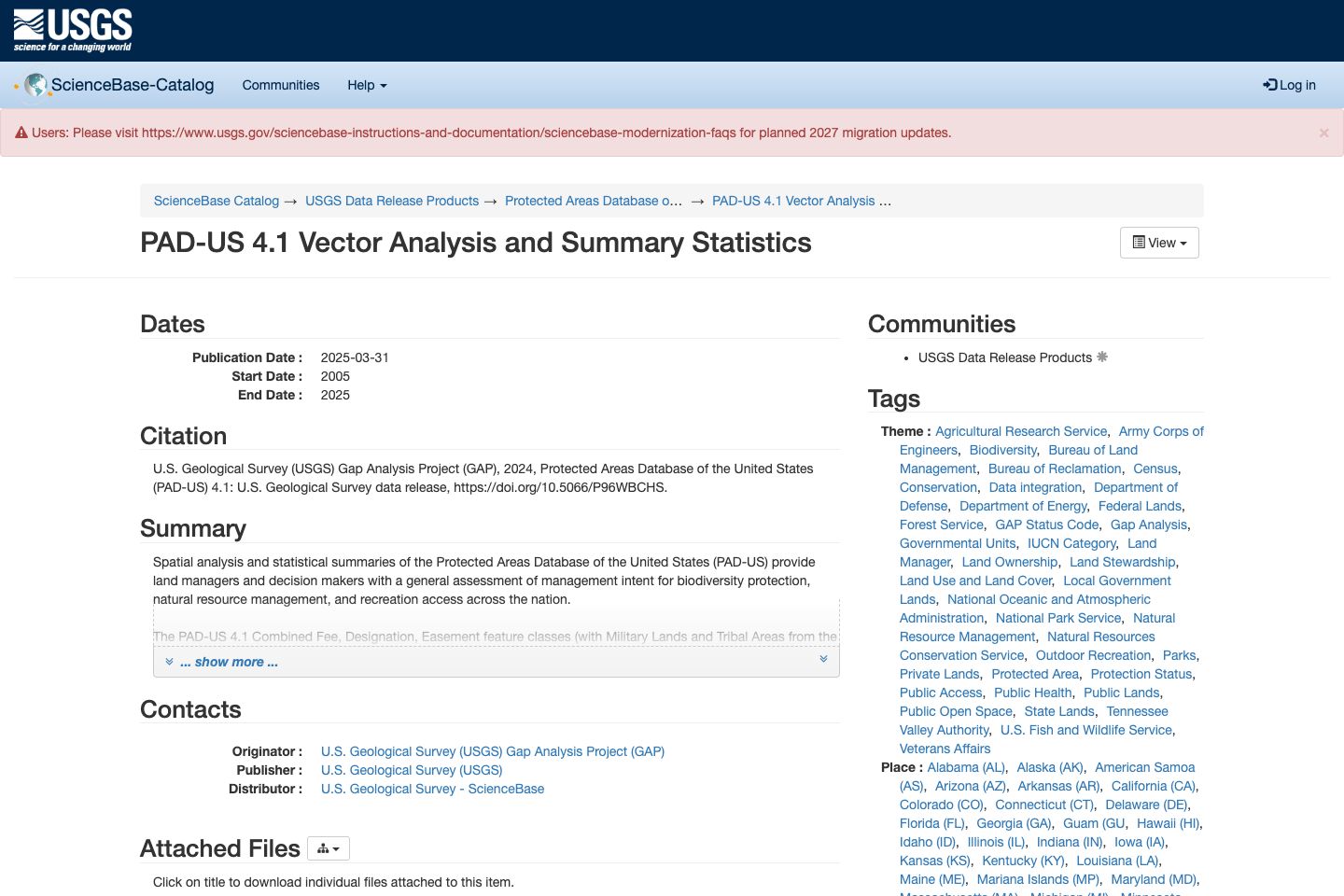
We used the PAD-US 4.1 Vector Analysis and Summary Statistics state table from the U.S. Geological Survey. USGS removes overlapping designations before it adds anything up, so a wilderness inside a national forest isn’t counted twice. Each acre carries one of four access codes. Per USGS, “Open” means no special requirements for public access, “Restricted” means you need a permit or the hours vary a lot, “Closed” means no public access, and “Unknown” means nobody reported it.
From there, we did three things:
- Counted only Open acres.
- Removed National Park Service land. Per the NPS, hunting is authorized in 76 of its “over 400 park units,” and without a specific legal designation it isn’t allowed, so park acres would mostly inflate the count.
- Divided by each state’s land area from the Census Bureau’s state area table (2010 Census) to get a share.
The percentages are approximate. PAD-US clips to Census state boundaries that include water, so a few water-based protected areas may slip into the count.
Which states have the most open public land?
If you hunt mule deer and elk, it’s the West, and it isn’t close. Nevada, California, Oregon, Idaho, Utah, New Mexico, Montana, Wyoming, Arizona and Colorado are the top ten. Most of that is Bureau of Land Management and Forest Service ground.
Most whitetail hunters asking this question mean the other 37 states, so here they are on their own. We set aside the 11 states from the Rockies west (Arizona, California, Colorado, Idaho, Montana, Nevada, New Mexico, Oregon, Utah, Washington and Wyoming). That’s our cut, not a USGS category.
| Rank (outside the West) | State | Open acres, NPS excluded | Share of land area | Restricted-access acres |
|---|---|---|---|---|
| 1 | Minnesota | 6.39 million | 12.5% | 3.16 million |
| 2 | Michigan | 6.24 million | 17.2% | 0.41 million |
| 3 | Wisconsin | PASS, PAA batch-09 (captured 2026-11-05). Covered: top 5 states / best state (ranking H2s, by open public land only). Cut: easiest/hardest/worst/cheapest state, biggest bucks, caliber, shot placement, predators, best all-around state (unsourced or off-topic). Depth: top 3 are listicles (MeatEater 2021, JX3) and a Facebook group (depth only); our PAD-US tabulation is deeper. No body changes. | 15.7% | 0.64 million |
| 4 | Pennsylvania | 5.01 million | 17.5% | 0.06 million |
| 5 | New York | 4.62 million | 15.3% | 0.47 million |
| 6 | Florida | 4.18 million | 12.2% | 3.45 million |
| 7 | South Dakota | 3.80 million | 7.8% | 0.36 million |
| 8 | Texas | 2.82 million | 1.7% | 1.46 million |
| 9 | Arkansas | 2.76 million | 8.3% | 1.35 million |
| 10 | North Dakota | 2.55 million | 5.8% | 0.65 million |
Source: RAD tabulation of PAD-US 4.1 (USGS), Census land area. Restricted acres are not in the rank.
Who owns it varies a lot. Wisconsin’s open total includes about 2.39 million acres coded as county land. Pennsylvania’s is mostly state land, including about 1.52 million acres under the state fish-and-wildlife manager. Michigan splits almost evenly between federal and state.
Which states have the biggest share of their land open?
By percentage: New Jersey (23.5%), Pennsylvania (17.5%), Michigan (17.2%), Massachusetts (16.3%), Wisconsin (15.7%) and New York (15.3%). Treat the first and fourth with care. About 278,000 of New Jersey’s open acres are local or regional land, and roughly 615,000 of Massachusetts’ have no manager listed in PAD-US. Town parks and water-supply land don’t always allow hunting.
So here’s the question that matters more than the table: do you want the most acres, or the most acres per hunter? Those can be two very different states.
Why isn’t Missouri or Tennessee higher?
Because of how the land is coded, not because the land isn’t there. Missouri ranks 12th outside the West with 1.99 million open acres, but PAD-US also lists about 780,000 restricted acres in Missouri with no manager named. Tennessee ranks 30th on open acres, yet PAD-US codes about 1.19 million acres of its state fish-and-wildlife land as restricted. Add restricted acres in and both states jump.
That’s the honest limit of this ranking. Restricted covers anything from a permit-only area to land with highly variable hours. Open can include a city park. PAD-US was built to track land protection and access, not hunting rules. The state’s own regulations are the only thing that tells you whether you can hunt deer on a given tract.
How does Texas fit?
It’s the best example of why acres and hunting access aren’t the same thing. PAD-US counts about 2.82 million open acres in Texas, NPS excluded. Texas Parks and Wildlife says it offers public hunting on “approximately 1.4 million acres of agency-owned or leased lands,” which is “less than one percent of the roughly 172 million acres in Texas.” Some open acres aren’t hunting ground, and some TPWD leases aren’t in PAD-US as open land. Our Texas public land guide walks through the $48 Annual Public Hunting Permit and the rules on those units.
Can you compare harvest, pressure or tags across states?
Not with the data this page is limited to. The agency reports we read, like Ohio’s, count harvest by county, and we found no agency dataset that splits harvest between public and private land the same way in every state. That’s why harvest isn’t in the rank.
Pressure and access costs have the same problem. Nonresident license prices, draws and public-land permits differ in every state, and each needs its own check against the agency’s rules. We do that state by state on pages like public land deer hunting in Ohio, where the state caps antlerless deer on its own public areas. Season timing is on our deer season guide.
If you want the harvest split anyway, our Colosseum debate on public versus private land covers the National Deer Association’s compilation of where deer are actually killed.
So which state should you pick?
Start with the table, then cut it with your own filters:
- Distance and license cost. A nonresident tag can cost more than the gas.
- Restricted land you’d actually use. In states like Tennessee and Missouri, a permit-only area may be the best ground you can get.
- Your own state’s public land first. Ohio is 17th outside the West on open acres, a long way behind Minnesota, but if you live there it’s the only state on the list where you pay resident prices.
Related reading on RAD:
- Public land deer hunting in Missouri
- Public land deer hunting in Texas
- Colosseum: Public vs. private vs. permission land
The other side of it
Acres are the easy number, and they flatter big states. A state with a sliver of public ground and few hunters can be a better hunt than one with millions of acres and a truck at every gate, and nothing on this page measures that. If you’ve found the best public land deer hunting in some state that ranked 30th, the data isn’t going to argue with you. Funny how the guy who swears he found the best public land in America never seems to remember which county it was in.
Keep reading
Latest deer news
Sources
- PAD-US 4.1 Vector Analysis and Summary Statistics - ScienceBase-Catalog
- PAD-US Statistics Dashboard | U.S. Geological Survey
- Hunting, Fishing, Trapping Activities Across the National Park Service (U.S. National Park Service)
- State Area Measurements and Internal Point Coordinates
- Lease of Private Lands for Management Deer Hunts
Comments