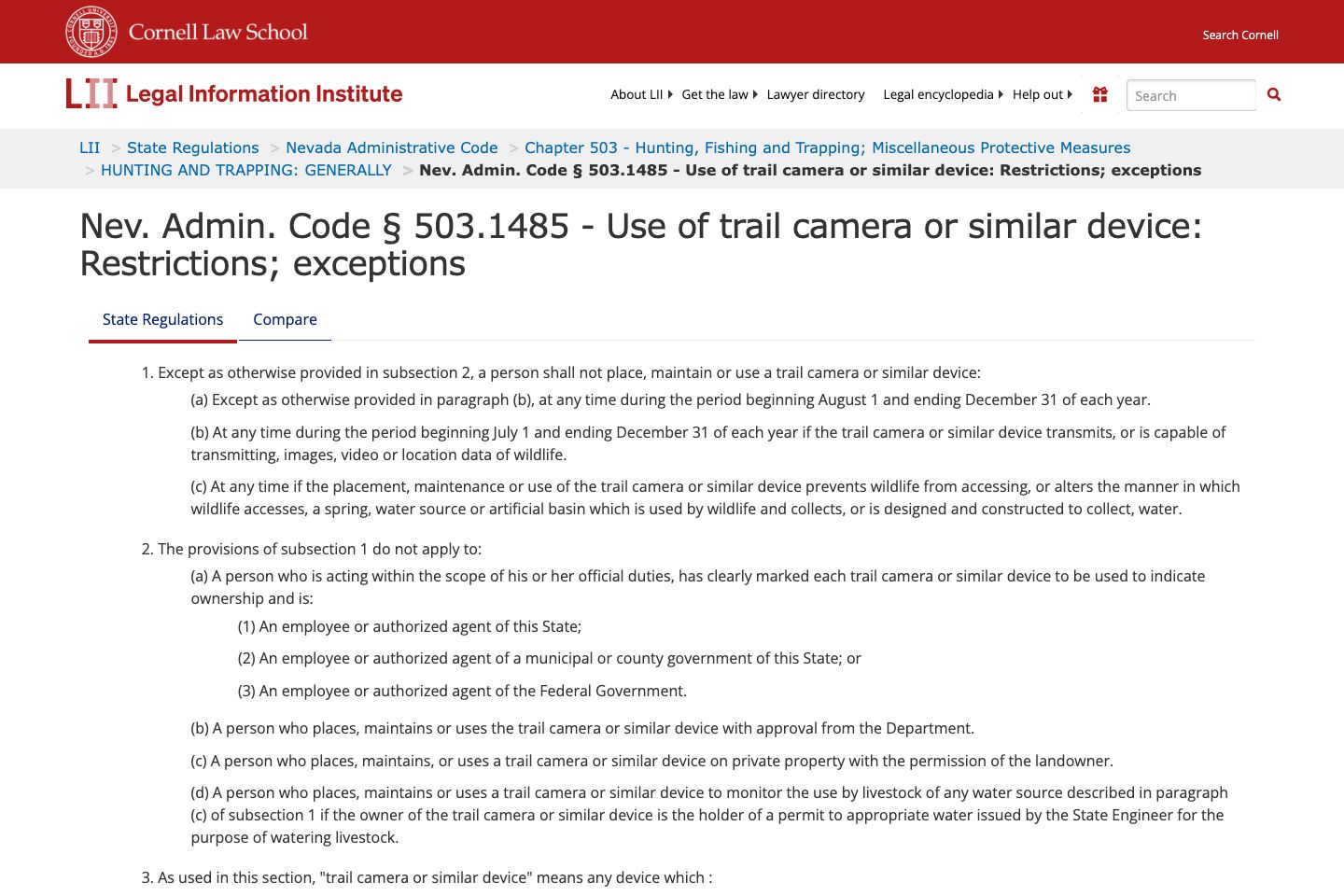
Trail cameras are legal for deer hunting in many places, but not everywhere, and the rules are tightening, especially for cellular cameras that send photos to your phone. As of Nov. 4, 2026, we’ve confirmed that Utah bans all trail cameras on public land from July 31 to Dec. 31, and Nevada bans them from Aug. 1 to Dec. 31, with cellular cameras banned starting July 1 (Utah DWR; NAC 503.1485). Separately, the Boone and Crockett Club won’t accept a buck killed in response to a real-time camera photo (Boone and Crockett Club).
Key Takeaways
- Utah: all trail cameras are prohibited on public land July 31 – Dec. 31, with exceptions. Non-transmitting cameras with internal storage are allowed on private land (Utah DWR).
- Nevada: no trail cameras Aug. 1 – Dec. 31, and no transmitting cameras July 1 – Dec. 31, with exceptions including private property with landowner permission (NAC 503.1485).
- Record books: B&C excludes animals taken using technology that delivers real-time location data, including photos, that “elicits an immediate (real-time) response” (Boone and Crockett Club).
- Bowhunters: Pope and Young bars electronic devices “for attracting, locating or pursuing game or guiding the hunter to such game” (Pope and Young).
Can you have trail cameras out during hunting season?
It depends on the state, and in some states on whether the land is public or private. We only list states where we’ve read the official rule. If yours isn’t here, we haven’t verified it yet, so check your state’s regulations. So far:
Utah. The Utah Division of Wildlife Resources says “all trail cameras are prohibited on public land from July 31 to Dec. 31,” with some exceptions. A camera “using internal data storage and not capable of transmitting data” is allowed on private land. Utah also makes it unlawful to buy or sell trail camera images or data to take, or help take, big game (Utah DWR).
Nevada. Under Nevada Administrative Code 503.1485, nobody may place, maintain or use a trail camera from Aug. 1 through Dec. 31, or from July 1 through Dec. 31 if it can transmit images, video or location data. Cameras are also banned any time they block or change how wildlife reaches a water source. Exceptions include officials on duty, people with department approval, and cameras on private property with the landowner’s permission (NAC 503.1485 via Cornell LII).
Iowa. Trail cameras will be banned on state game management areas starting Feb. 1, 2027, unless a permit allows them or the DNR runs them. The rule covers card and cellular cameras alike, so 2026-27 is the last season you can hang one on an Iowa GMA. Private land isn’t part of it. The commission said the goal was to cut down on camera clutter and complaints and to keep any hunter from gaining “an improper or unfair technological advantage over game.” The proposal drew 102 comments, 59 in favor, 35 against and 8 asking for a modified ban, and it passed unchanged (Iowa ARC 0557D).
Wisconsin. Cameras left overnight on DNR-managed lands are allowed if they follow the rules. Under NR 45.04, the camera has to be permanently and legibly marked on the outside with your name and address or DNR customer ID. You can’t damage trees or brush to hang it or clear a view, and it can’t be aimed at beaches, trails, campgrounds or parking areas. The DNR isn’t responsible if it gets stolen (Wisconsin NR 45.04; Wisconsin DNR).
Utah and Nevada are western states where mule deer and water sources drive a lot of the debate. We’re working through more whitetail states and will add each one only after reading its official rule.
What states have banned trail cameras for hunting?
Of the states we’ve verified, Utah and Nevada both have seasonal bans covering hunting season, and neither is a total ban. Utah’s applies to public land, and Nevada’s has exceptions for private property with landowner permission (Utah DWR; NAC 503.1485). Iowa’s ban on game management areas is year-round once it starts Feb. 1, 2027 (Iowa ARC 0557D). Other states have rules too.
Are cellular trail cameras treated differently?
Often, yes. Nevada starts its transmitting-camera ban a month earlier than its ban on all cameras, and Utah’s private-land allowance applies only to cameras that can’t transmit (NAC 503.1485; Utah DWR).
Why are trail cameras being banned?
The rule texts we read don’t explain their reasons. But you can tell what they’re aimed at from what they ban:
- Real-time information. Nevada bans transmitting cameras a month before it bans all cameras (NAC 503.1485).
- Selling camera data to help hunters kill big game. Utah makes this unlawful (Utah DWR).
- Crowded water sources. Nevada bans cameras that block or change how wildlife reaches water (NAC 503.1485).
So these rules aren’t just about what you hang on a tree. They’re about what you do with the pictures.
Utah’s DWR says there have been “several Utah Wildlife Board and legislative updates” on trail cameras since 2022 (Utah DWR). The fair chase argument against real-time cameras is spelled out by Boone and Crockett below.
The National Deer Association’s 2022 position statement says trail cameras haven’t been shown to hurt deer populations and are useful for management. It ties the western bans to social and ethical conflict, and says it will judge new camera features for fair chase case by case (NDA).
Can you enter a trail-camera buck in the record books?
Yes, if you didn’t kill it in real time. B&C says “‘real time’ is the key concept.” Seeing a photo and killing that deer “a few hours later, or even the same day” disqualifies it. Waiting “several days, or even until the following season” would not be deemed unethical. B&C has no specific policy on cameras you check by hand, and requires you to follow state law (B&C).
Pope and Young bars using electronic devices “for attracting, locating or pursuing game or guiding the hunter to such game” (Pope and Young). If you plan to enter a bow kill, read P&Y’s full rules before relying on a cell cam.
Related reading on RAD:
The other side of it
Supporters of cell cams argue they mean fewer trips into the woods, less human scent on a property and less pressure on deer, which is hard to argue with. Critics, including some wildlife commissions, say real-time photos give hunters an unfair edge, especially around scarce water. Both can be true at the same time. Of course, the guy who says he “doesn’t need cameras” usually has six of them on his phone’s home screen.
Keep reading
Latest deer news
Sources
- Trail camera regulations - Utah Division of Wildlife Resources
- Nev. Admin. Code § 503.1485 - Use of trail camera or similar device: Restrictions; exceptions | State Regulations | US Law | LII / Legal Information Institute
- B&C Position Statement - Big Game Records Eligibility | Boone and Crockett Club
- Fair Chase | Pope and Young Club | Preserve, Promote, and Protect Bowhunting
- ARC 0557D - Iowa Administrative Rules
- Wisconsin Legislature: NR 45.04(4)(c)
- DNR-Managed Lands | Public And Private Lands | Wisconsin DNR
- NDA trail-camera position (deerassociation.com)
Comments