What is slope on a rangefinder? It is the feature that measures the angle between you and the target and uses it to give an angle-compensated distance instead of just the straight-line range. Vortex says its HCD mode “displays the slope angle compensated distance to the target” (Vortex Optics). Hunters use that number because gravity pulls on a bullet or arrow over the horizontal distance, not the full slant range. Golfers call the same idea “slope,” and in golf it comes with rule limits.
Key Takeaways
- Slope or angle compensation turns a line-of-sight range into a horizontal, shoot-to distance.
- Uphill or downhill, an uncorrected shot at a steep angle tends to hit high.
- At short range and shallow angles, the difference is small. At long range or steep angles, it matters.
- Brands name the modes differently: Vortex HCD and LOS, Leupold TRIG, BOW and LOS.
- The R&A’s golf rules say a distance device must not measure elevation changes.
What is slope on a rangefinder, and why does it matter?
A plain laser rangefinder measures one thing: the straight-line distance. Leupold describes that line-of-sight mode as one that “calculates the distance to a target in a straight line regardless of incline or decline” (Leupold).
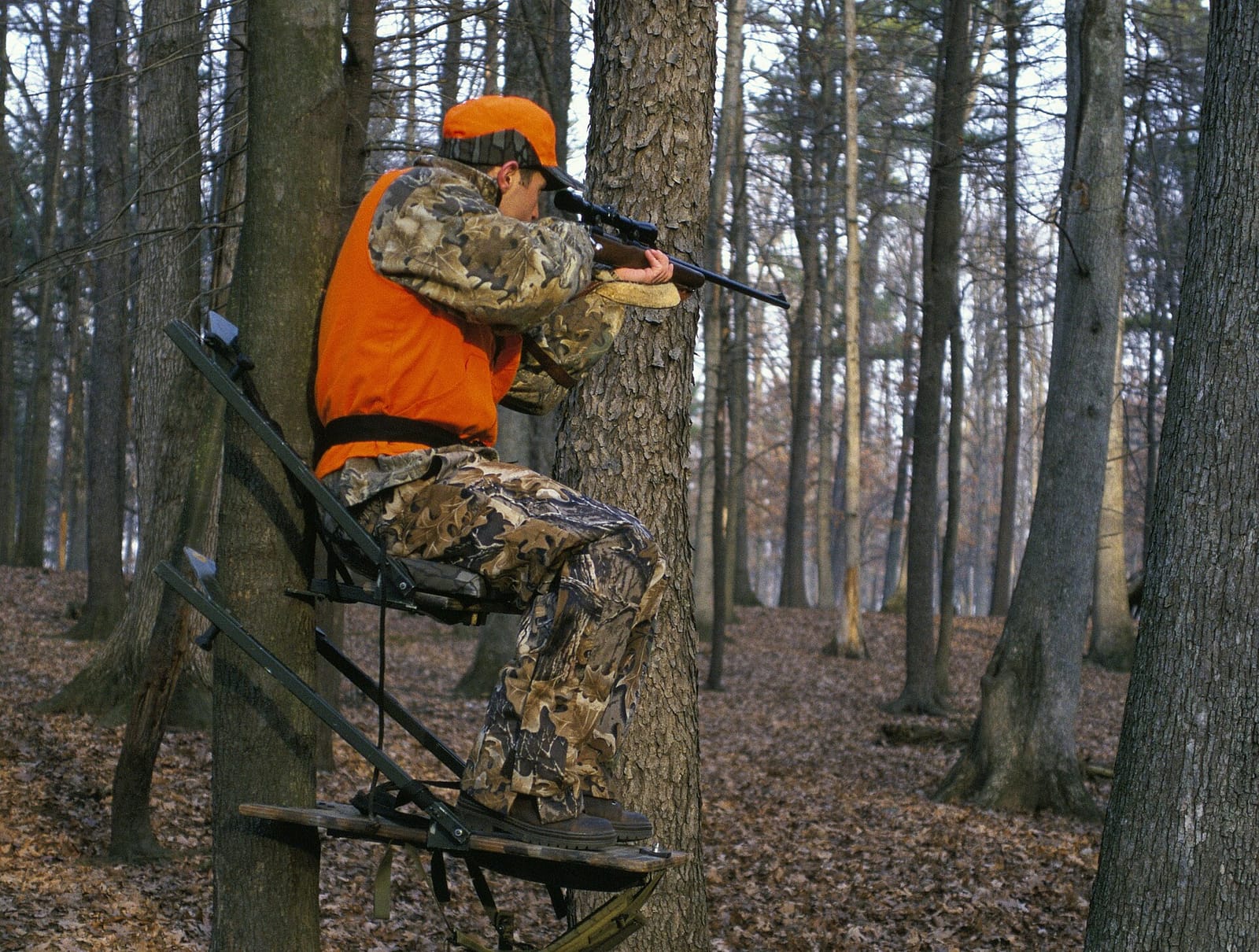
Slope adds the angle. The National Shooting Sports Foundation’s Let’s Go Shooting site explains why: “Gravity only acts on your bullet over the horizontal distance to the target” and when you shoot at an angle, “that horizontal distance is shorter, meaning gravity has less time to pull the bullet down.” Its rule of thumb: “Uphill or downhill, your bullet will hit high” (NSSF Let’s Go Shooting).
The American Rifleman put it this way in its Q&A on shooting at angles: “On a given slope, the effect is substantially the same in firing uphill or down.” Its example: “the horizontal range corresponding to a slant range of 300 yds. on a 45° slope is 210 yds. The rifle should be aimed for 210 yds.; if aimed for 300, the bullet may pass over the target” (American Rifleman).
The math behind it
NSSF gives the formula: “Angle Distance = True Distance x cos(Angle).” Its worked example is a 1,000-yard target at a 30-degree downhill angle: “1,000 (True Distance) x 0.866 (cos(angle)) = 866 yards.”
Most hunters never do the math. NSSF notes “Most modern rangefinders often calculate angle distance automatically.” For a treestand example, a 20-yard line-of-sight reading at 30 degrees works out to about 17.3 yards horizontal (RAD arithmetic using the same cosine). At a shallow angle, the change is tiny. American Rifleman says “At small angles, the effect is trifling.”
How brands label slope modes
Vortex. Its “Horizontal Component Distance” mode “is the default and primary mode for most rifle and archery applications.” Vortex says it is “most useful for archers shooting out of a treestand, mountain hunters, and precision competitors who need an angle compensated distance for an accurate shot,” and that “Archers use the appropriate level ground sight pin.” Its LOS mode “displays the actual” line-of-sight range “along with the slope angle,” and Vortex says that mode “is intended for shooters utilizing ballistic devices and shooting at distances beyond 500 yards with slopes greater than 15 degrees.”
Leupold. Its TRIG mode “displays more accurate ranges by using trigonometry equations with input from the line-of-sight and angle readings,” which Leupold calls “the range-finding equivalent of the rifleman” rule. Its BOW mode “calculates angle compensated ranges out to 175 yards.” For more, see rangefinder angle compensation modes explained.
Slope for bowhunters
Treestand shots angle down, which is the situation Vortex names first for its HCD mode. Vortex says archers using HCD should use their level-ground pin for the distance shown. Leupold notes its Archer’s Advantage mode is “especially helpful for close, steep shots.” For pairing a rangefinder with your pins, see rangefinder bow sight. For setting up the unit before you climb, see the next section.
How should you set your rangefinder in a treestand?
Slope is only half the job. The laser also has to hit the deer and not the brush. Vortex lists three target modes (Vortex Optics):
- Last mode shows the farthest return. Use it to range a deer through branches and leaves.
- First mode shows the closest return. Use it for a small target in front of a far backdrop like rocks.
- Normal mode shows the strongest return. Vortex recommends it for most situations.
A simple stand routine: set the range mode to HCD, pick the target mode for the cover in front of you, and use scan so the yardage updates as the deer moves. Before opening day, range known spots from your stand height and check that your pin matches the number you get.
Where slope does not fix everything
NSSF points out that “the bullet still travels the full line-of-sight distance through the air, meaning it” is exposed to wind for the whole flight. So a slope reading helps with drop, not wind. NSSF also says “At short ranges and small angles, the difference is negligible. At long ranges or steep angles, failing to make the proper adjustment can cause significant misses.”
Slope in golf
Slope means something different on a golf course, where the rules limit it. The R&A says a device “must not” do two things, and the first is to “Measure elevation changes” (The R&A). It adds that “In some competitions, the Committee may adopt a Local Rule that prohibits the use of distance-measuring devices.” That is a golf rule, not a hunting one.
FAQ
Is slope the same as angle compensation? Yes, in practice. Different brands name it differently, but it uses the angle to give a horizontal distance.
Should I use slope for bowhunting from a treestand? Vortex recommends its angle-compensated mode for archers in treestands, using a level-ground pin.
Do I need slope for rifle hunting? At close range on mild angles, the effect is small. At long range or steep angles, it can decide the shot.
Does slope account for wind? No. NSSF notes the bullet is still exposed to wind over the full line-of-sight distance.
The other side of it
Some hunters say slope is a gimmick on a deer rangefinder, since most whitetail shots are close and the correction is a yard or two. For a lot of rifle shots across a flat field, they are right. But a bowhunter in a tall stand or a hunter shooting across a canyon is working at exactly the angles where the numbers start to move. The guy who swears he never needs slope and then misses over the back of a buck below him is just proving the American Rifleman right.
Keep reading
Latest deer news
Sources
- How Laser Rangefinder Modes Work, Vortex Optics
- How To Choose A Rangefinder, Leupold
- How to Shoot Uphill and Downhill, Simplified, NSSF Let's Go Shooting (Ryan Cleckner)
- "Rifleman Q&A: Shooting Uphill Or Down", American Rifleman (NRA)
- Distance Measuring Devices (Rule 4.3a(1)), The R&A
Comments