Yes, the .270 Winchester is good for deer hunting. It’s a long-action cartridge firing a .277-inch bullet, and current factory deer loads run 130 to 145 grains at 2,970 to 3,060 fps: Winchester’s Deer Season XP 130-grain Extreme Point at 3,060 fps and Hornady’s Precision Hunter 145-grain ELD-X at 2,970 fps from a 24-inch test barrel (Winchester Deer Season XP; Hornady .270 ELD-X). SAAMI sets its maximum average pressure at 65,000 psi on a 24-inch test barrel (SAAMI Z299.4).
Key Takeaways
- Winchester Deer Season XP .270 130-grain Extreme Point: 3,060 fps and 2,702 ft-lb (Winchester Deer Season XP).
- Hornady Precision Hunter .270 145-grain ELD-X: 2,970 fps (Hornady .270 ELD-X).
- The .270’s 65,000 psi SAAMI pressure ceiling sits above the .30-06 at 60,000 psi and the .308 at 62,000 psi (SAAMI Z299.4).
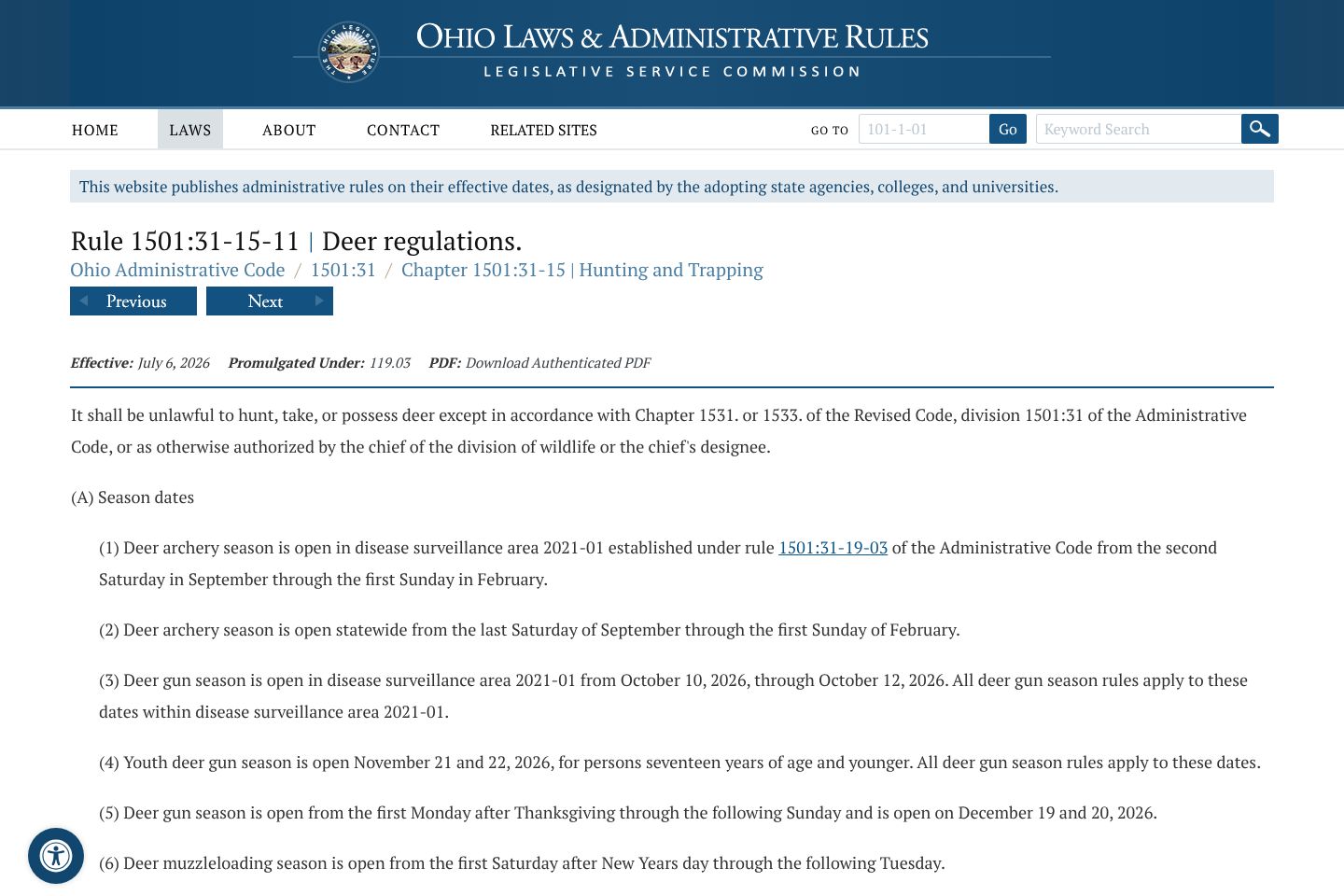
- It’s a bottleneck cartridge, so it isn’t legal where deer rifles must be straight-wall. Ohio’s rule bars necked-down rifle cartridges for deer (Ohio Adm.Code 1501:31-15-11).
Why do hunters like the .270 for deer?
Makers publish fast muzzle speeds for it. Winchester’s Deer Season XP 130-grain Extreme Point leaves at 3,060 fps, and even Hornady’s heavier 145-grain ELD-X Precision Hunter leaves a 24-inch test barrel at 2,970 fps (Winchester Deer Season XP; Hornady .270 ELD-X).
SAAMI gives the .270 Winchester a 65,000 psi maximum average pressure, higher than the .30-06 Springfield’s 60,000 psi and the .308 Winchester’s 62,000 psi (SAAMI Z299.4). That’s a pressure standard for commercial ammo. It doesn’t promise a wound channel, and it isn’t permission to take longer shots.
What is the best .270 bullet weight for deer?
The current deer-branded loads cited here land on 130 and 145 grains, not 100-grain varmint territory (Winchester Deer Season XP; Hornady .270 ELD-X).
| Load | Bullet | Muzzle velocity | Why pick it |
|---|---|---|---|
| Winchester Deer Season XP | 130 gr Extreme Point | 3,060 fps (2,702 ft-lb) | Higher published muzzle speed |
| Hornady Precision Hunter | 145 gr ELD-X | 2,970 fps | Heavier polymer-tip bullet with Hornady’s downrange table |
Sources: Winchester Deer Season XP; Hornady .270 ELD-X.
Both are deer loads, but they won’t share a zero. Pick one, zero it, and keep a spare box of that same load sealed for November instead of a “close enough” neighbor on grain weight. If a box says varmint or predator with a very light .277 bullet, it isn’t the deer answer, even though it chambers.
Is the .270 better than a .30-06 or .308 for deer?
It depends on what you value. The .270 fires a .277-inch bullet, against .308 inch for the .30-06 and .308 Winchester. Pick the rifle you shoot best. Neither is wrong with a hunting bullet from the maker pages above.
The .270 usually needs a long-action magazine, so rifle fit belongs in the decision right next to the velocity chart.
How far can you shoot a deer with a .270?
As far as your cold-bore groups and wind calls agree, and no farther. High catalog velocity tempts longer shots than your wind calls support. Write the exact load on a range card, print the maker’s trajectory notes for it, and confirm your zero from the sitting and kneeling positions you’ll use from your stands (Winchester Deer Season XP; Hornady .270 ELD-X).
Where is the .270 not legal for deer?
Where deer rifles must use straight-wall cartridges. Ohio’s rule makes it unlawful to hunt deer with a necked-down rifle cartridge, so the bottleneck .270 is out there (Ohio Adm.Code 1501:31-15-11). Confirm your unit allows bottleneck centerfires before you buy ammo.
The other side of it
The .30-caliber crowd argues that on a steep quartering shot, more frontal area buys margin a fast .277 bullet doesn’t. Pressure and catalog speed say nothing about the wound channel. If most of your deer step out close in the timber, that flat arc is a feature you’ll rarely use. The .270 versus .30 argument will still outlive every rifle in camp, since neither side has ever let a dead deer settle it.
Keep reading
Latest deer news
Comments