A hunter safety course is a state-run class, usually six to ten hours long, that you have to pass before most states will sell you a hunting license, and its curriculum follows standards written by the International Hunter Education Association-USA (IHEA-USA). Who has to take one comes down to your birth year and your state. Texas draws the line at September 2, 1971, Colorado goes back to January 1, 1949, and New York skips the birthday math and requires it of every first-time license buyer (TPWD; CPW; NYS DEC).
Rules below were read on the linked agency pages on November 4, 2026. Season-year rules are noted where the agency gives one.
Key Takeaways
- Who runs it: the 50 state wildlife agencies, with “more than 32,000 instructors, many of whom are volunteers,” certifying “more than 550,000 students annually” (IHEA-USA).
- Who needs it: depends on your state’s cutoff birthday. Examples verified below run from 1949 (Colorado) to 1980 (Illinois).
- How long: classroom courses run 6 hours in Texas, at least 7 in New York, at least 8 in Alabama and 10 or more in Illinois and Colorado. Online versions take about 3 to 8 hours.
- What it costs: classroom courses are free in Illinois, New York, Pennsylvania, Alabama and Georgia, while Illinois puts online courses at “$29.00-$49.95” depending on the provider (Illinois DNR).
Who actually runs the hunter safety course?
Your state does. Every hunter education program in the country belongs to a state fish and wildlife agency, which sets the rules on who must take it, approves the online providers and issues the card. The instructor in front of the room is usually a volunteer.
The thread tying all 50 programs together is IHEA-USA, which describes itself as a “professional hunter education association affiliated with the Association of Fish and Wildlife Agencies” and says that “since 1949, nearly 40 million students have completed hunter education courses” (IHEA-USA). Its Standards Committee, “composed primarily of State agency experts appointed on a regional basis,” writes the core curriculum the states build their courses on (AFWA Resolution 2024-01-10).
So when a Hunter-Ed or HUNTERcourse ad says “state-approved,” that is what it means: the agency signed off on that provider’s version of the IHEA-USA curriculum. The companies don’t certify you. The state does.
Do you have to take a hunter safety course?
Probably, if you were born after the late 1950s to 1970s, depending on where you buy your license. Most states wrote their law with a cutoff birthday, and anyone born on or after it has to show a card. Here are the rules we read directly on agency pages. If your state isn’t here, it’s because we couldn’t reach its official page, not because it has no rule.
| State | Who must be certified | Source |
|---|---|---|
| Alabama | Born on or after August 1, 1977 | Outdoor Alabama |
| Colorado | Born on or after January 1, 1949 | Colorado Parks and Wildlife |
| Georgia | Born on or after January 1, 1961 | Georgia DNR |
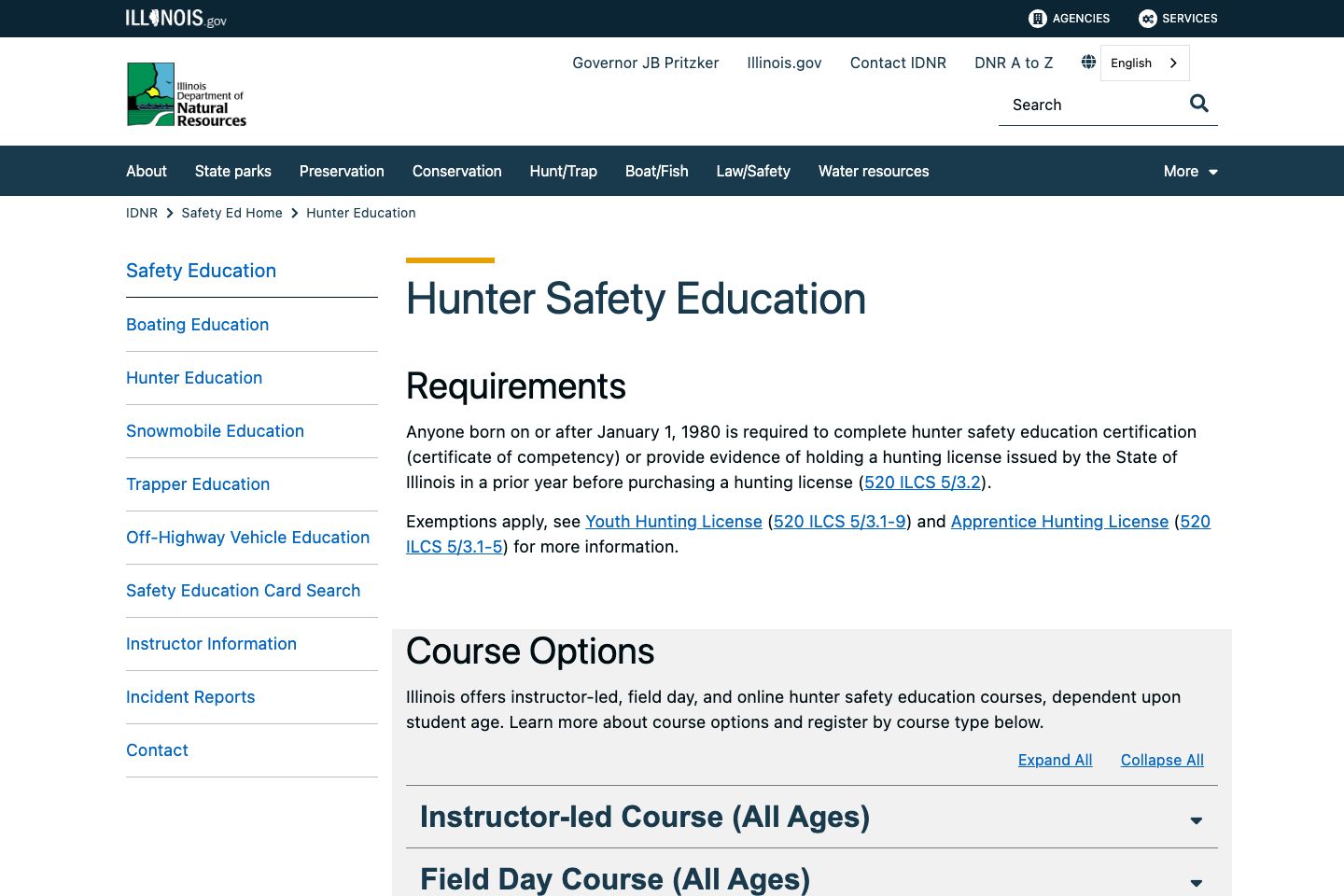
| Illinois | Born on or after January 1, 1980 | Illinois DNR |
| Minnesota | Born after December 31, 1979 | Minnesota DNR |
| Missouri | Born on or after January 1, 1967 | Missouri Dept. of Conservation |
| New York | Every first-time license buyer, no birth-year cutoff | NYS DEC |
| Texas (2026-27) | Born on or after September 2, 1971, including out-of-state hunters | TPWD Outdoor Annual |
| Wisconsin | Born on or after January 1, 1973 | Wisconsin DNR |
Notice that Texas applies its rule to nonresidents too. A 50-year-old from Ohio who never needed a card at home still needs one to hunt deer in the Hill Country.
What if you were born before the cutoff?
Then your state doesn’t require the course, and you can buy a license without it. That’s not the same as being exempt everywhere. Colorado’s 1949 line means almost every living hunter needs a card there, which is why the state offers a one-time online test-out for hunters 50 and older, passed “with a score of 90% or better” (CPW).
What does a hunter safety course cover?
Texas describes its classroom course as covering “core standards in Firearm, Hunting and Outdoor Safety, Hunting Responsibilities and Wildlife Conservation,” with some classes adding bowhunting, muzzleloaders, survival and first aid (TPWD FAQ). Alabama’s list is similar: firearm safety, responsible hunting, wildlife laws, hunter ethics, wildlife management, archery, muzzleloading, first aid, survival and game care (Outdoor Alabama).
In practice, much of the hands-on work is gun handling. North Dakota’s practical exam has students cross a fence alone and with another hunter, and they must “maintain correct muzzle control during the entire demonstration” (North Dakota Game and Fish). The conservation section explains where license money goes. The ethics section is where the instructor tells the story about the guy who shot at movement.
Is the hunter safety course hard?
Not for anyone who pays attention. Missouri’s all-online version ends with a 60-question final that needs 80 percent to pass (MDC). Texas field days end with a written exam that also requires 80 percent (HUNTERcourse field day page). Kids as young as 9 pass it in Texas, where the minimum certification age is 9 (TPWD). New York starts students at 11 (DEC).
How long does a hunter safety course take?
Longer in a classroom than online, and it varies by state.
| Format | Length | Source |
|---|---|---|
| Texas classroom | “6 hours of basic instruction” | TPWD |
| New York in-person | Minimum of 7 hours | DEC |
| Alabama in-person | At least eight hours plus a written exam | Outdoor Alabama |
| Illinois instructor-led | “10-plus hours, typically taught over 2 days” | Illinois DNR |
| Colorado classroom | “a minimum of 10 hours of class time” | CPW |
| Online portion (where allowed) | About 3 to 8 hours, then a field day in some states | Illinois DNR, FWC |
Illinois says the online course is “typically completed in 4-6 hours” and its field day “is typically 6 to 8 hours long.” Florida tells students to “allow approximately 8 hours” for the online course. Hunter-Ed’s Texas page says “most students complete the online course in about 3–4 hours” (Hunter-Ed). Whether you can skip the field day entirely is its own question, and we answer it state by state in our online course guide.
How much does a hunter safety course cost?
The in-person class is usually the cheapest route, and often free. Illinois, New York, Pennsylvania, Alabama and Georgia all list their classroom courses at no charge (Illinois DNR, DEC, PGC, Outdoor Alabama, Georgia DNR). Texas charges $15, “paid directly to instructor” (TPWD). Colorado’s classroom course “costs up to $10” (CPW).
Online courses are where the money is. Illinois puts the range at “$29.00-$49.95” depending on the provider. New York’s three approved online courses run $29.99, $39.95 and $49.95 (DEC). In Texas, HUNTERcourse charges $29 for students 16 and under and $34 for 17 and older (HUNTERcourse), Hunter-Ed charges $39.95 plus a $5.25 TPWD fee (Hunter-Ed), and ilearntohunt charges $54.95 plus the same fee (ilearntohunt). Hunter-Ed’s own FAQ puts it plainly: “Each state sets its own price” (Hunter-Ed).
The NRA’s online course is free in the states that accept it. Georgia says it’s “offered free to everyone (regardless of age or state residency)” (Georgia DNR), and Florida’s provider list marks it “100% FREE” (FWC).
Once you pass, the card is good for life and travels with you. Expiration, other states, apprentice permits and replacing a lost card are on the hunter safety card page.
Related reading on RAD:
- Can you take a hunter safety course online?
- Deer hunting license: what you need in every state
- Deer hunting tips for beginners
- Hunter safety card: does it expire, and does it work in other states?
The other side of it
A fair criticism of the hunter safety course is that a birth-year cutoff is a strange way to measure competence. A 60-year-old who has never touched a rifle can buy a Texas license with no class at all, while a farm kid who has handled guns since she was six sits through ten hours in Illinois. The states half-admit this with their own deferrals and mentored licenses, which are a polite way of saying the class matters less than the person standing next to you. Then again, the guy who brags that he’s never needed a hunter safety course is reliably the same guy sweeping the whole truck bed with his muzzle while he tells you about it.
Keep reading
Latest deer news
Sources
- About International Hunter Education Association
- AFWA Reciprocity Resolution 2024-01-10
- Alabama Hunter Education Classes Prepare New Hunters for the Upcoming Season | Outdoor Alabama
- Education and Outreach | Colorado Parks and Wildlife
- Hunter Education Courses | Department Of Natural Resources Division
- Hunter Safety
- Firearms Safety Certification for Adults (16 and older) | Minnesota DNR
- Hunter Education | Missouri Department of Conservation
- NYS DEC (dec.ny.gov)
- Hunter Education — Texas Parks & Wildlife Department
- Register Today For Spring Hunter Education Classes; Be Ready To Enjoy Fall Hunts | Wisconsin DNR
- FAQ — Texas Parks & Wildlife Department
- Finalize your Texas Hunter Education Training | HUNTERcourse.com
- Hunter Education — Texas Parks & Wildlife Department
- Which Hunter Safety Course Is Right For You? | FWC
- Texas Hunter Safety Course | Hunter-ed.com™
- Hunter-Trapper Education | Game Commission | Commonwealth of Pennsylvania
- DEC (dec.ny.gov)
- Official Texas Hunter Safety Course | HUNTERcourse.com
- Official Online Texas Hunter Safety Course | ILearnToHunt
- National Online Hunter Safety Course | Hunter-ed.com™
- Hunter Education Practical Exam Requirements | North Dakota Game and Fish
Comments