How to cook venison round steak depends on which round you have and how tender it is. Michigan State University Extension’s venison guide says round “is usually cut into steaks” for dry heat cooking and “can also be made into Swiss steaks.” So you have two good roads: sear tender round steaks hot and fast, or pound tougher ones and braise them low and slow. Both work. The mistake is treating a tough bottom round like backstrap.
Key Takeaways
- The round is the hindquarter. Top (inside) round is the most tender; bottom (outside) round is a little tougher.
- Tender round steaks can take dry heat: searing, grilling, broiling.
- Tougher round steaks do best pounded, floured, browned and braised as Swiss steak.
- Venison is lean. Add fat, don’t walk away from the pan, and slice against the grain.
- RAD’s house temperature for venison is 160°F, per Penn State Extension. Use a thermometer.
What is venison round steak?
Round steak comes from the hind leg. MeatEater’s Danielle Prewett describes the top round, which she calls the inside round, as “a thick, tender muscle with a long grain line” found “on the inside of the hindquarter.” She says it’s “not to be confused with the bottom (or outside) round found on the outside of the leg, which is a little tougher” (MeatEater).
The third piece is the eye of round, “a cylindrical muscle that is tucked towards the bottom of the hindquarter.” Prewett admits “it isn’t quite as tender as the tenderloin,” and for an older or tougher deer she recommends “either pan-roasting or reverse searing.”
Method 1: How to cook venison round steak hot and fast
MSU Extension says “Because venison is a dry meat, only certain cuts (tenderloin, round, and loin steaks or chops) can be cooked using dry heat methods (broiling, frying, roasting, grilling)” (MSU Extension, Michigan Venison). It adds that “Adding beef suet, butter, pork fat or bacon prevents venison from becoming dry and chewy.”
Prewett’s chili-rubbed top round is a good template (MeatEater, Chili Rubbed Steak):
- “trim off all the silverskin and cut the top round in half lengthwise so you’re left with two flat pieces.”
- Pound it even. “You want it to be about 1 inch thick.”
- Rub with salt, brown sugar and chili powder. She says you can “let it rest in the refrigerator for up to 24 hours.”
- Get a grill or “a large cast iron skillet” very hot with oil.
- “Sear the meat for roughly 2 minutes on each side for medium-rare.”
- Rest it, then “Slice the steaks thin, against the grain.”
She uses the top round “because it has a long grainline and is very tender,” and says it “bears the closest resemblance to flank steak from a cow.”
If you’d rather broil, MSU’s recipe says to baste with oil or butter, or “cover the steaks with a strip of bacon,” then “broil for approximately 5 to 7 minutes per side” for 1-inch steaks. MSU also warns “Venison cooked beyond medium well is usually dry and chewy.”
About doneness: chefs cook round steaks pink. RAD’s house temperature for venison is 160°F, following Penn State Extension: “Cook venison, including jerky, to a minimum internal temperature of 160°F to reduce the risk of food-borne illness” (Penn State Extension). That’s a long way from medium-rare. If you cook thin round steaks to 160°F, slice them thin and against the grain, or go with Method 2, where the braise makes a well-done steak tender.
Method 2: Swiss steak for tougher round steaks
This is the classic. American Hunter explains that “Historically, Swiss steak was made from beef round roasts cut into thin steaks and run through a tenderizing machine, or swisser.” If you don’t have one, “pound steaks with a meat mallet, or use a needling device like a Jaccard knife” (American Hunter).
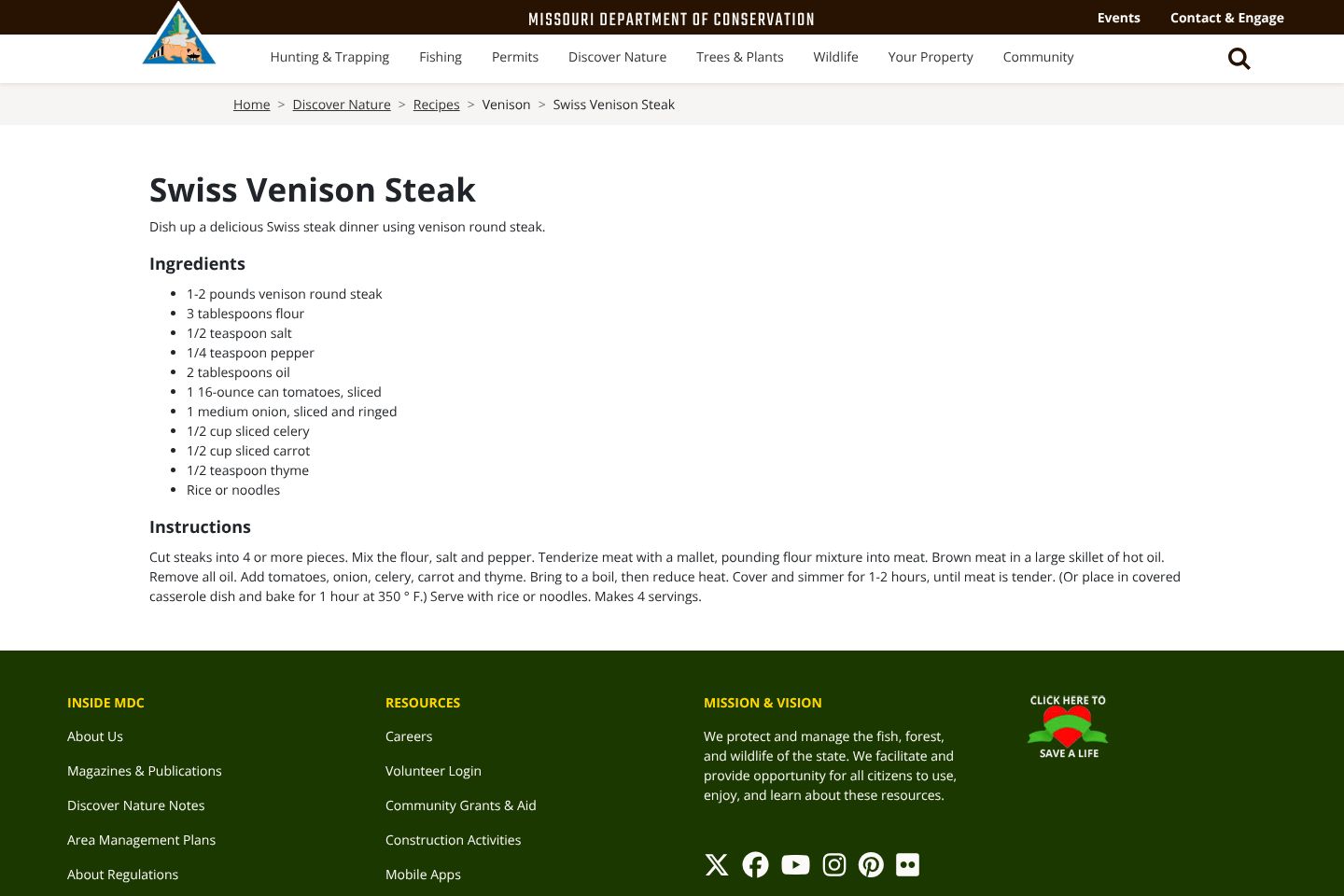
The Missouri Department of Conservation’s Swiss venison steak calls for “1-2 pounds venison round steak,” flour, salt, pepper, oil, a can of tomatoes, onion, celery, carrot and thyme (Missouri Department of Conservation). The steps:
- “Cut steaks into 4 or more pieces.”
- “Tenderize meat with a mallet, pounding flour mixture into meat.”
- “Brown meat in a large skillet of hot oil. Remove all oil.”
- Add the tomatoes, vegetables and thyme. “Bring to a boil, then reduce heat.”
- “Cover and simmer for 1-2 hours, until meat is tender.”
MDC offers an oven option too: “bake for 1 hour at 350 ° F.” It says to serve it “with rice or noodles.”
American Hunter’s version adds tomato paste, smoked paprika, oregano, Worcestershire and beef broth, and braises “in an oven preheated to 325°F” for “two hours to make the meat tender and the gravy rich in flavor.” Its steaks start “½-inch thick” and get pounded to “¼-inch thick.” Make sure the browned steaks are “completely submerged in liquid.”
MSU’s own braised round steak recipe, a Creole steak with celery, peppers, onions and tomatoes, says to cook it covered “until meat is tender, about 1 1/4 hours, and has an internal temperature of at least 165 degrees F.” That’s the appeal of a braise: you can get past RAD’s 160°F and the meat still comes out tender. Check with a thermometer rather than the clock.
Tips that apply either way
- Cut against the grain. Prewett slices “thin, against the grain” for tender bites.
- Add fat. Venison is lean. MSU suggests suet, butter, pork fat or bacon.
- Match the cut to the method. Save tender top round for searing and give bottom round the Swiss steak treatment.
- Use a thermometer. Times are guides. Check the thickest part.
If your round steaks are already cubed, see how to make venison cube steak. Rounds also make good jerky; see our venison jerky guide.
FAQ
How do you cook venison round steak so it’s not tough? Either sear tender top round quickly and slice it thin against the grain, or pound tougher round steaks and braise them as Swiss steak for 1 to 2 hours.
Can you grill venison round steak? Yes. MSU lists round among the cuts that can take dry heat, and MeatEater sears top round over high heat. Bottom round is tougher and better braised.
What temperature should venison round steak reach? RAD’s house temperature is 160°F, per Penn State Extension.
What is the most tender round cut? The top (inside) round, according to MeatEater’s Danielle Prewett. The bottom round is a little tougher.
The other side of it
Wild game chefs will tell you that braising a good top round is a waste and that the steak belongs in a hot pan for four minutes, not a pot for two hours. For a young deer’s top round, they’re right about the texture. But plenty of round steaks come off older bucks, or out of the freezer in uneven slabs a processor cut a year ago, and Swiss steak forgives all of that. Pick the method by the meat in front of you. And the hunter who grills a bottom round to gray and then blames the deer has found the problem, just not where he’s looking.
Keep reading
Latest deer news
Sources
- Michigan Venison (Extension Bulletin E657), Michigan State University Extension
- 5 Best Steaks on a Deer Beyond Backstraps and Tenderloins, MeatEater (Danielle Prewett, Jul 31, 2025)
- Chili Rubbed Steak with Corn Salsa, MeatEater Wild + Whole (Danielle Prewett, Jun 8, 2020)
- Canning and Freezing Venison, Penn State Extension
- "Recipe: Moose Swiss Steak", American Hunter (NRA)
- Swiss Venison Steak, Missouri Department of Conservation
Comments