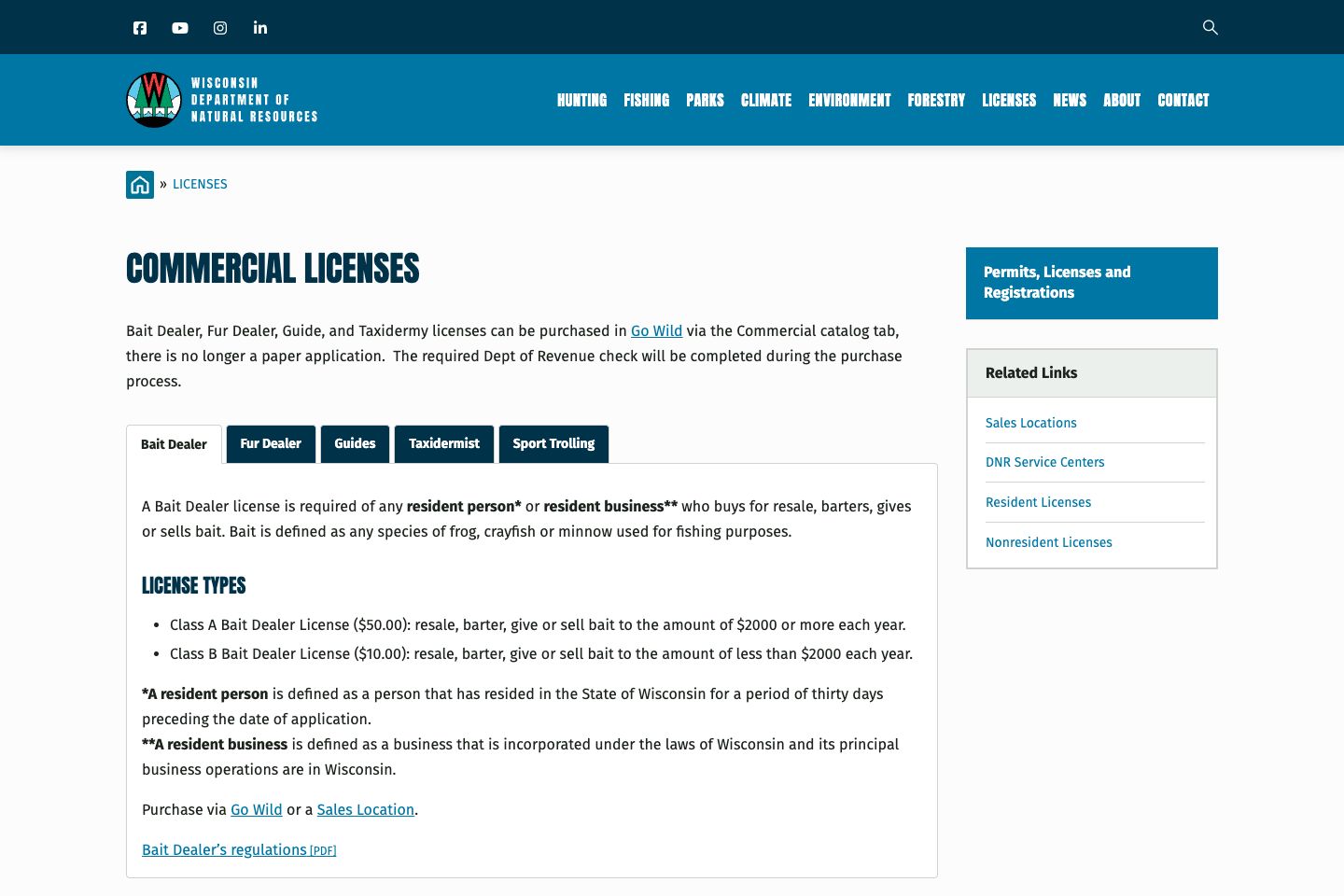
Deer hunting outfitter licensing rules differ in every state, and some famous deer states barely regulate guides at all. Wisconsin requires a resident guide license to guide, direct or assist another person hunting for pay, while Texas has no statewide hunting-guide license in the usual sense, so hunters there lean on landowner agreements, outfitter reputation and written contracts instead (WI DNR guide license PDF; WI DNR commercial licenses; TPWD commercial licenses). Know which pattern you’re dealing with before you wire a deposit.
Key Takeaways
- Wisconsin: paid hunting guides generally need a resident guide license (WI DNR guide license PDF).
- Texas: TPWD’s commercial license list has fishing guide licenses but no hunting-guide license, so verify land control and contracts instead (TPWD commercial licenses).
- Paid guiding on public land can be banned even where private-land guiding is open. Missouri lists “guiding for pay” among activities prohibited on department areas (3 CSR 10-11.110).
- Ask for license numbers, insurance certificates and a written hunt contract before you pay.
- Your own hunting license and tags are still your responsibility on a guided hunt.
Why do guide licensing rules differ so much?
States weigh consumer protection, wildlife enforcement and rural business freedom differently. Some require exams, first aid and residency. Others treat guiding on private land as ordinary commerce. Comparative roundups are a starting point, but the controlling text is the state statute and commission regulation for the year you hunt (WildWork guide license by state; licensedoutfitters state index).
How does a licensed-guide state like Wisconsin work?
Wisconsin DNR’s guide-license materials say that guiding, directing or assisting another person in hunting for compensation triggers licensing, with age and residency limits. Hunting guide licenses are resident-only (WI DNR guide license PDF; WI DNR commercial licenses).
So if someone offers you a paid Wisconsin deer sit, ask for the guide license details and check that they match DNR’s commercial-license rules. A nonresident influencer selling paid sits in a resident-only state may be out of compliance no matter how good the deer herd is. Ask for the license class in writing (WI DNR guide license PDF).
What should you check in a state with no guide license, like Texas?
Texas deer hunting runs heavily on leases and private ranches. Without a statewide guide license, the burden shifts to you: prove the outfitter actually controls the land, carries insurance and puts promises in writing. TPWD sells fishing guide licenses, but its commercial license list has no hunting-guide license (TPWD commercial licenses). Missouri is similar. MDC’s commercial permit list covers hunting preserves, dog training areas, fur dealers and taxidermists, with no guide permit (MDC commercial permits).
A slick social media page doesn’t replace a contract and a call to the landowner.
Can a paid guide take you on public land?
Often not. Even in states that allow private-land guiding, agencies frequently prohibit or tightly limit paid guiding on wildlife areas, and Missouri’s Wildlife Code says “guiding for pay” is prohibited on department areas and “may not be authorized by a special use permit” (3 CSR 10-11.110). Never assume a booked public-land hunt is legal for a paid guide. Check the property class.
Is an outfitter different from a land broker or a drop camp?
It can be, and it changes which rules apply. Some operations sell access without guiding in the field. That may avoid guide-license triggers in some states while still creating lease-law duties. Ask exactly which service you’re buying so you know which regulations and insurance apply.
Drop camps that provide lodging and a map without daily guiding can fall in a gray zone. Get it clear who handles transport after a recovery, who has access to the cabin and whether other paying parties share the same timber. Shared drop camps create interference fights that pure DIY public land doesn’t.
What should you get in writing before you pay?
Put these in the contract:
- Dates, species and weapon
- Lodging and transportation
- Refund rules for weather and tags
- Who owns the meat and the cape work
- Whether the guide promises a shot opportunity or only access and effort
No ethical outfitter guarantees a specific buck. Ask for a certificate of liability insurance that names the landowner and, when it makes sense, you as certificate holder for the hunt dates. Confirm whether guide professional liability is included. Accidents on steep stands and ATV trails are where that paper matters (WildWork guide license by state).
When you compare outfitters, ask both the same questions: license status, insurance limits, exact acreage, hunter density, shot opportunity history without guarantees and cancellation terms. The cheaper hunt that packs eight strangers onto one ridge is often the louder hunt (licensedoutfitters state index).
What are the red flags when booking a guided deer hunt?
Walk away from no written contract, pressure to wire a big deposit to a personal account, refusal to name the county or ranch until after you pay, a guarantee of a specific Boone and Crockett buck, or jokes about tagging someone else’s deer. Legitimate operations survive slow bookings. Scams need urgency.
Guided hunts sometimes tempt party-hunting abuses and tag swapping. Refuse. You shoot only deer tagged on your own valid license, and a guide who winks at tagging violations is an enforcement risk, not a bargain.
Afterward, keep copies of your license, tags, contract and meat-processing receipts. If an officer questions a guided harvest, paperwork ends the argument faster than stories (licensedoutfitters state index).
Related: Deer lease contracts.
The other side of it
A guide license is a floor, not a quality rating, and plenty of Texas deer hunting runs on leases and private ranches without one. The Texas and Missouri “no guide license” points rest on what the agencies’ license lists leave out, not on a statute that says so. Still, the client who won’t ask for an insurance certificate because it feels rude is the same one who’s surprised the deposit went to a personal account.
Keep reading
Latest deer news
Sources
- WI DNR guide license PDF (dnr.wisconsin.gov)
- Commercial Licenses | | Wisconsin DNR
- Commercial Licenses | Texas Parks and Wildlife
- 3 CSR 10-11.110: General Provisions | Missouri Department of Conservation
- Commercial and Confined Wildlife Permits | Missouri Department of Conservation
- Hunting Guide Licensing by State: All 50 States
- Hunting Guide License Requirements in 33 States | WildWork
Comments