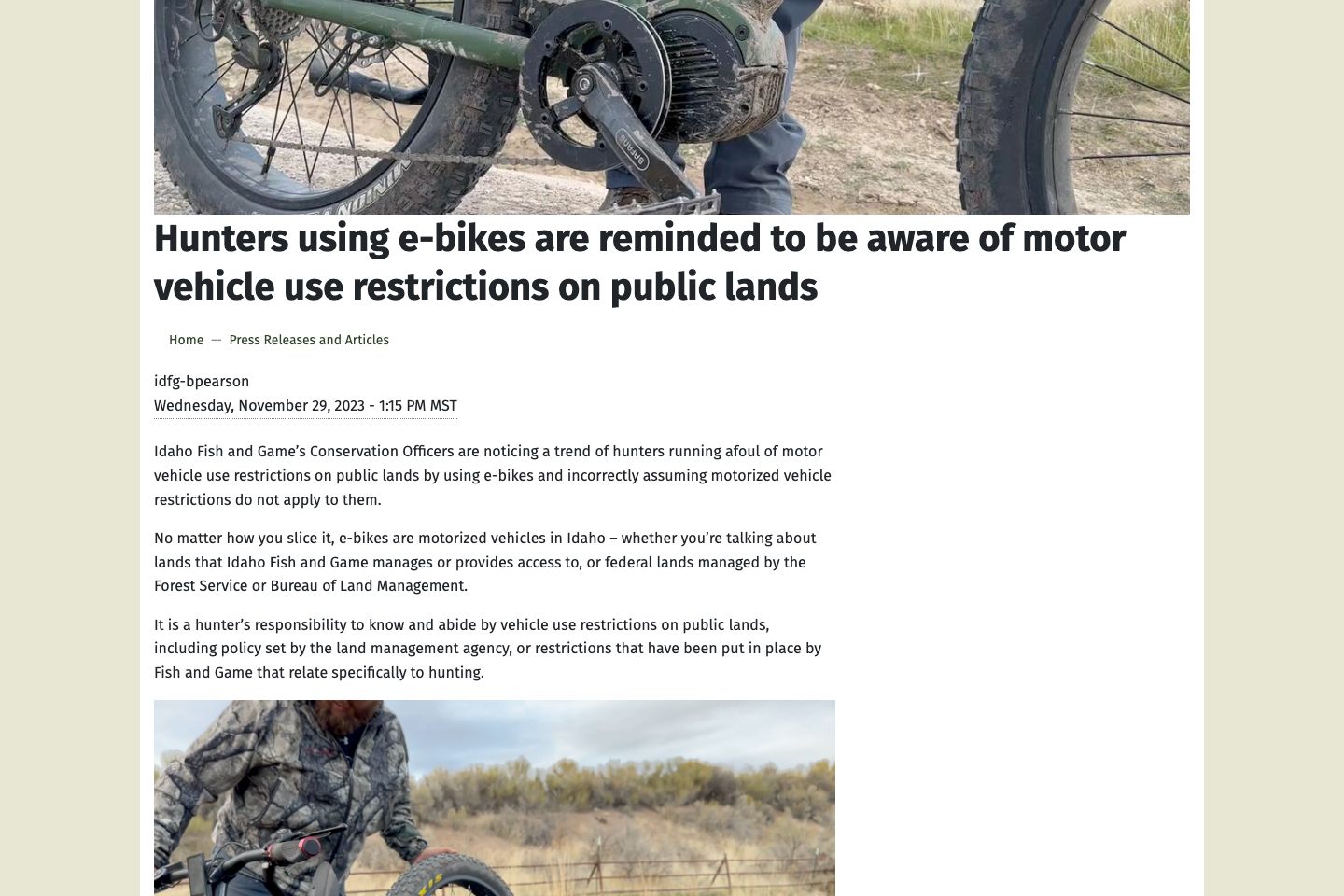
Electric bicycles blur the line between a push bike and a motor vehicle - and wildlife agencies do not all draw that line the same way. Idaho Fish and Game tells hunters that e-bikes are treated as motorized on lands it manages or provides access to, including WMAs, matching many Forest Service and BLM travel rules (Idaho Fish and Game e-bikes). Arkansas Game and Fish limits bicycles including e-bikes to specified areas or designated trails on AGFC-owned WMAs and warns that national-forest MVUMs control e-bike use on forest lands (AGFC general WMA regulations). Hunters who assume “if a bicycle can go, my Class 2 throttle bike can go” get tickets and tear habitat.
Key Takeaways
-
Idaho Fish and Game states e-bikes are not allowed on roads, trails, or areas closed to motorized travel on WMAs and related access properties (Idaho Fish and Game e-bikes).
-
On U.S. Forest Service land, e-bikes are generally limited to roads and trails designated for motorized use or specifically opened to e-bikes (Idaho Fish and Game e-bikes; USFS e-bikes).
-
Arkansas allows bicycles including e-bikes only in specified areas or designated trails on AGFC-owned WMAs as shown on maps and signs (AGFC general WMA regulations).
-
Class 1 pedal-assist, Class 2 throttle, and Class 3 speed-capable bikes are often regulated differently - confirm which class your state uses before you load the truck (Idaho Fish and Game e-bikes).
-
Motor Vehicle Use Maps, not social trails, decide legality on many federal parcels (Idaho Fish and Game e-bikes; AGFC general WMA regulations).
Why agencies care
Quiet motors still cut new paths, widen mud holes, and push into closed roost or nesting cover. Arkansas WMA vehicle language exists to keep motorized traffic on open roads and off levees, food plots, and wildlife developments (AGFC general WMA regulations). Idaho’s reminder followed hunter confusion about whether an e-bike “counts” as motorized (Idaho Fish and Game e-bikes).
Federal travel maps
Idaho’s guidance quotes the practical Forest Service rule hunters meet nationwide: ride only where motorized vehicles or e-bikes are designated (Idaho Fish and Game e-bikes; USFS e-bikes). BLM OHV-open routes may allow e-bikes where other OHVs are allowed, but closed areas stay closed. Download the current MVUM; last year’s pocket map can be wrong.
WMA-specific patterns
Some states treat Class 1 like bicycles and Class 2/3 like motor vehicles. Others ban e-bikes unless posted. Idaho’s WMA line is blunt: if motorized travel is closed, e-bikes are closed (Idaho Fish and Game e-bikes). Arkansas points hunters to public-use maps for where any bicycle may operate (AGFC general WMA regulations).
Never trust a YouTube route overlay over a signed gate.
Hunting ethics on the edge of the rule
Even where Class 1 is legal on a trail, riding through bedding cover at midnight to claim a “remote” oak flat is still pressure. Use legal e-bike range to reduce road hunting miles, not to invent illegal shortcuts (Idaho Fish and Game e-bikes; AGFC general WMA regulations).
Pack-out and disability access
Mobility-impaired permits on some WMAs authorize ATVs under separate rules - that is not a blanket e-bike waiver for every hunter (AGFC general WMA regulations). If you need adaptive access, apply for the permit the agency actually issues.
Pre-hunt checklist
Identify the land manager, pull the WMA brochure and federal MVUM, confirm e-bike class definitions in state traffic or wildlife code, and screenshot the page that allows your ride (Idaho Fish and Game e-bikes; USFS e-bikes; AGFC general WMA regulations). Do this the night before, not at the trailhead with spotty service.
Bottom line
E-bikes on deer WMAs follow motorized-travel logic unless a state explicitly maps bicycle-class exceptions - Idaho and Arkansas show how quickly assumptions fail (Idaho Fish and Game e-bikes; AGFC general WMA regulations; USFS e-bikes).
Class labels on the frame
Class 1 assists only while pedaling and cuts out near 20 mph. Class 2 can propel without pedaling. Class 3 assists at higher speeds. Agencies that split classes usually privilege Class 1 on non-motorized routes and treat throttle bikes like OHVs (Idaho Fish and Game e-bikes). If your bike has a removable governor or dual modes, ride the mode the property allows - and be ready to prove it.
Habitat damage examples officers cite
Deep-rut shortcuts across wet WMA meadows and cut-arounds of earthen berms are why Arkansas keeps bicycles on designated lines and why Idaho equates e-bikes with other motors on closed routes (AGFC general WMA regulations; Idaho Fish and Game e-bikes). A quiet motor does not prevent soil compaction.
Trip-planning stack
- State wildlife WMA brochure. 2) USFS or BLM MVUM. 3) County or state e-bike traffic definition. 4) Screenshot of the paragraph that authorizes your class (USFS e-bikes; Idaho Fish and Game e-bikes; AGFC general WMA regulations). Without all four, leave the e-bike on the rack and walk.
Noise and hunting pressure myths
E-bikes are quieter than ATVs, which tempts hunters to ride closer to bedding. Quiet is not invisible, and illegal quiet is still illegal (Idaho Fish and Game e-bikes; AGFC general WMA regulations). Use legal routes to cut road miles, then walk the last ethical distance.
If a WMA map is silent on e-bikes, default to the motorized rule and call the area manager rather than inventing permission (USFS e-bikes; Idaho Fish and Game e-bikes).
Related: Public land pressure and trail cams and Military base deer hunts.
The other side of it
Two states and a federal page are a thin base for a national default, and the article itself admits some states treat Class 1 bikes like ordinary bicycles. A hunter with bad knees would add that a legal pedal-assist ride to a far bench is how he still hunts public ground at all, not a loophole. Funny how the guys most offended by a quiet e-bike are usually the ones who left a diesel idling at the gate.
Keep reading
Latest deer news
Comments