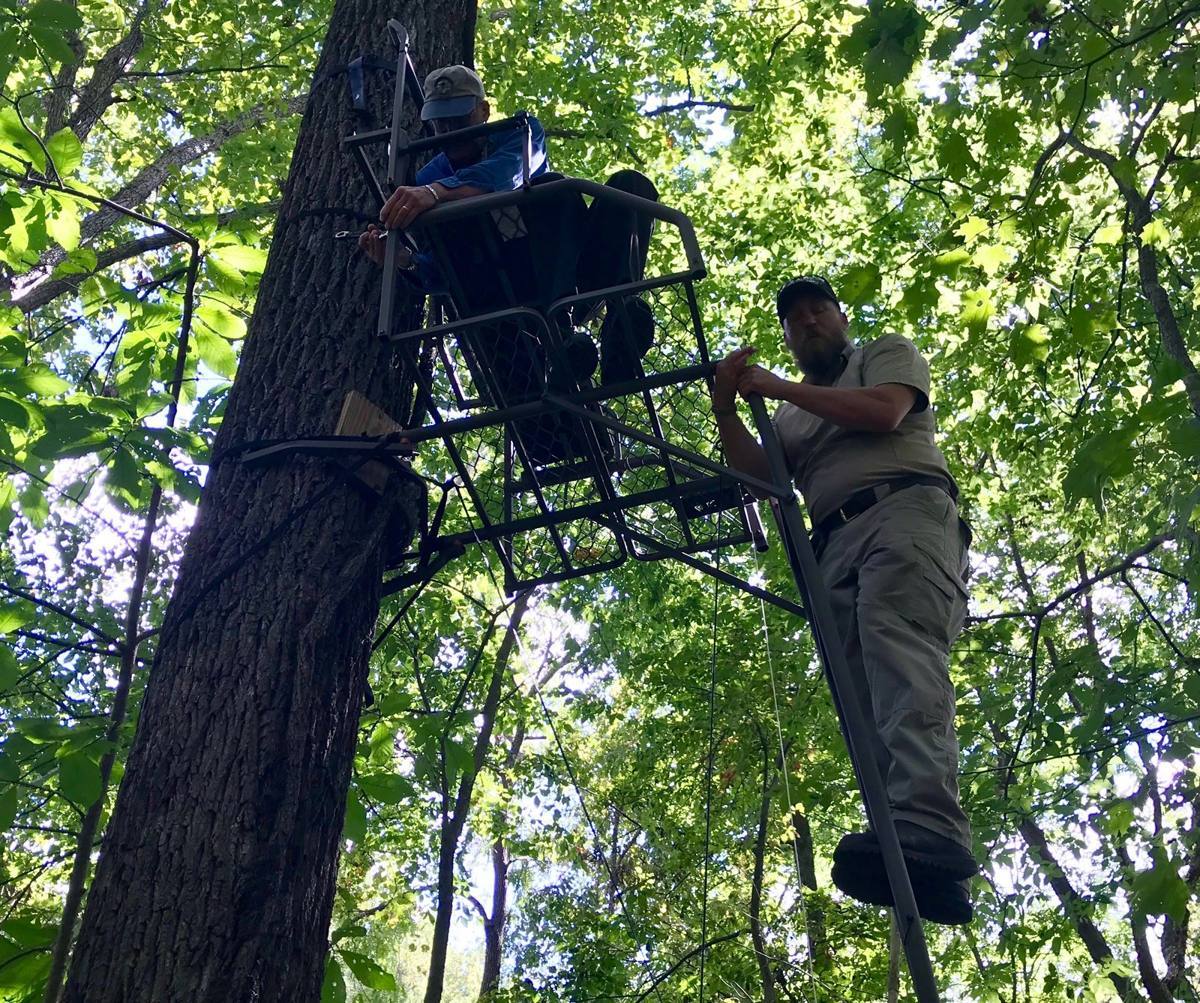
How to hang a tree stand safely comes down to staying attached to the tree the whole time. Before you leave the ground, wear a full-body harness and use a lineman’s belt while you climb and install. Haul the stand up on a rope instead of carrying it, then strap it tight and level. Millennium’s hang-on manual puts it bluntly: “ALWAYS use a pull-up (hoist) rope to pull your treestand up to the desired installation height” (Millennium M-150 manual). Below are the general steps, drawn from that manual, the Treestand Manufacturers Association (TMA) and state wildlife agencies. Your stand’s own manual comes first.
Key Takeaways
- Practice at ground level first. TMA says to practice “installing and using your treestand at ground level and with a responsible adult present.”
- Pick a “live, straight tree that fits within the size limits recommended in your tree stand’s instructions,” per Minnesota DNR. TMA adds: “Never select a leaning tree.”
- Stay connected. Wisconsin DNR says a lifeline “keeps you connected from the time you leave the ground to the time you get back down.”
- Keep three points of contact while climbing, and use a haul line for gear and your unloaded gun or bow.
- Don’t leave it up all season. TMA says “Never leave a treestand installed for more than two weeks.”
Before you go: gear and practice
You need the stand, a climbing system (sticks, steps or a ladder section), a full-body fall arrest harness with a lineman’s belt, a haul rope and, ideally, a lifeline. TMA’s guidelines say to “ALWAYS read and understand the manufacturer’s WARNINGS and INSTRUCTIONS before using a treestand and Full Body Fall Arrest Harness System (FBFAHS) each season” (TMA).
Practice in the yard. TMA recommends practicing in your harness “in the presence of a responsible adult” and learning “what it feels like to hang suspended in the harness at ground level.”
Step 1: Pick the tree
Millennium’s manual says to “Select a straight healthy tree, one devoid of dead branches,” between 9 and 22 inches in diameter at installation height. That range is for its M-150. Your stand’s limits may differ. The manual also says “DO NOT use this product on any tree that does not allow for a level standing platform” (Millennium).
Step 2: Install your climbing system
Set up your sticks or steps per their own manual. Climb with three points of contact. Wisconsin DNR defines that as “two hands and one foot or two feet and one hand at all times” (Wisconsin DNR). Millennium’s diagram shows the climbing system extending at least 24 inches above the standing platform, so you step down onto the stand rather than up. For stick spacing, see our guide to climbing stick section length and spacing.
Step 3: Tie in and climb
Put on your harness and attach the lineman’s belt around the tree. Millennium says “Both sides of the lineman belt must be tightly cinched down to the lineman belt loops.” Tie your haul rope to the stand and keep the tag end with you, not in your hand. Climb to installation height and “re-check to ensure your lineman belt is properly secured to you and the tree” (Millennium).
Step 4: Mount the strap or receiver
On the M-150, you wrap the receiver’s strap around the trunk “making certain the receiver is facing upwards,” hook the loop and ratchet it tight. With “the M-102S receiver level and the strap untwisted,” ratchet out the slack. The manual says to “Make certain you have at least two (2) wraps (turns) of webbing around the ratchet spool (barrel).” Other stands use a chain or different bracket, so follow your manual.
Step 5: Haul up the stand and hang it
Pull the stand up with the rope. On the M-150, “With the M-102S receiver firmly installed, hoist your treestand up using the previously installed hoist rope,” seat the stand’s tongue in the receiver and insert the clip. Then lower the platform. The manual warns: “DO NOT use your treestand if the contacts are not firmly engaged with the tree trunk” and “Failure to engage the lower tree contacts will result in an unsafe condition which will lead to treestand failure” (Millennium). Add the bottom ratchet strap and check the platform is level.
Step 6: Switch to your tree tether and haul up gear
Once you’re seated, attach your harness tether above your head. Wisconsin DNR says to “keep your tether line short,” because “The tether is designed to keep you in the seat, not to catch you after you fall.” Then use a haul line: “Always use a haul line to raise and lower your unloaded firearm or bow into and out of the stand” (Wisconsin DNR). Minnesota DNR adds: “Before descending, lower your equipment on the opposite side of the tree” (Minnesota DNR).
Step 7: Plan for a fall
Wisconsin DNR warns that “Suspension trauma can happen in less than 20 minutes and can be fatal.” Carry a phone on your body and tell someone where you’ll be.
How high should you hang a tree stand?
There’s no single right height. Minnesota DNR says “The recommended height for an elevated tree stand is less than ten feet above the ground.” If you go higher, the harness and lifeline matter more. TMA’s advice: “If you start thinking about how high you are, don’t go any higher.”
FAQ
Can you hang a tree stand by yourself? Many hunters do. TMA recommends practicing with “a responsible adult present.”
How long can I leave a tree stand up? TMA says no more than two weeks.
What size tree do I need? Check your manual. Millennium’s M-150 lists a 9 to 22 inch diameter.
Do I need a lineman’s belt? For hang-ons, Millennium says yes during installation.
The other side of it
Some hunters say lineman’s belts and lifelines slow them down, and on a quiet November morning, every minute and every clank counts. Fair. Practice at home until the gear is quick and quiet. But the hunter who skips the belt to hang it real quick is betting on the one stretch of the job when both hands are busy.
Keep reading
Wisconsin's biggest bucks in the record book →
Latest deer news
Sources
- Millennium M-150-SL Lock-On Treestand with M-102S Receiver Instruction Manual, Millennium Treestands
- Treestand Safety Guidelines, Treestand Manufacturers Association
- Tree Stand Safety, Wisconsin Department of Natural Resources
- Tree stand safety, Minnesota Department of Natural Resources
Comments