A broadhead arrow is a hunting arrow tipped with a bladed head instead of the smooth, bullet-shaped field point you practice with. The field point punches a hole in foam. The broadhead cuts a wound channel through a deer, and in every state we checked it is the only arrowhead you may legally hunt big game with. The real decisions are which design (fixed, mechanical or hybrid), how wide a cut, how heavy a head, and whether your state’s rulebook agrees with your choice. We cover all four below, plus what the little research that exists says about penetration and sharpness.
Key Takeaways (state rules verified 2026-11-04)
- Hunter education course material puts it plainly: “The only arrowhead that may be used for big game hunting is the broadhead,” and it “must be solidly built and always razor-sharp” (Hunter-Ed, Iowa course).
- The common legal floor is a 7/8-inch cutting width with at least two cutting edges. Oregon, Idaho, Pennsylvania, New York and Alabama all use 7/8. Ohio allows 3/4. Georgia doesn’t restrict cutting diameter at all (agency sources in the table below).
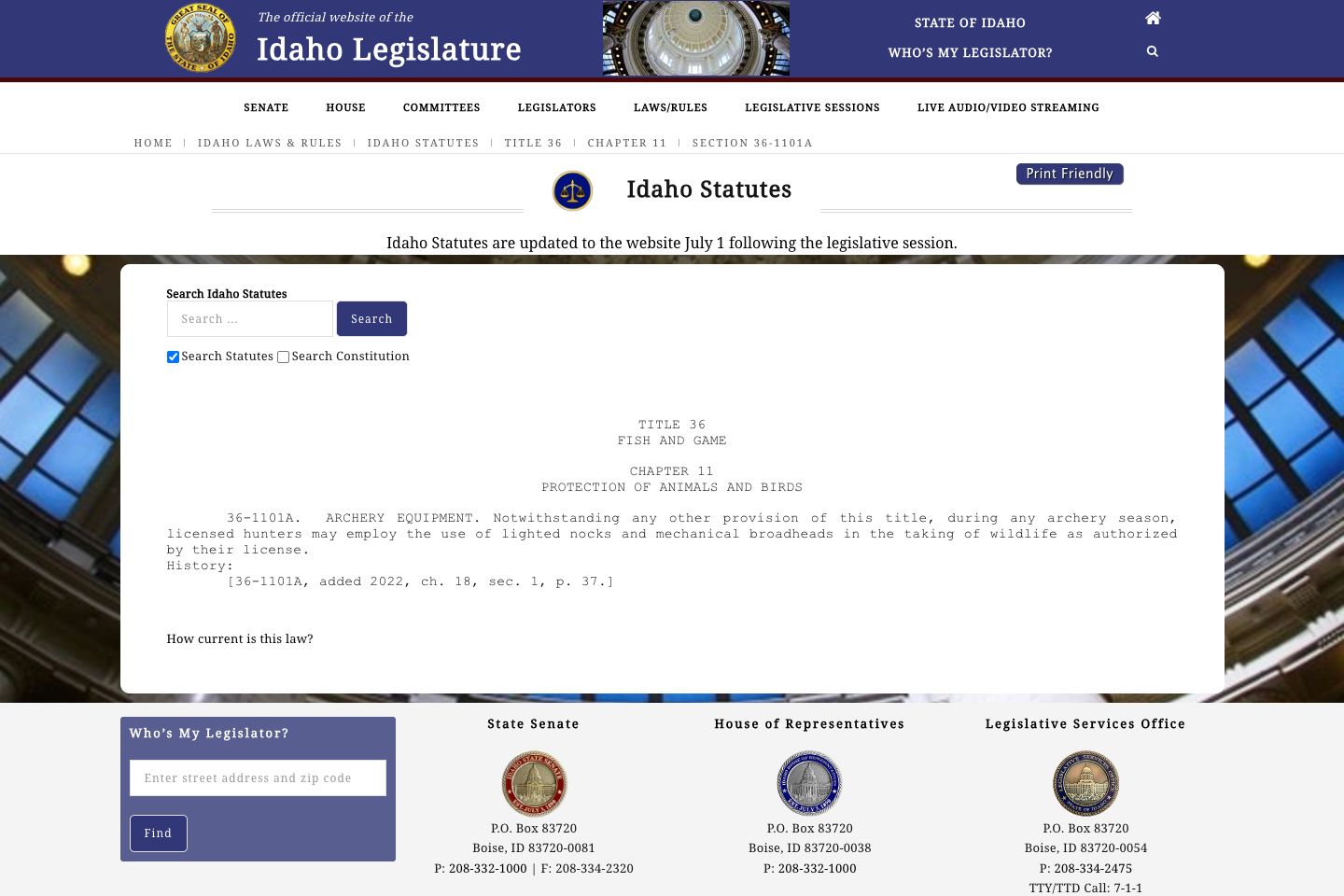
- No state we checked bans mechanical broadheads. Idaho, the last holdout, allowed them by statute in 2022 (Idaho Code 36-1101A).
- Easton recommends 10 to 15 percent FOC (front of center) for hunting arrows (Easton).
- In a Maryland study of 908 deer hit with compound bows and crossbows over 18 seasons, 18 percent were not recovered (Pedersen et al. 2008, SEAFWA).
What is a broadhead arrow actually for?
Cutting. A field point kills nothing but targets. A broadhead opens blood vessels and lungs so the deer expires quickly and leaves a trail you can follow. That is the whole job, and every design argument below is really an argument about how to do that job most reliably.
The head threads into the insert at the front of your arrow, usually in place of a 100-grain field point of the same weight, so the arrow’s spine and balance stay close to what you tuned. Close is not identical, which is why broadheads need their own practice sessions (more on that below).
Fixed, mechanical or hybrid: how does each broadhead work?
Fixed-blade broadheads
The blades are exposed and rigid from the quiver to the deer. Within fixed heads there are two tips. A cut-on-contact head has blades that run all the way to a knife-edge point, so it starts slicing the instant it touches hide. TenPoint describes its EVO-X Montec as “a three-blade, cut-on-contact design” with a 1 1/8-inch cut (TenPoint). A chisel-tip head leads with a hardened point that punches first and lets the blades cut behind it. NAP’s marketing for its Trophy Tip point is the pitch in one line: “bone-shattering toughness” (NAP).
Mechanical (expandable) broadheads
The blades ride folded against the ferrule in flight and swing open on impact. The Iowa hunter education course describes it this way: “Blades are retracted close to the ferrule before the shot. Upon impact, the blades expand to expose the cutting edges.” The same course recommends mechanicals “for use only with bows rated 50 pounds or more” (Hunter-Ed), because opening the blades spends some of the arrow’s energy. Mechanicals come in front-deploy and rear-deploy versions. Ravin, Rage and TenPoint all sell rear-deploying heads with 1 7/8- to 2-inch cuts (Ravin, TenPoint).
Hybrid broadheads
A hybrid pairs a small fixed main blade with expandable secondary blades, so you get a cut-on-contact start and a wider finish. NAP lists its DK4 in that category (NAP crossbow line).
| Design | How it opens the wound | Typical cut | What you trade |
|---|---|---|---|
| Fixed, cut-on-contact | Slices from first contact | about 1 to 1 1/4 in. | Smaller hole; most sensitive to tuning |
| Fixed, chisel tip | Punches, then blades cut | about 1 to 1 1/4 in. | Needs more energy to start the cut |
| Mechanical | Blades deploy on impact | 1 7/8 to 2 in. and up | Energy spent opening; moving parts |
| Hybrid | Fixed blade plus expandables | varies | Complexity of both |
Cut figures are from the manufacturer pages linked above.
Does a bigger cutting diameter kill better?
Here is where the campfire gets loud. The only large body of field data on this question is Dr. Ed Ashby’s work, which began in the Natal Study under South Africa’s Natal Parks Board and, by his count, covers “several hundred arrow shots on real game animals” (Ashby, Arrow Lethality Part I). His Part III conclusion is blunt: “There is no correlation between broadhead size, number of blades or ‘cut area’ and the percentage of killing hits,” while “the deeper an arrow penetrates, the more likely it is to kill.” Across all hit placements, he reports single-blade heads averaged “41 percent more penetration than three blade heads” (Ashby, Arrow Lethality Part III).
Two honest caveats. Those animals were African plains game and buffalo, not 150-pound whitetails, and the reports are one researcher’s data published by his own foundation, not peer-reviewed studies. The Ashby Bowhunting Foundation, which now publishes them, says plainly that it favors fixed heads (ABF article series via DSC).
So what should a deer hunter take from it? Penetration is the thing to protect. A two-inch mechanical through both lungs of a broadside doe is a dead doe. The same head on a quartering buck’s shoulder is where the arguments start.
How much should a broadhead weigh, and what is FOC?
Nearly everything on the shelf is 100 grains, with 125 the common step up (NAP’s Hellrazor, for one, comes in both: NAP). Pick the weight your arrows were spined for, and know that going heavier up front weakens the dynamic spine.
Head weight also sets your FOC, which Easton defines as “the percentage of the arrow’s total weight that is located in the front half of the arrow.” Easton’s formula: measure the balance point from the nock throat, subtract half the arrow’s length, divide by the length, multiply by 100. Its guidance is “10-15% F.O.C. for hunting setups.” Too much and the arrow “will shed its trajectory quicker and nose-dive”; too little and it “can fly erratically” (Easton). Ashby’s 2024 ranking puts forward-of-center weight third among his twelve penetration factors, behind structural integrity and arrow flight (Ashby, 2024 Terminal Arrow Performance Update).
One state writes a floor into law: Idaho requires an arrow and broadhead “with a combined total weight” of at least 300 grains (IDAPA 13.01.08.410). Most whitetail setups clear that easily, but it tells you where agencies think “too light” starts.
Why do broadheads fly differently from field points?
Because a fixed blade is a wing. Any misalignment between the arrow’s true center and the head turns those blades into steering fins, and the faster the arrow, the more they steer. The Ashby Foundation argues the fix is tuning, not giving up on fixed heads: the authors write that the “prevalence of mechanical broadheads led to a reduction in the quality of tuning,” and that the claim “fixed blade broadheads are inaccurate” is “simply not true” (ABF via DSC).
What does tuning look like at camp? Spin the arrow on its tip and watch for wobble (TenPoint says its Montec is “100% spin tested to ensure perfect broadhead-to-shaft alignment,” which tells you how much alignment matters: TenPoint). Shoot a broadhead and a field point at the same spot from 20 and 40 yards. If the broadhead groups left, your rest or arrow spine is pushing it there. Fix the bow until both hit together. Only then do you have a reason to trust the pin.
Mechanicals fly closer to field points out of the box because the blades are tucked. That convenience is exactly why some hunters skip the tuning and find out at the worst moment that “close” wasn’t close.
How sharp is sharp enough?
Sharper than you think. Ashby’s edge work is about clotting as much as cutting: a “thin, smoothly honed, truly sharp cutting edge” damages fewer vessel-wall cells, which delays coagulation and keeps the trail open (Ashby, Getting an Edge on Success, 2009). His 2024 update credits a “beard-shaving sharp, honed and stropped edge” with a 26 percent penetration advantage over a filed edge in fibrous tissue, and 60 percent or more over serrated edges (Ashby, 2024 update). Same caveats as above, but nobody has published data saying dull is better.
For the bigger picture on how often arrows fail, two peer-reviewed wildlife-agency studies are worth knowing. At Naval Support Facility Indian Head, Maryland, trained bowhunters hit 908 deer with compound bows and crossbows from 1989 to 2006 and failed to recover 162, an 18 percent wounding rate, with “no difference in deer recovery metrics between compound bow and crossbow users” (Pedersen et al. 2008). An Oklahoma study of radio-collared bucks hunted with recurves and longbows found 11 of 22 deer shot were not recovered, though only 3 of the 22 died unrecovered (Ditchkoff et al. 1998). Neither study isolates broadhead type. Both say the shooter matters most.
Is your broadhead legal where you hunt?
This is the part the shop pages skip. Minimum cutting width, number of edges, barbed-head bans and arrow weight all vary by state, and the agency, not the manufacturer, decides. We read these rules on the official source on November 4, 2026.
| State (agency) | Rule for the current season | Mechanicals | Source |
|---|---|---|---|
| Oregon (ODFW), 2026 regs | “Broadheads must be unbarbed and at least 7/8” wide.” 40 lb minimum draw. | Moveable blades that “fold/collapse when withdrawn are not considered barbed.” (ODFW’s 2017 release for the 2018 regs had called mechanical blades “not lawful,” so this is a change worth confirming with ODFW.) | ODFW 2026 regulations, OAR 635-065-0720, ODFW 2017 release |
| Idaho (IDFG) | Broadheads under 7/8 inch unlawful; arrow and broadhead at least 300 grains combined; no barbed heads; 40 lb minimum draw. | Legal since 2022: “licensed hunters may employ the use of lighted nocks and mechanical broadheads.” | Idaho Code 36-1101A, IDAPA 13.01.08.410 |
| Pennsylvania (PGC), 2026-27 | Broadhead “outside diameter or width of at least 7/8 inch,” no longer than 3.25 inches; bow at least 35 lb peak draw. | Not restricted in the rule. | 58 Pa. Code 141.43 |
| Ohio (ODNR), rule eff. 7/6/2026 | At least two cutting edges measuring at least 3/4 inch wide; longbow at least 40 lb; no explosive or poisoned arrows. | Not restricted in the rule. | OAC 1501:31-15-11 |
| New York (DEC), 2026 guide | Unlawful: “arrowheads less than 7/8 inches at the widest point or with less than 2 sharp cutting edges,” and barbed heads; bows under 35 lb. | “Broadheads with mechanical blades are legal if the blades freely swing into a nonbarbed position.” | DEC 2026 hunting guide |
| Alabama (ADCNR) | Minimum cutting diameter 7/8 inch with two sharpened edges; bows at least 30 lb peak tension. | Not restricted in the rule. | Ala. Admin. Code 220-2-.03, 2026 Alabama digest |
| Georgia (DNR), table updated April 2023 | Broadhead required for deer; “Broadhead Cutting Diameter: Not Restricted”; cutting edges not restricted. | Not restricted. | Georgia DNR equipment table |
If your state isn’t here, we haven’t read its rule yet. Your agency’s current digest is the answer, not a forum.
Which matters more for the deer in front of you, a wider cut or a deeper one? Decide that before the season, not when the buck is quartering away.
Related reading on RAD:
The other side of it
The case for the big mechanical is not silly. A whitetail is thin-skinned and light-boned, modern compounds carry plenty of energy, and a two-inch hole leaves the kind of blood trail that gets deer found by hunters who are not expert trackers. The Ashby data came from much tougher animals, and the Maryland study found trained hunters recovering deer at the same rate regardless of the bow in their hands. Then again, the guy quoting kinetic energy numbers at the check station is usually the same one who hasn’t shot a broadhead into anything but a deer since 2019.
Keep reading
Latest deer news
Sources
- Common Types of Arrowheads: Broadheads | Iowa Hunter Safety Course
- Section 36-1101A – Idaho State Legislature
- WHAT IS F.O.C. AND HOW DOES IT AFFECT ARROW FLIGHT? -
- Wounding Rates of White-tailed Deer with Modern Archery Equipment
- TenPoint (tenpointcrossbows.com)
- NAP (newarchery.com)
- Mechanical Broadhead | Titanium Alloy | Ravin Crossbows
- TenPoint (tenpointcrossbows.com)
- NAP crossbow line (newarchery.com)
- Ashby Bowhunting Reports — Ashby Bowhunting Foundation
- Rethinking Arrow & Broadhead Performance: Article 3 - Dallas Safari Club
- NAP (newarchery.com)
- Idaho Admin. Code r. 13.01.08.410 - UNLAWFUL METHODS OF TAKE - GENERAL | State Regulations | US Law | LII / Legal Information Institute
- Wounding Rates of White-tailed Deer with Traditional Archery Equipment
- Oregon Legal Hunting Weapons for Game Mammals | eRegulations
- OAR 635-065-0720 – Bows and Arrows — Requirements
- Commission adopts 2018 Big Game Regulations
- 58 Pa. Code § 141.43. Deer seasons.
- Rule 1501:31-15-11 - Ohio Administrative Code | Ohio Laws
- Big Game Hunting - New York Hunting | eRegulations
- Ala. Admin. Code r. 220-2-.03 - Legal Specifications For Bow And Arrow | State Regulations | US Law | LII / Legal Information Institute
- Alabama Legal Arms & Ammunition for Hunting | eRegulations
- Georgia DNR equipment table (gadnrle.org)
Comments