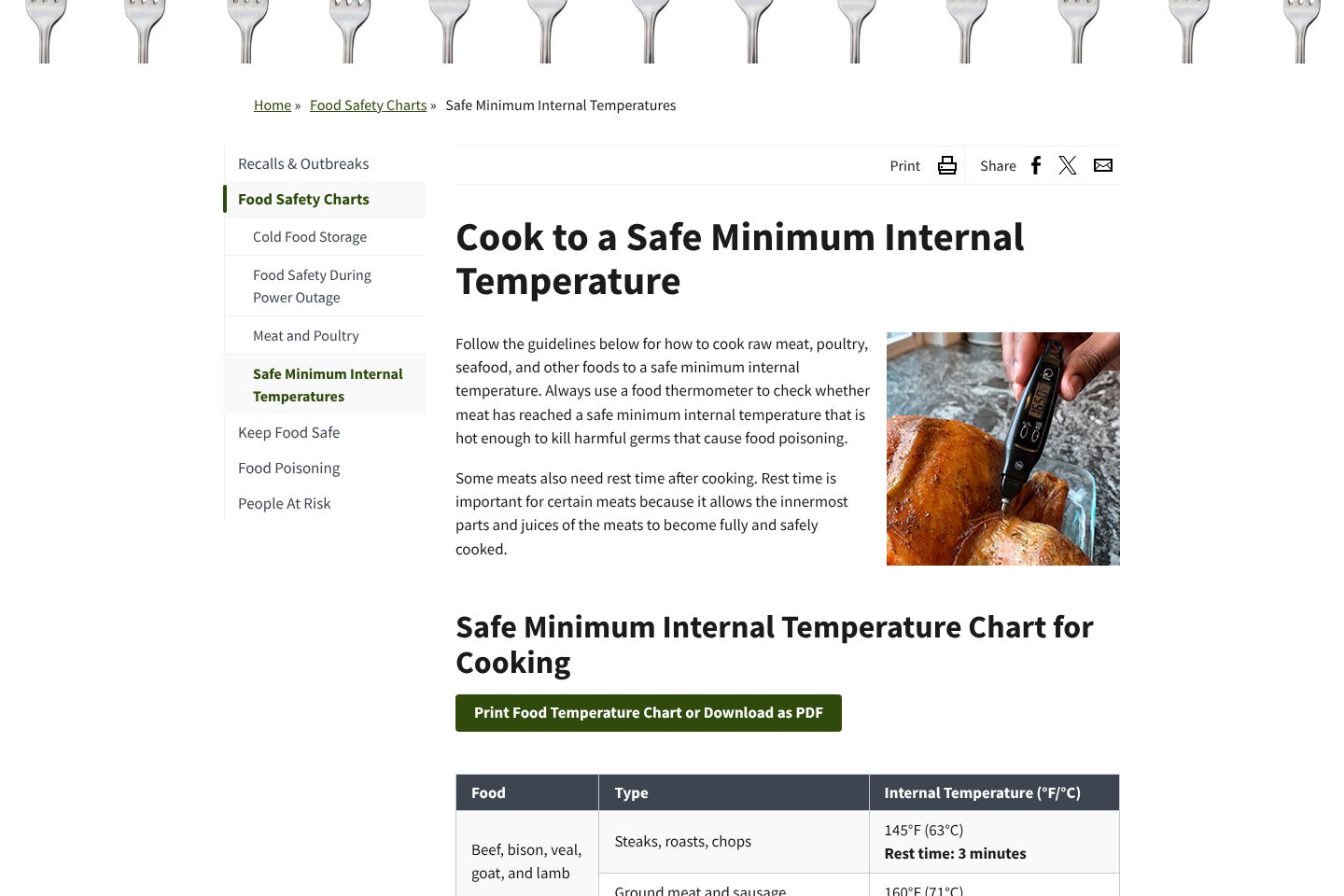
NDSU’s sausage guide covers emulsion-style products where bind fails if meat is warm, fat smears, or lean wild meat lacks enough fat (NDSU Extension FN176). Deer bologna that weeps fat caps or crumbles usually failed temperature control during chopping or used too-lean trim (NDSU Extension FN176). Fix those process faults, then still cook to the published internal temperature (NDSU Extension FN176). FoodSafety.gov’s 160 deg F line covers many ground venison finishes (FoodSafety.gov).
Key Takeaways
- Keep meat max 40F during emulsion work (NDSU Extension FN176)
- Add fat per recipe (NDSU Extension FN176)
- Thermometer essential (NDSU Extension FN176)
- Sanitize choppers and stuffers (NDSU Extension FN176)
- Ground/venison 160F when applicable (FoodSafety.gov)
- Do not taste-test raw emulsion (FSIS Food Safety Basics)
Fat smear
Warm fat liquefies and coats proteins so the batter cannot bind - chill bowls and metal parts (NDSU Extension FN176).
Lean deer problem
Straight deer without pork or beef fat often fails bologna texture; follow a published fat addition (NDSU Extension FN176).
Water and binder
Extension recipes specify ice or water additions - freestyle water wrecks bind (NDSU Extension FN176).
Cook
Probe the center of the largest chub (NDSU Extension FN176; FoodSafety.gov).
Chill after
Cool finished bologna under FSIS leftover rules if not canned by a validated schedule (FSIS Food Safety Basics).
Handwashing
Wash 20 seconds when switching tasks (NDSU Extension FN176).
Instrument checks
Before running Venison Bologna Bind and Fat Cap Failures, verify every thermometer for this topic against an ice-water bath near 32 deg F and, at known elevation, a boiling-water check. Write the offset on the probe cable. The batch fails when the smokehouse display, the handheld stem, and the drawer dial disagree and nobody records which reading closed the batch. Replace tools that drift more than a few degrees between checks rather than building a folklore offset chart.
Bottom line
Fix deer bologna bind with cold meat and adequate fat from NDSU-style formulas, then verify the cook with a thermometer (NDSU Extension FN176).
The other side of it
A hunter who likes his deer lean has a fair point: a crumbly chub that hit its cook temperature is a texture complaint, not a safety failure, and blending in pork or beef fat means less deer in every slice. The article also leans on a single extension guide for nearly every fix, so treat the formula as a starting point. Then again, the guy bragging about his all-deer bologna is usually the one handing out slices nobody finishes.
Keep reading
Latest deer news
Comments