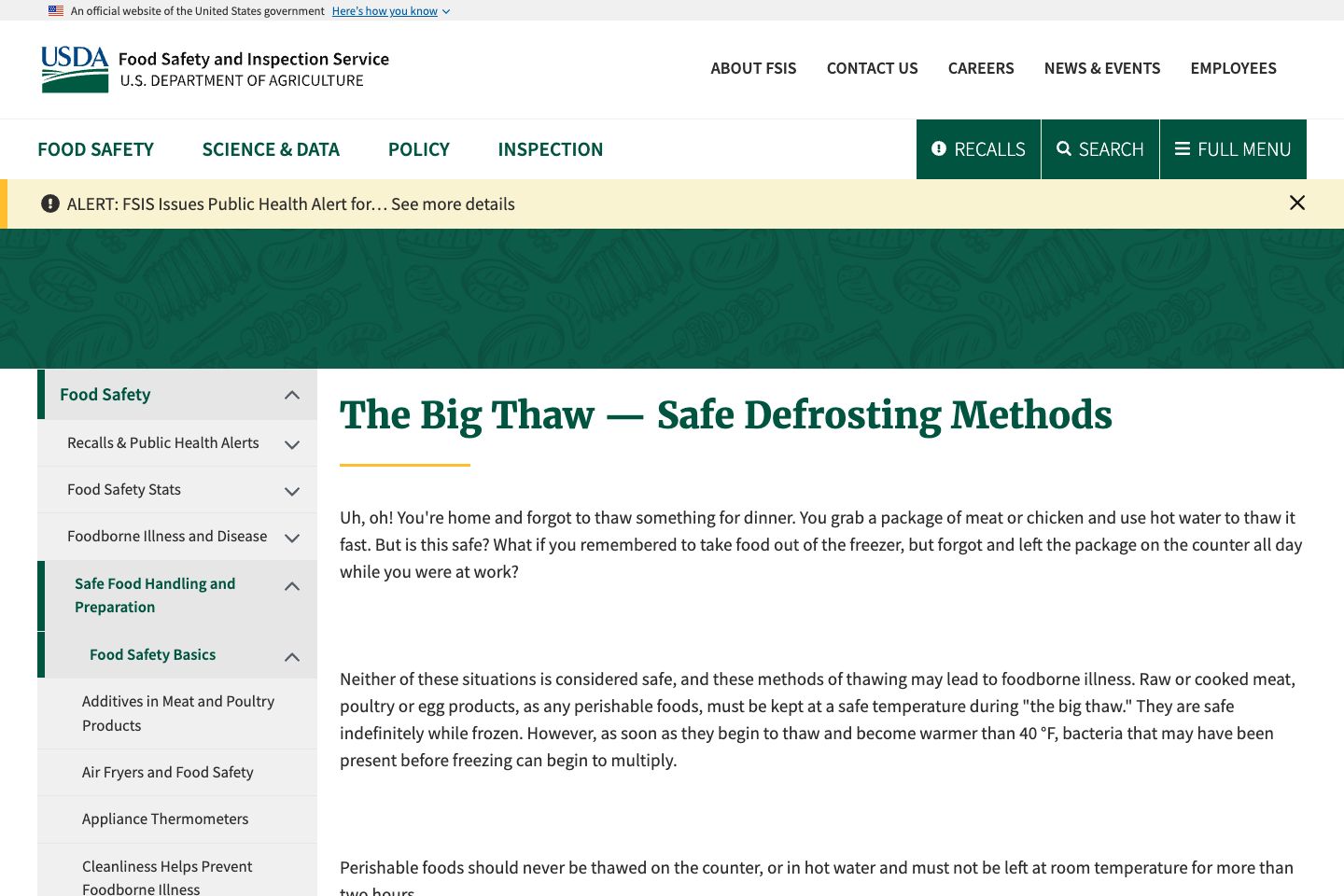
USDA FSIS’s Big Thaw page ranks safe defrosting methods and bans the ones hunters still try in garages and on counters. Perishable meat is safe indefinitely while frozen, but once it warms above 40°F, bacteria that survived freezing can multiply; FSIS forbids counter and hot-water thaws and caps room-temperature holds at two hours (U.S. Department of Agriculture). The Danger Zone is 40-140°F (U.S. Department of Agriculture). Three safe methods remain: refrigerator, cold water, and microwave (U.S. Department of Agriculture). Refrigerator thawing keeps meat at or below 40°F the whole time; plan about a day for a pound of ground meat and at least a day per five pounds for large roasts (U.S. Department of Agriculture). After a fridge thaw, ground meat and stew meat keep an extra day or two before cooking; red-meat roasts, chops, and steaks keep three to five days; fridge-thawed food may be refrozen without cooking though quality can drop (U.S. Department of Agriculture). Cold-water thawing needs a leak-proof bag, water changes every 30 minutes, and immediate cooking when thawed; cook before refreezing (U.S. Department of Agriculture). Microwave thawing also requires immediate cooking and cooking before any refreeze (U.S. Department of Agriculture). Cooking from frozen is safe and takes about 50 percent longer (U.S. Department of Agriculture). Penn State Extension echoes refrigerator, cold running water, or microwave-then-cook thawing for venison and warns against refreezing thawed products when quality already slipped (Penn State Extension).
Key Takeaways
- Never thaw on counter/hot water; ≤2 hours room temp (U.S. Department of Agriculture).
- Best: refrigerator at ≤40°F (U.S. Department of Agriculture).
- Cold water: leak-proof bag; change water q30 min; cook immediately (U.S. Department of Agriculture).
- Microwave: cook immediately after (U.S. Department of Agriculture).
- Cooking from frozen is safe (~50% longer) (U.S. Department of Agriculture).
- PSU agrees on fridge / cold water / microwave+cook (Penn State Extension).
Risk ranking in plain language
Lowest risk: refrigerator. Medium attention: cold water with timed changes. Higher mishap risk: microwave if you forget to cook immediately. Unacceptable: counter, hot water, garage, car, porch (U.S. Department of Agriculture).
Why the outer layer fails first
FSIS notes the package center can stay frozen on the counter while the outer layer enters the Danger Zone and grows bacteria rapidly (U.S. Department of Agriculture).
Refreeze rules differ by method
Fridge thaw may be refrozen without cooking; cold-water and microwave thaws must be cooked before refreezing (U.S. Department of Agriculture).
Banned locations list
FSIS explicitly says never thaw in a garage, basement, car, dishwasher, plastic garbage bag, on the counter, outdoors, or on the porch (U.S. Department of Agriculture).
Cold-water timing ballpark
About a pound may thaw in an hour or less in cold water; 3-to-4-pound packs may take 2-3 hours with 30-minute water changes (U.S. Department of Agriculture).
Venison package sizes
Meal-size packs PSU recommends freeze and thaw faster than whole quarters, which reduces time in any borderline temperature (Penn State Extension; U.S. Department of Agriculture).
Planning ahead beats emergency thaws
Fridge thawing is slow on purpose because it never leaves 40°F; move packs from freezer to fridge a day early for burger and several days early for roasts (U.S. Department of Agriculture). If you forgot, cook from frozen with about 50 percent more time rather than staging a counter thaw (U.S. Department of Agriculture). PSU’s meal-size packaging habit makes those fridge thaws realistic for weeknight venison (Penn State Extension).
Bottom line
Thaw venison in the fridge when you can, use cold water or microwave only with immediate cooking, and never stage a counter thaw in the Danger Zone (U.S. Department of Agriculture; Penn State Extension).
The other side of it
The ranking in the title is the article’s own call. FSIS lists refrigerator, cold water and microwave as safe methods without grading them against each other, so calling the microwave a higher mishap risk is about forgetful cooks, not bacteria. Cooking straight from frozen skips the whole debate at the cost of about 50 percent more time. But the guy who leaves a roast on the porch overnight because it’s cold out isn’t reading rankings anyway.
Keep reading
Latest deer news
Comments