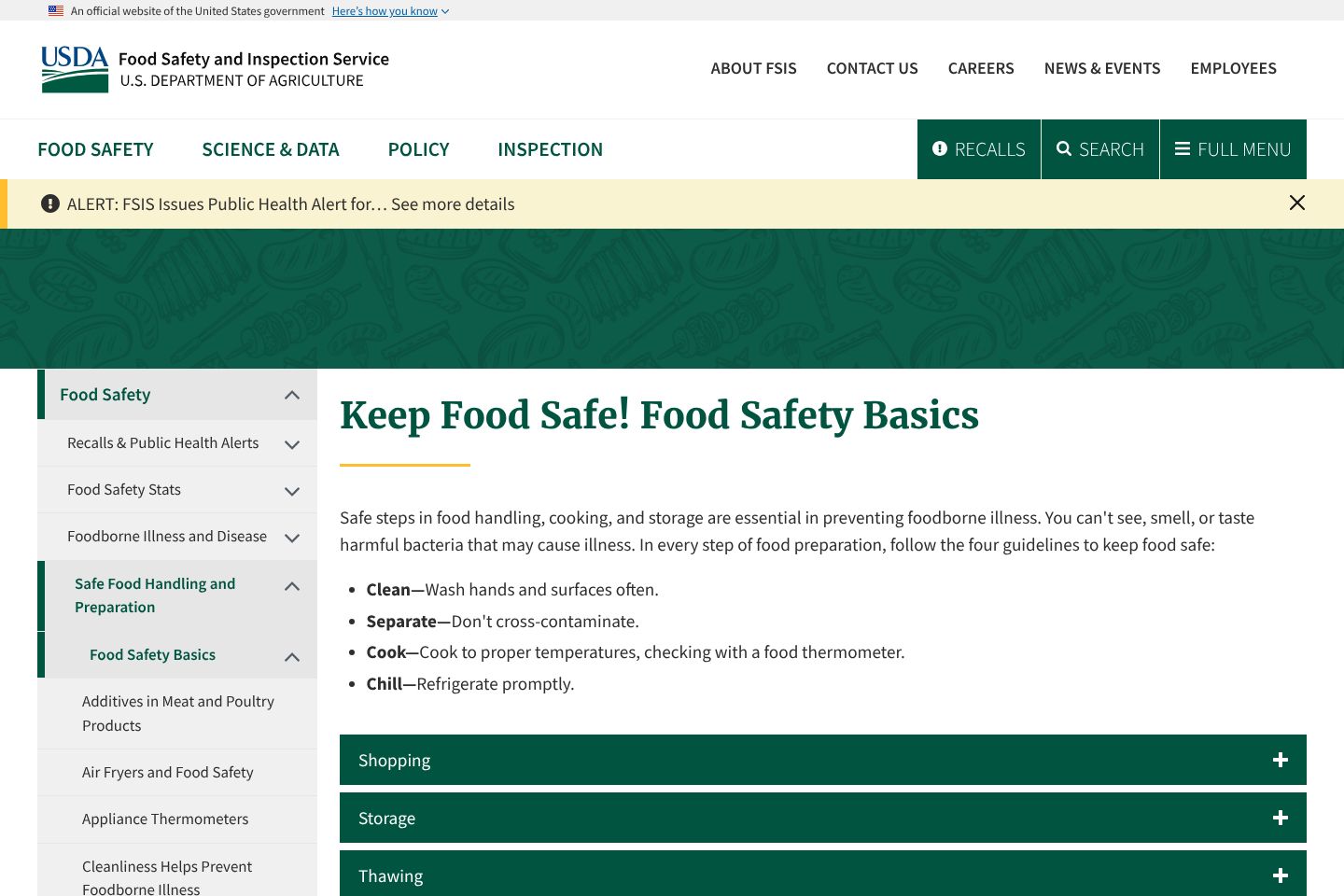
Deer casserole leftovers are a chill-and-reheat problem, not an almost-done freeze guess. FSIS says place leftover food into shallow containers and refrigerate or freeze immediately for rapid cooling, use most cooked leftovers within 3 to 4 days, and reheat leftovers to 165 deg F (FSIS Food Safety Basics). FoodSafety.gov lists leftovers of any type at 165 deg F and meat casseroles at 165 deg F (FoodSafety.gov). Partial-cook-then-freeze only helps if you still finish to those temperatures after thawing - freezing does not sanitize an undercooked center (FSIS Food Safety Basics; FoodSafety.gov).
Key Takeaways
- Cool leftovers in shallow containers promptly (FSIS Food Safety Basics)
- Use most cooked leftovers within 3-4 days refrigerated (FSIS Food Safety Basics)
- Reheat leftovers to 165 deg F (FSIS Food Safety Basics; FoodSafety.gov)
- Meat casseroles: 165 deg F (FoodSafety.gov)
- Perishable food: out no more than 2 hours (1 hour if >90 deg F) (FSIS Food Safety Basics)
- Fridge 40 deg F or below; freezer 0 deg F or below (FSIS Food Safety Basics)
Why shallow pans matter
Deep pots cool slowly through the danger zone; FSIS calls for shallow containers so heat leaves the mass quickly before the fridge door closes (FSIS Food Safety Basics). Split a big deer chili into multiple pans rather than one deep Dutch oven brick (FSIS Food Safety Basics). Rapid cooling is why the shallow-pan rule exists alongside the reheat temperature (FSIS Food Safety Basics).
Partial cook then freeze
If you underbake a venison casserole intending to finish later, freeze promptly after the partial cook cools in shallow pans, then thaw cold and reheat to 165 deg F throughout before serving (FSIS Food Safety Basics; FoodSafety.gov). Do not treat freezer time as a substitute for that final lethality temperature (FoodSafety.gov). Label the pan with the unfinished status so nobody serves it from frozen lukewarm (FSIS Food Safety Basics).
Time and temperature limits
Discard food left out more than 2 hours at room temperature, or 1 hour when air is above 90 deg F (FSIS Food Safety Basics). Refrigerator target is 40 deg F or below; freezer 0 deg F or below (FSIS Food Safety Basics). Those numbers apply to deer casseroles the same as to beef leftovers (FSIS Food Safety Basics). Check appliance thermometers rather than trusting dial art (FSIS Food Safety Basics).
Thawing before the finish bake
FSIS lists refrigerator thawing as the slow safe default, cold-water thawing in a leak-proof bag with water changes every 30 minutes then immediate cook, or microwave thawing followed by immediate cooking (FSIS Food Safety Basics). Finish the casserole to 165 deg F after thaw (FoodSafety.gov). Meat thawed outside the fridge should be cooked before any refreeze (FSIS Food Safety Basics).
Labeling camp batches
Mark freeze date and reheat to 165F on each pan so opening-weekend cooks do not serve lukewarm centers (FSIS Food Safety Basics; FoodSafety.gov). Use within the refrigerated 3-4 day window once thawed and finished if you switch to fridge storage (FSIS Food Safety Basics). Keep raw deer prep boards separate from leftover pans (FSIS Food Safety Basics).
Freezer quality window
FSIS leftover casserole freeze guidance lands around a few months for best quality on similar dishes; safety still hinges on the 165 deg F reheat when you pull the pan (FSIS Food Safety Basics; FoodSafety.gov).
Bottom line
Partial-cook venison casseroles only if you cool in shallow pans, freeze or chill promptly, and still finish to 165 deg F after thaw - matching FSIS leftover and FoodSafety.gov casserole rules (FSIS Food Safety Basics; FoodSafety.gov).
The other side of it
The catch is that none of the FSIS or FoodSafety.gov pages cited here talk about partial cooking at all. They cover leftovers, cooling and a 165-degree reheat, so the half-baked-then-frozen plan is stitched together from rules written for food that was fully cooked the first time, and a hunter could fairly ask why not just finish the dish before freezing it. Meanwhile, the camp cook who judges a thawed casserole by bubbling cheese is gambling with everybody’s ride home.
Keep reading
Latest deer news
Comments