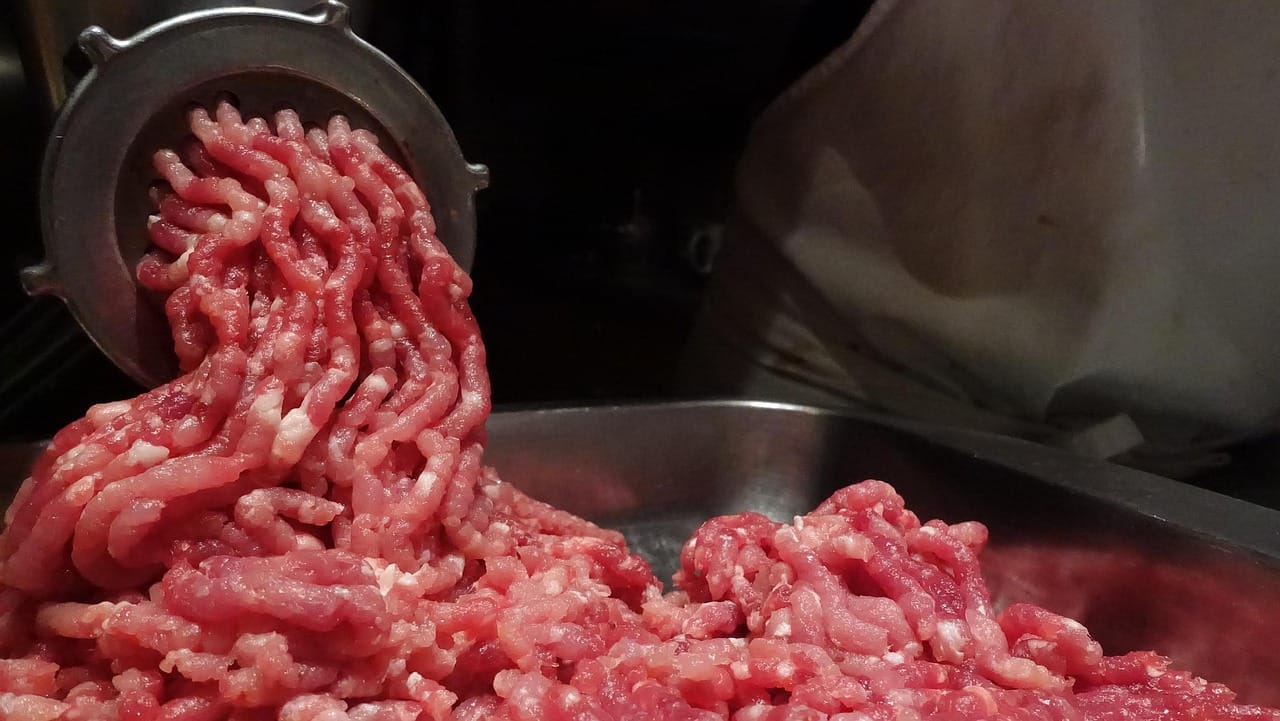
How to make venison breakfast sausage comes down to three things: add fat, season it, and grind it cold. University of Connecticut animal scientists say “Game meats can be substituted for pork or beef in any sausage recipe,” but warn that “a sausage made without any fat will be dry and unpalatable” (UConn Home Sausage Making). Below is UConn’s fresh breakfast sausage formula, adapted for venison using UConn’s own game-meat guidance, plus the food safety steps from extension sources.
Key Takeaways
- Trim all deer fat, then add pork fat. UConn suggests 15 to 20 percent fat.
- UConn’s breakfast seasoning: salt, white pepper, sage, nutmeg and mace.
- Grind coarse, mix in seasoning, then grind fine.
- Keep meat at 40°F or colder while you work.
- Fresh sausage keeps about 3 days in the fridge, per NDSU. Cook it to 160°F.
Step 1: Trim the venison and add pork fat
UConn says “All external fat should be removed prior to grinding,” because the gamey taste “comes from fat, not the meat.” It also notes that “Sausage making is a great way of using less tender cuts and trim pieces,” and that aging the carcass “is not necessary for sausage making.” The fix is pork: UConn says pork or pork fat “(not salted pork fat) is often added with game meat when grinding,” and “It is common to use pork shoulder butt as a source of fat for game sausages.” Its target: “The sausage should have 15 to 20 percent fat content to achieve a desirable texture and flavor.”
As a rough example (our math, not UConn’s): 4 pounds of well-trimmed venison plus 1 pound of pork fat is about 20 percent fat. Pork butt is part lean, so you’d need more of it than straight fat to reach the same percentage. UConn adds that “you will need to experiment with these over time to find what you like best.”
Step 2: Keep everything cold
NDSU Extension says to “Keep meat as cold as possible (40 F or lower) during processing” (NDSU). UConn says an “accurate thermometer is necessary for ensuring that raw meat ingredients do not exceed 40° F.” Dull grinder blades are a problem too: UConn warns “Dull equipment produces excessive heat,” which can melt the fat and smear the grind.
Step 3: Season it
UConn’s “Fresh Pork Breakfast Sausage” uses, for 25 pounds of meat: salt 196 g (7 oz), white pepper 40 g (1.4 oz), sage 15 g (0.5 oz), nutmeg 8 g and mace 8 g. Since UConn says game can be swapped in for pork, use the same seasoning for 25 pounds of your venison and pork fat blend.
For a 5-pound batch, divide by five (our math):
| Ingredient | 25 lb (UConn) | 5 lb |
|---|---|---|
| Salt | 196 g | about 39 g |
| White pepper | 40 g | 8 g |
| Sage | 15 g | 3 g |
| Nutmeg | 8 g | about 1.6 g |
| Mace | 8 g | about 1.6 g |
Weigh spices on a scale. UConn calls “A properly calibrated scale” the “second most important item in sausage making.” For more on salt levels, see salt percentage bands in fresh venison sausage.
Step 4: Grind twice
UConn’s breakfast sausage method: “grind the trimmings through a 1/2 inch coarse plate. Thoroughly mix the meat with seasoning. Grind it again through a 3/8 inch fine plate.” On plates generally, UConn says “1/8 or 3/16-inch holes produce a fine grind.”
Step 5: Patty or stuff
UConn says the sausage “can then be made into patties or stuffed into an 18-22mm sheep casing or hog middle.” NDSU agrees casings are optional: “It is not necessary to stuff fresh sausage meat. It can be left in bulk form or made into patties.” For freezing patties, see venison breakfast sausage freezer patty separators. Clean your gear between batches; see sausage stuffer sanitation.
Step 6: Store and cook
NDSU’s storage table says fresh sausage should be kept refrigerated: “Consume within 3 days or freeze.” UConn says to “Refrigerate or freeze the sausage until used.” This is a raw sausage, so cook it fully. Penn State Extension says to “Cook venison, including jerky, to a minimum internal temperature of 160°F to reduce the risk of food-borne illness” (Penn State Extension). UConn says “sausage cooking must be regulated by temperature and not by time,” so use a thermometer.
FAQ
Can I make venison breakfast sausage without pork? UConn says sausage without fat will be dry. Pork fat is its suggested fix.
What spices go in breakfast sausage? UConn’s recipe uses salt, white pepper, sage, nutmeg and mace.
Does breakfast sausage need curing salt? UConn’s fresh breakfast formula lists no cure. It is a fresh sausage, so it is cooked before eating rather than smoked or dried.
How long does fresh venison sausage last? NDSU says about 3 days refrigerated, or freeze it.
The other side of it
Some hunters say adding pork to venison defeats the purpose, and that a lean all-deer sausage is healthier and more honest. That’s a fair choice, and you can make it. But UConn’s sausage scientists say a fat-free sausage will be dry and unpalatable, and the breakfast table tends to agree. The hunter who grinds pure venison into patties and then drowns them in syrup has fixed the dryness after all, just with sugar instead of fat.
Keep reading
Latest deer news
Sources
- Home Sausage Making, Second Edition (Ehr, Tronsky, Rice, Kinsman, Faustman), University of Connecticut, Department of Animal Science
- The Art and Practice of Sausage Making (FN176, Revised Oct. 2022), NDSU Extension
- Canning and Freezing Venison, Penn State Extension
Comments