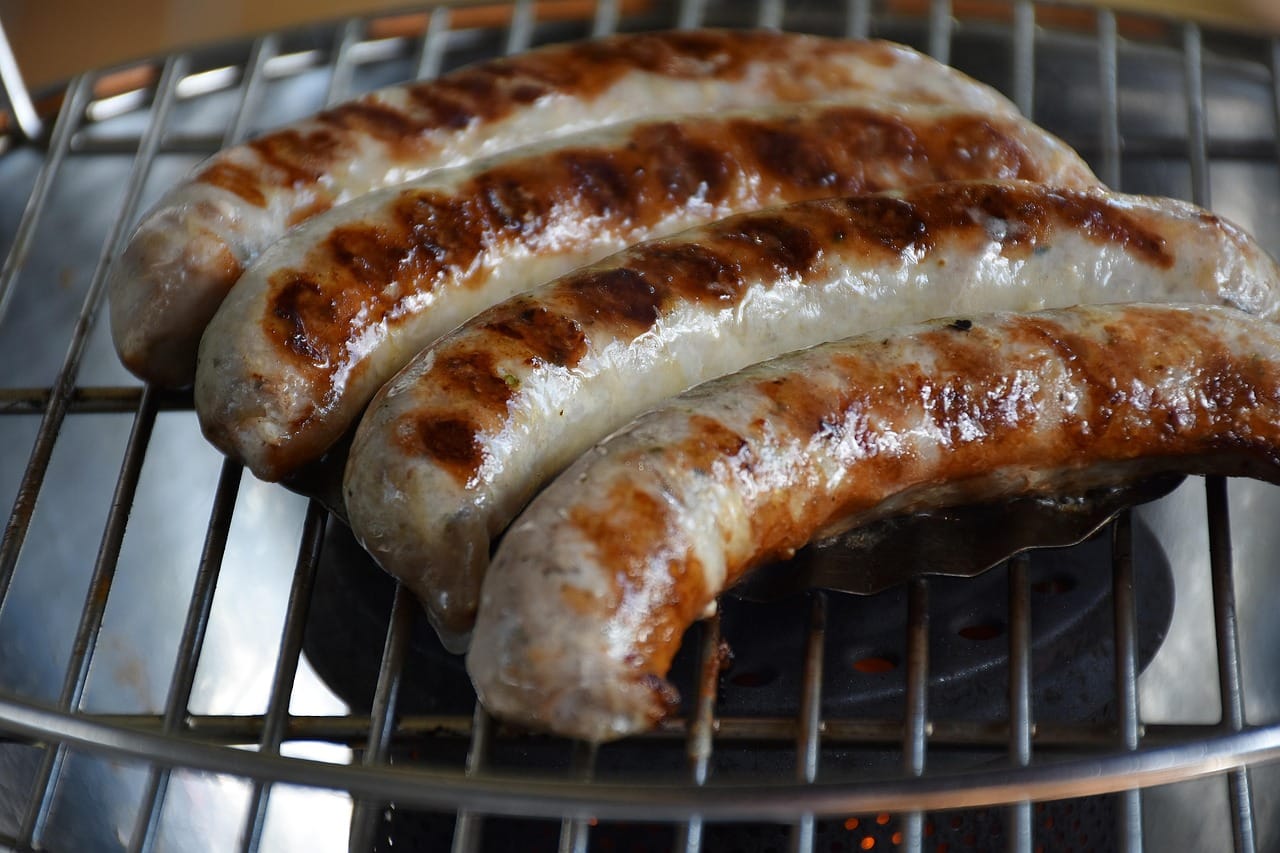
How to make venison brats comes down to three things: enough pork for fat, meat kept ice-cold the whole way through, and a thermometer at the end. Field & Stream’s Wild Chef columnist Jonathan Miles makes his by “grinding equal parts venison roast and pork butt seasoned with classic brat spices, stuffing into soaked casings, then steam-cooking in dark beer” before a hot grill (Field & Stream). Here’s the method, with tips from Field & Stream and a university extension service.
Key Takeaways
- Use about equal parts venison and pork butt. Venison alone makes dry brats.
- Keep the meat and grinder parts near freezing. Warm fat smears.
- Grind twice: coarse plate, then fine.
- Stuff into soaked natural hog casings.
- Cook brats to 160°F internal, our rule for ground venison.
What you need to make venison brats
Field & Stream’s Jack Hennessy says a grinder “allows you to add pork fatback to ground venison for better texture. Without it, venison sausage tends to be dry” (Field & Stream). For links, you’ll also want a sausage stuffer, a scale, casings and a meat thermometer.
Miles’s brat ingredients (about 12 links):
- 1 1/2 lb. venison roast and 1 1/2 lb. pork butt, cubed
- Salt, black pepper, sugar, ground ginger, onion powder, garlic powder, marjoram, mace, ground mustard and caraway
- 1/2 cup milk or cream
- Sausage casings, soaked and rinsed
- Three 12 oz. bottles of strong, dark beer for steaming
Step 1: Get the fat ratio right
Miles uses “equal parts venison and pork butt to keep sausages juicy and balanced.” If you’d rather use pork fatback, Hennessy recommends “30 to 35 percent” fatback by weight with fresh game, and “40 percent pork fatback (by weight)” if you start with frozen, pre-ground venison, because ground meat leaks more juice after thawing.
Mississippi State University Extension, writing about sausage in general, lists the usual mixture as two-thirds “lean and one-third fat,” and adds that you can change the ratio to your liking (MSU Extension). For more on fat choices, see ground venison fat: beef versus pork.
Step 2: Keep everything cold
This is where most homemade sausage goes wrong. MSU Extension says meat should be “chilled to approximately 32°F to minimize fat smearing” and to “Keep meat cold (40°F or lower) during grinding and mixing” (MSU Extension).
Hennessy puts it more bluntly: “You want to work with ice-cold, borderline-frozen meat.” If it warms up, he says to put it back in the freezer “for 30 to 60 minutes” (Field & Stream). Miles freezes the seasoned meat with the grinder’s metal parts for about half an hour before grinding.
Step 3: Season and grind twice
Miles mixes the cubed meat with the spices first, then grinds “with the grinder’s coarse plate, then regrind using the finer plate,” and stirs in the milk or cream with a wooden spoon. MSU Extension also starts with a coarse plate, describing “a one-half to three-fourths-inch” plate for the first grind.
If you use fatback, Hennessy grinds “the pork fat by itself once, then a second time with the ground game and spices” for a more even texture. To check the mix, he says “you should be able to hold a golf-ball-sized ball upside down on your palm without it falling off immediately.” If it falls right away, mix a little longer.
Salt matters. Hennessy’s rule of thumb is “6.8 grams of kosher (non-iodized) salt per pound of sausage.”
Step 4: Stuff the casings
Hennessy uses natural hog casings and says to follow the package directions, “which likely include thoroughly rinsing and soaking in lukewarm water one hour prior to stuffing.” He adds: “It’s better to under-stuff versus overstuff.” Miles twists his into roughly 6-inch links.
Step 5: Cook venison brats to 160°F
Miles steams his brats in dark beer for about 10 minutes until they reach 150°F, then finishes them on a hot grill until golden (Field & Stream). He notes that if you skip the grill and eat them steamed, you should “bring to 160 degrees.”
Our rule for ground venison is simpler: brats are done at 160°F internal, measured with a thermometer, whether steamed, grilled or both. Since brats are part pork, check the thickest link after the grill.
Storing venison brats
MSU Extension says fresh sausage should not sit in the “refrigerator for more than 3 days,” and recommends a freezer “set to 0°F or lower.” Freeze what you won’t cook soon. If you hunt where chronic wasting disease is found, read CDC guidance on CWD and venison before you grind a batch.
FAQ
Can I make venison brats without pork? You can, but Hennessy says venison sausage without added fat “tends to be dry.”
Can I use pre-ground venison? Yes. Hennessy suggests more fat, about 40 percent fatback.
Do I need a binder? It’s optional. Hennessy uses a carrot fiber binder to hold moisture in sausage made from pre-ground game.
The other side of it
Some cooks say brats should be grilled hard over fire, never steamed, and that a beer bath is a crutch. It’s a fair point if you have the patience to cook them slowly. Steaming first just makes hitting 160°F inside easier without burning the casing. The cook who cuts every brat open to check doneness has a thermometer in a drawer somewhere.
Keep reading
Latest deer news
Sources
- How to Make Perfect Venison Bratwurst (Jonathan Miles), Field & Stream
- How to Make Venison Sausage (Jack Hennessy), Field & Stream
- Making Sausage at Home (P2692), Mississippi State University Extension
Comments