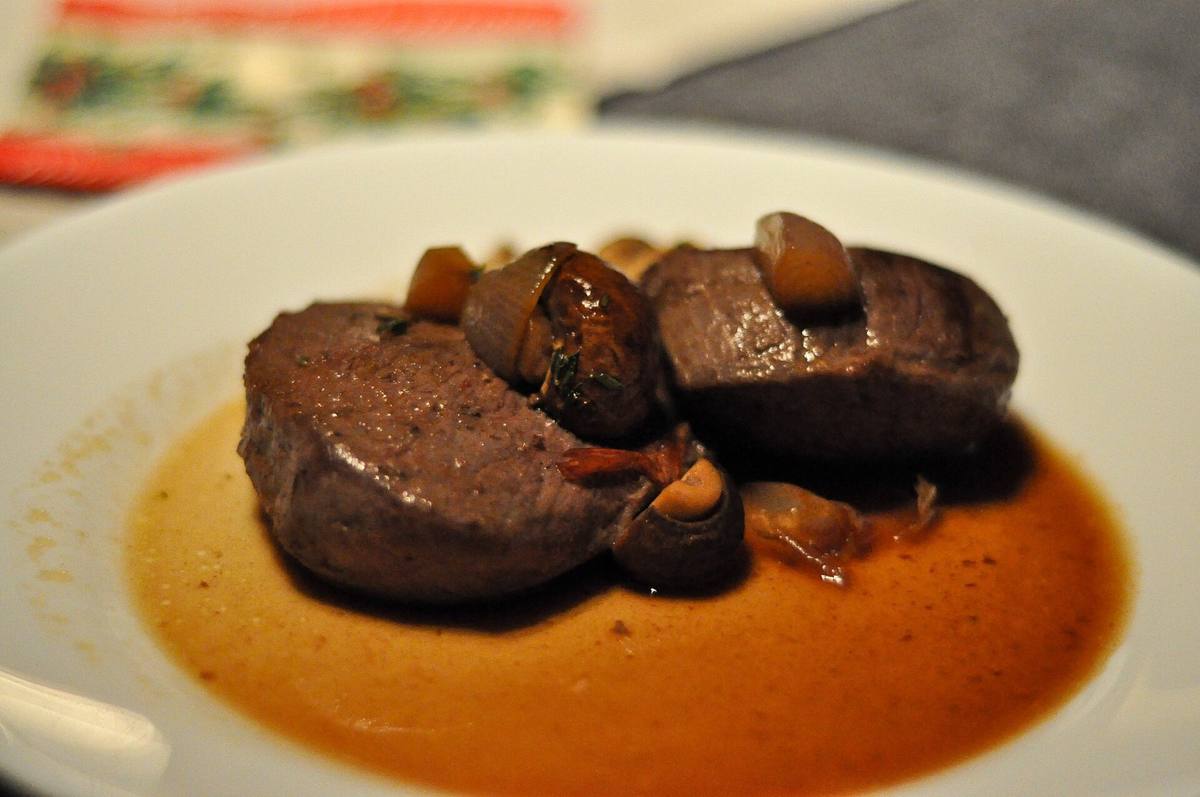
How to grill venison tenderloin is mostly about speed. The tenderloins are small and very tender, so they need a hot grill, a few minutes per side and a thermometer. MeatEater’s Danielle Prewett says to preheat “to high heat,” then “Sear over the flames for 2 to 5 minutes per side (timing will depend on how large your tenderloin is)” (MeatEater). Prewett’s own timing range is short, so stay at the grill.
Key Takeaways
- The tenderloins are the two small muscles inside the spine, separate from the backstrap.
- Trim the small strip of silverskin and keep seasoning simple.
- Grill over high heat for 2 to 5 minutes per side, depending on size.
- RAD’s house temperature for venison is 160°F. Chefs often pull tenderloin far lower.
- Handle tenderloins cleanly in the field; a gut shot can taint them.
What the tenderloin is
Prewett describes tenderloins as “those two pieces of meat that line the inside of the spine” (MeatEater). In another recipe, she calls them “the pair of narrow muscles attached to the inside of the spine near the hips” and says they “can easily be missed if you” have never been shown where to find them (MeatEater).
The Missouri Department of Conservation’s Conservationist magazine calls them “the strips from inside the lower back” and adds, “My butcher calls them catfish because of their shape” (MDC Conservationist).
How to grill venison tenderloin, step by step
- Trim. Prewett says “There is a small piece of silverskin exposed on the outside that will need to be trimmed, but it” is easy with a sharp knife (MeatEater).
- Temper. She says to “Bring the meat to room temperature, drizzle with oil, and season with salt and pepper” (MeatEater).
- Heat the grill. Begin “by preheating coals or grill to high heat.”
- Sear. Grill “2 to 5 minutes per side,” depending on size.
- Check and rest. Prewett pulls at “an internal temperature of 130°F” and lets it rest to “a final temp of 135°F for medium rare.” See the temperature section below for RAD’s house number.
Whole or sliced?
Sources split here. Prewett says “the tenderloins are relatively small and best cooked whole” and warns against cutting “them into medallions or” butterflying them (MeatEater). MDC’s writer takes the other route: the tenderloins “can be sliced into small, 1-inch thick medallions and cooked like tiny steaks” (MDC Conservationist).
No grill? Use a skillet and oven
Prewett gives an indoor version too. She says “If you’re pan-roasting, start by preheating your oven to 350°F,” sear in a hot cast iron skillet, then “transfer the pan directly to the oven” for “an additional 4 to 8 minutes, depending on size” (MeatEater).
Season or marinate
Most sources keep it simple. Prewett says “Most times, plain coarse sea salt and fresh cracked pepper are all you need.” Outdoor Life agrees: “For a tenderloin or backstrap on the grill, salt and pepper are a great start” (Outdoor Life). MDC says tenderloins “are so tender that marinating is unnecessary.”
If you want a marinade anyway, Prewett says she marinates tenderloins for the grill in a “zesty, garlic-herb marinade infused with lemon.” MDC’s soy and ginger marinade says to “Marinate in the refrigerator for 8-12 hours.” Marinades add flavor but don’t make meat safe; see marinade acid levels that do not replace heat.
The temperature question
Chefs like tenderloin pink. Outdoor Life’s Brooks Hansen says tenderloins and backstraps are “best cooked with high heat for a short period of time and served medium rare,” and “A medium-rare cut is going to taste better and be a lot more tender” (Outdoor Life).
Food-safety guidance is higher. Penn State Extension lists “whole cuts, steaks, and roasts to 145°F (63°C) (medium rare)” on one page (Penn State Extension) and says to “Cook venison, including jerky, to a minimum internal temperature of 160°F to reduce the risk of food-borne illness” on another (Penn State Extension). RAD’s house temperature for venison is 160°F. Tenderloins are small, so check the temperature often. For more on carryover heat in small cuts, see venison steak thickness and carryover cooking.
Start in the field
Grilling a great tenderloin starts at the deer. Prewett says to “get the tenderloins out as clean as possible while field dressing” and, after removing them, to “keep the muscle clean from dirt and debris and chill as quickly as possible.” She warns that “if you gut-shoot a deer, the tenderloins will be tainted with intestinal fluid,” and that even if you salvage the meat, “this can introduce unwanted bacteria.” See gut-shot deer.
FAQ
How long do you grill venison tenderloin? Prewett grills over high heat for 2 to 5 minutes per side, depending on size. Go by temperature.
Is tenderloin the same as backstrap? No. The tenderloins sit inside the spine; the backstrap runs along the outside of the back.
Should I cut tenderloin into medallions? Prewett cooks them whole. MDC’s writer slices them into 1-inch medallions. Both are sourced methods; pick the one that suits your grill.
What temperature should grilled tenderloin reach? RAD uses 160°F for venison. Penn State lists 145°F for whole cuts on one page.
The other side of it
Tenderloin purists say any temperature above medium-rare is a waste of the best bite on the deer, and the chefs quoted here would mostly agree. That’s a taste call, and it’s why their numbers are in this piece. But RAD’s house temperature is 160°F, and a thermometer is the only way to know you’re there. The hunter who leaves the tenderloins in the deer overnight and then frets about grill temps has already made his biggest mistake.
Keep reading
Latest deer news
Sources
- Venison Tenderloin with Italian Salsa Verde, MeatEater (Danielle Prewett)
- Venison Tenderloin with Garlic Butter, MeatEater (Danielle Prewett)
- Savoring Venison, Missouri Department of Conservation, Conservationist magazine (2004)
- How to Cook Venison, Outdoor Life (Brooks Hansen)
- Proper Care and Handling of Venison from Field to Table, Penn State Extension
- Canning and Freezing Venison, Penn State Extension
Comments