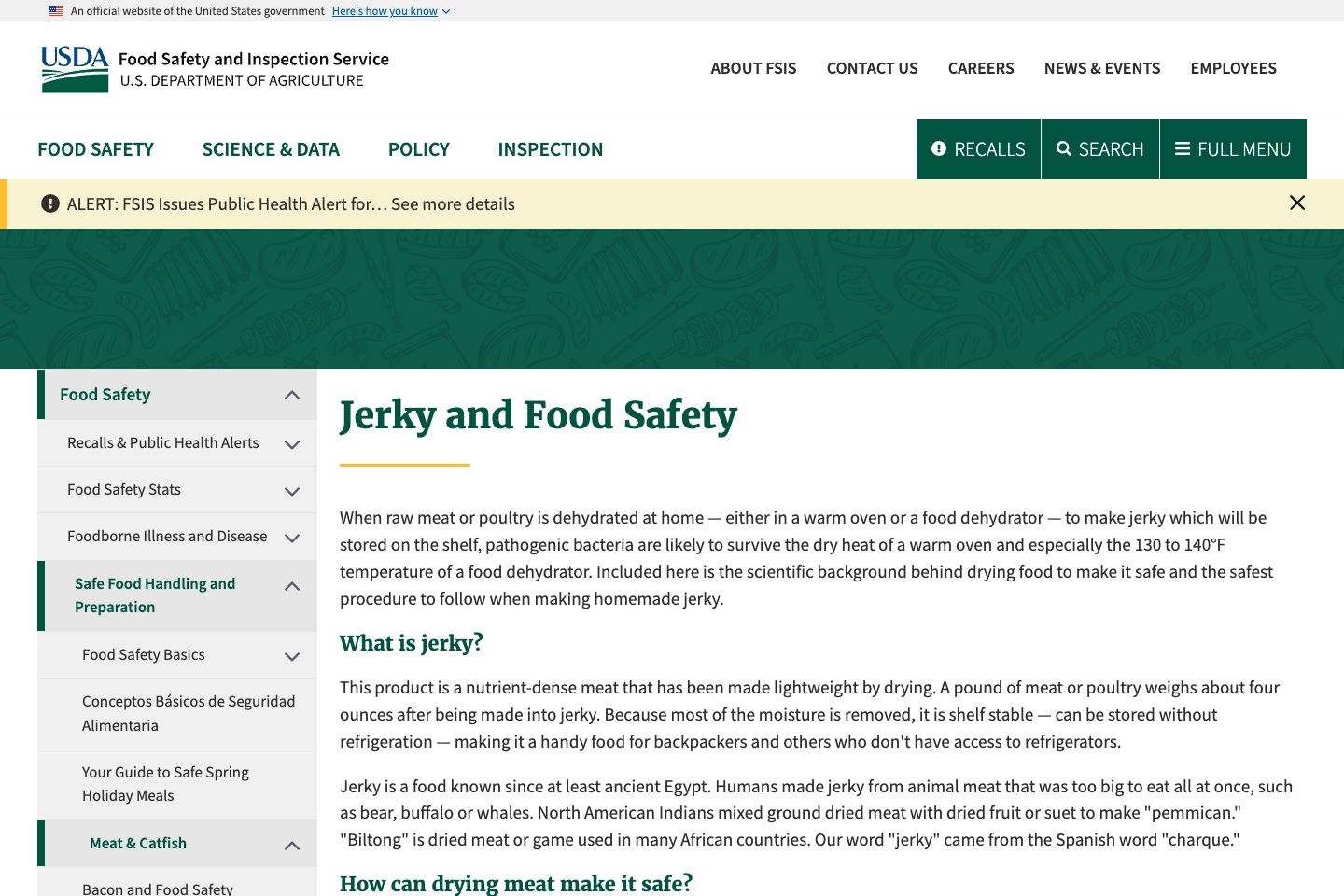
Hot smoking deer meat is a flavor step layered on a lethality step, not a substitute for cooking. USDA FSIS tells home jerky makers to heat meat to 160°F with wet heat before any dehydrating hold, because low-temperature dry chambers often never cook the interior (U.S. Department of Agriculture). Evaporating moisture absorbs heat early in a dehydrator or cool smoker, so bacteria can become more heat resistant before meat temperature finally rises (U.S. Department of Agriculture). Penn State Extension lists jerky among foods that must hit 160°F before drying and stores home-dried product about one to two months under refrigeration (Penn State Extension). Wisconsin DHS tells hunters not to rely on smoking, curing, or drying alone for wild-game parasite safety and pushes cooking wild game to at least 160°F (Wisconsin Department of Health Services). NCHFP jerky directions dry at 140°F after a preheat path that still targets 160°F in the meat (National Center for Home Food Preservation).
Key Takeaways
- Wet-heat climb to 160°F before calling smoked sticks done (U.S. Department of Agriculture; Penn State Extension).
- FSIS dry hold after preheat: constant 130-140°F (U.S. Department of Agriculture).
- NCHFP drying target around 140°F until a strip cracks but does not break (National Center for Home Food Preservation).
- Smoke, cure, and dry alone are not kill steps for wild game (Wisconsin Department of Health Services).
- Home-dried storage about 1-2 months refrigerated (Penn State Extension).
- Keep raw trim at 40°F or below until heat begins (U.S. Department of Agriculture; Penn State Extension).
Why wet heat has to come first
FSIS explains that inside a dehydrator or low-temperature oven, evaporating moisture absorbs most of the heat, so meat temperature lags until moisture is mostly gone (U.S. Department of Agriculture). By then surviving pathogens are more heat resistant (U.S. Department of Agriculture). Lab-inoculated venison in the FSIS jerky summary showed pathogenic E. coli surviving drying times up to 10 hours and temperatures up to 145°F when the process skipped a proper preheat (U.S. Department of Agriculture). That is why a chamber that sits at 140°F overnight is drying, not pasteurizing, unless the meat itself already reached 160°F (U.S. Department of Agriculture).
Two validated ways to hit 160°F
FSIS lists steaming or roasting meat to 160°F before dehydrating as the primary home path (U.S. Department of Agriculture). NCHFP describes heating strips in marinade before drying, or heating dried strips in an oven afterward, as two methods that still drive internal temperature to 160°F without case hardening (National Center for Home Food Preservation). Either way, use a food thermometer in the thickest piece rather than trusting chamber air or smoke color (U.S. Department of Agriculture; Penn State Extension). Ground-and-formed smoked sticks inherit the ground-meat 160°F target CDC publishes for Toxoplasma prevention and that Penn State lists for ground venison (Centers for Disease Control and Prevention; Penn State Extension).
Humidity and the dry hold
NCHFP’s jerky directions give no humidity or moisture target for the chamber. They judge doneness with a bend test instead (National Center for Home Food Preservation). After lethality, FSIS wants a constant dehydrator temperature of 130-140°F so drying finishes before spoilage and removes enough water that microorganisms cannot grow (U.S. Department of Agriculture). NCHFP runs racks in a dehydrator or oven preheated to 140°F and dries until a test piece cracks but does not break when bent, often 10 to 24 hours if strips were not preheated in marinade (National Center for Home Food Preservation). Samples heated in marinade dry faster; begin checking after about 3 hours (National Center for Home Food Preservation). Hot-smoked roasts still need a probed 160°F in the thickest muscle before you pull them for resting, because smoke flavor is not a kill step (Wisconsin Department of Health Services; Penn State Extension).
Cold trim, marinade, and hygiene before wood smoke
Cool carcasses to 35-40°F and keep raw product at 40°F or slightly below while you cut strips (Penn State Extension; U.S. Department of Agriculture). Marinate only under refrigeration and do not save marinade to reuse (U.S. Department of Agriculture; National Center for Home Food Preservation). Wash hands, knives, boards, and grinders with warm soapy water before and after meat contact so you do not recontaminate product after a lethality step (Penn State Extension; U.S. Department of Agriculture). Use or freeze ground meat within 2 days; whole red meats within 3 to 5 days (U.S. Department of Agriculture; National Center for Home Food Preservation).
Storage clock after a safe smoke
Penn State Extension stores home-dried jerky about one to two months under refrigeration below 40°F (Penn State Extension). FSIS compares home-dried product on a short refrigerated clock versus longer commercial packs, so label dates and rotate older boxes first (U.S. Department of Agriculture; Penn State Extension). Vacuum packaging is a good option after cooling, but it does not replace the 160°F kill step (National Center for Home Food Preservation; Wisconsin Department of Health Services).
Bottom line
Reach 160°F with wet heat before calling hot-smoked venison safe; treat 130-140°F as the finishing dry hold, not the kill step (U.S. Department of Agriculture; Wisconsin Department of Health Services; National Center for Home Food Preservation).
The other side of it
For a piece promising humidity targets, it never gives one, and most of its sources are written for jerky strips and then stretched to cover whole roasts. Plenty of smokers will argue a roast and a dehydrator tray are different problems, and a 160°F roast is a long way from the pink slices they’re after. But the guy who counts a cool smoker and a nice smoke ring as his kill step is running a science fair, not a kitchen.
Keep reading
Latest deer news
Comments