Deer heart and tongue are variety meats, not medium-rare steaks. FoodSafety.gov lists rabbit and venison (wild or farm-raised) at 160 deg F (FoodSafety.gov). FSIS’s holiday roasting chart also lists venison roasts at 160 deg F (FSIS Roasting Those “Other” Holiday Meats). Neither chart gives deer heart or tongue a line of its own, so the venison 160 deg F number is the one to probe offal to (FoodSafety.gov; FSIS Roasting Those “Other” Holiday Meats). FSIS cold-storage charts group variety meats with ground meat at 1-2 days refrigerated or 3-4 months frozen (FSIS Food Safety Basics). Skip pink centers on heart steaks and underdone tongue slices (FoodSafety.gov; FSIS Roasting Those “Other” Holiday Meats).
Key Takeaways
- Venison: 160 deg F minimum (FoodSafety.gov)
- Venison roasts: 160 deg F; no separate deer-organ line on either chart (FSIS Roasting Those “Other” Holiday Meats)
- Variety meats fridge: 1-2 days; freeze 3-4 months (FSIS Food Safety Basics)
- Always use a food thermometer (FoodSafety.gov)
- Leftovers: reheat to 165 deg F (FoodSafety.gov; FSIS Food Safety Basics)
- Keep raw offal juices off ready foods (FSIS Food Safety Basics)
Why offal is not the steak line
FoodSafety.gov’s beef steak line is 145 deg F with rest; venison as a category is listed at 160 deg F, and FSIS’s roasting chart gives venison roasts the same 160 deg F (FoodSafety.gov; FSIS Roasting Those “Other” Holiday Meats). A grilled deer heart cooked like a rare beef medallion fights both charts (FoodSafety.gov; FSIS Roasting Those “Other” Holiday Meats). Ground deer mixes stay at 160 deg F as well if heart is ground into sausage (FoodSafety.gov).
Heart and tongue workflow
Trim fat and connective tissue, keep pieces cold, and probe the thickest section to 160 deg F (FoodSafety.gov; FSIS Roasting Those “Other” Holiday Meats). However you cook tongue, finish to thermometer temperature rather than color (FoodSafety.gov). Wash hands 20 seconds before and after handling raw offal (FSIS Food Safety Basics).
Cold chain before the skillet
FSIS lists variety meats at 1-2 days in the refrigerator at 40 deg F or below (FSIS Food Safety Basics). Freeze promptly if you will not cook inside that window (FSIS Food Safety Basics). Wrap so purge cannot drip onto salads or cooked leftovers (FSIS Food Safety Basics).
Leftovers after the hunt breakfast
Reheat leftover heart hash or sliced tongue to 165 deg F (FoodSafety.gov; FSIS Food Safety Basics). Discard perishable trays left out more than 2 hours (1 hour above 90 deg F) (FSIS Food Safety Basics). Cool leftovers in shallow containers (FSIS Food Safety Basics).
Liver in the same basket
FSIS’s cold-storage chart lists liver alongside tongue, heart and kidney as variety meats (FSIS Food Safety Basics). Neither cooking chart gives deer liver its own line, so the venison 160 deg F row is the closest published number (FoodSafety.gov; FSIS Roasting Those “Other” Holiday Meats). Treat the whole offal cooler the same way (FSIS Food Safety Basics).
Separate boards for raw offal
FSIS preparation rules say keep raw meat juices away from other food and wash boards with hot soapy water after cutting raw meats (FSIS Food Safety Basics). Give heart and tongue their own board before salad prep (FSIS Food Safety Basics).
Thermometer habit
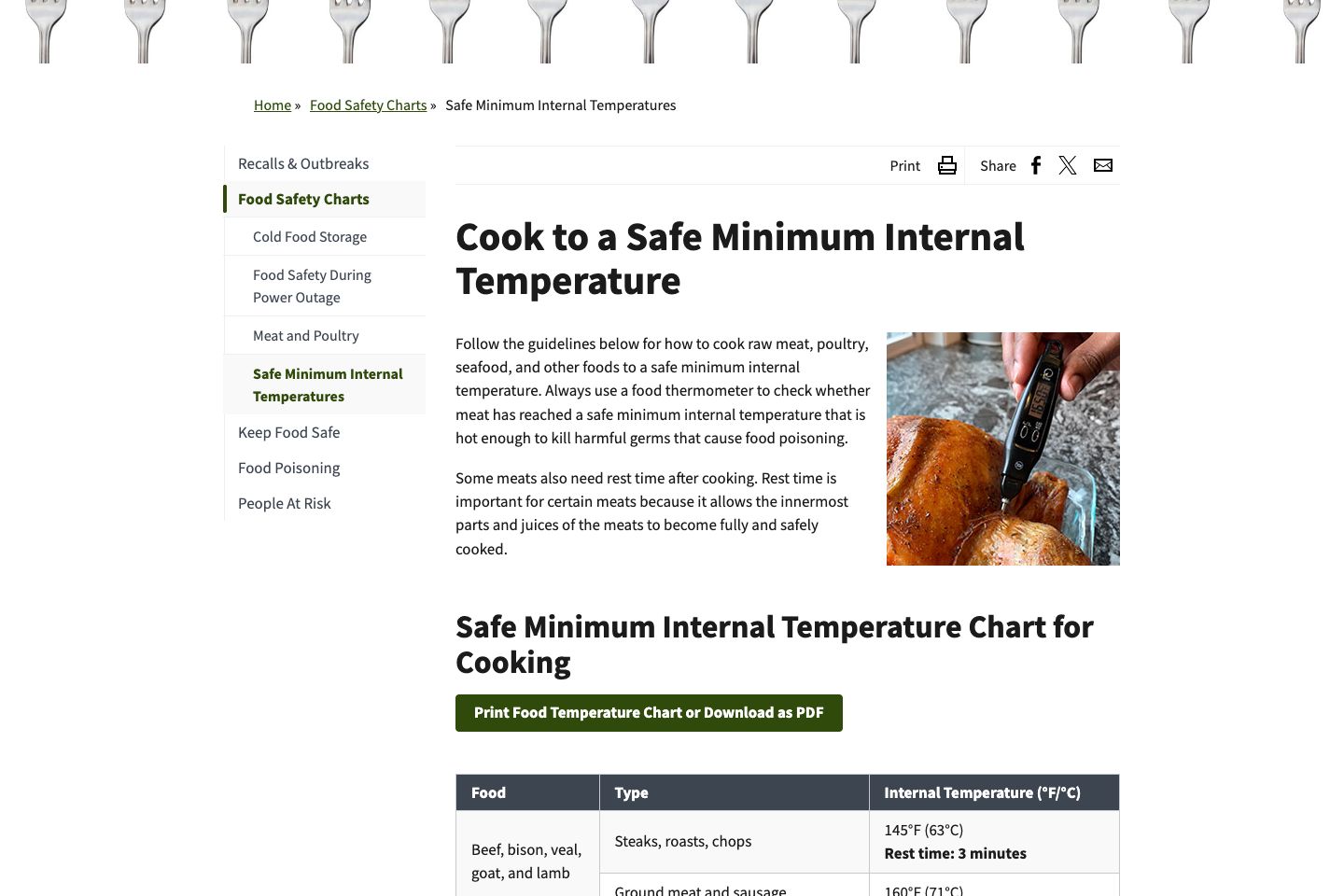
FoodSafety.gov emphasizes using a food thermometer for safe minimum internal temperatures - probe placement in the thickest part beats guessing by juice color (FoodSafety.gov).
Bottom line
Cook deer heart, tongue, and other offal to 160 deg F, matching the venison line on FoodSafety.gov and FSIS’s roasting chart, and hold raw variety meats to the 1-2 day fridge window (FoodSafety.gov; FSIS Roasting Those “Other” Holiday Meats; FSIS Food Safety Basics).
The other side of it
Neither federal chart lists deer organs on their own, so the 160 number here is the venison line stretched to cover offal, and hunters who have eaten seared deer heart for years will point out that a whole heart cooks more like a steak than like sausage. The charts draw one blanket line for venison, which is the cautious call, not proof that a pink heart is the danger the chart implies. Then again, the camp cook who serves heart blue-rare never seems to own a thermometer, so it’s hard to know what temperature he’s defending.
Keep reading
Latest deer news
Comments