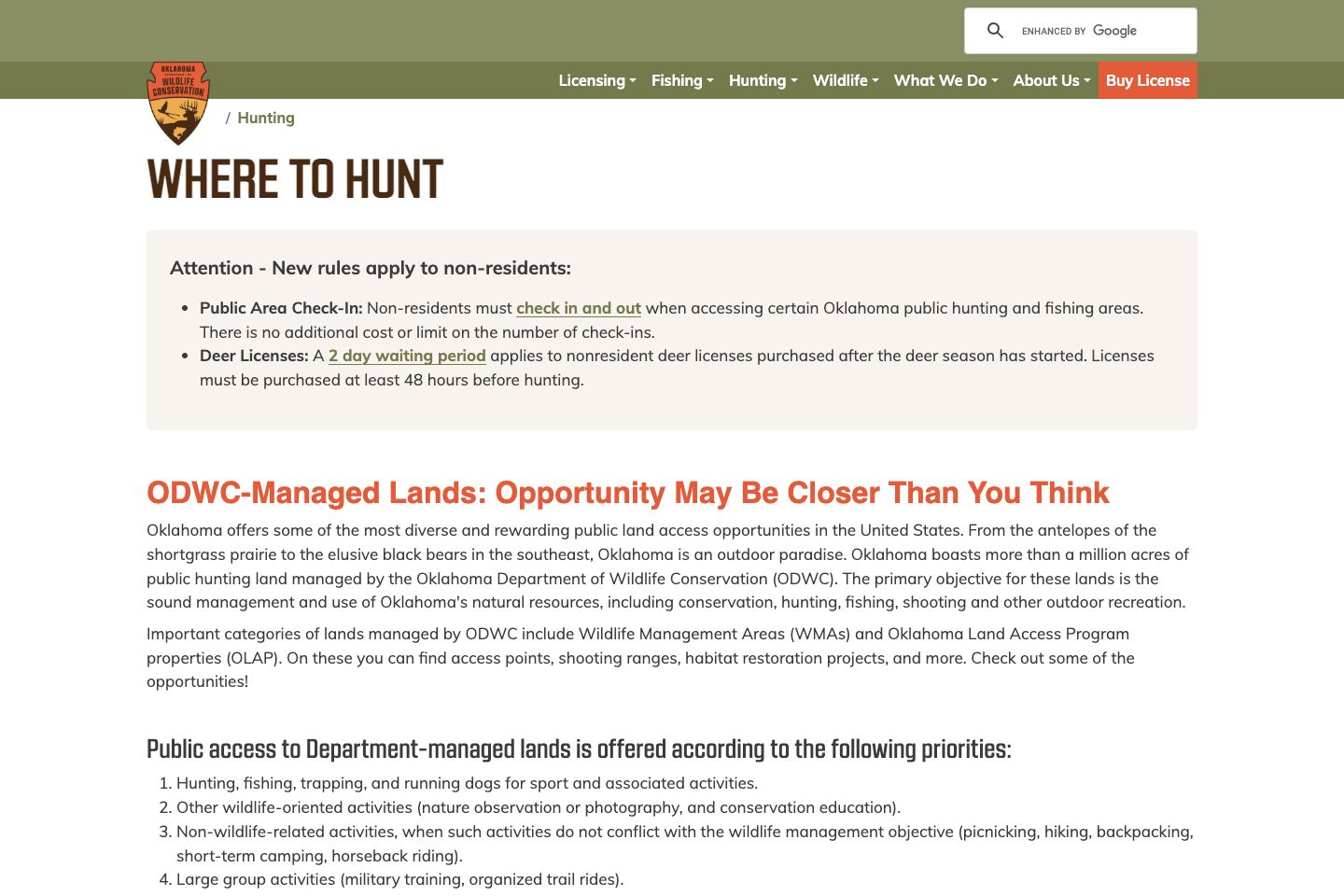
Hunting public land in Oklahoma for deer means Wildlife Management Areas (WMAs), leased private ground in the Oklahoma Land Access Program (OLAP) and drawn controlled hunts, all run by the Oklahoma Department of Wildlife Conservation (ODWC). The agency’s where-to-hunt page says Oklahoma “boasts more than a million acres of public hunting land managed by” ODWC. Every WMA can set its own deer seasons and gear limits, OLAP land is walk-in archery country for deer, and some areas need a separate permit or a check-in. Statewide dates and bag limits live on our Oklahoma deer season guide.
Verified against official ODWC (wildlifedepartment.com) pages on 2026-11-05.
Key Takeaways (verified 2026-11-05)
- Small footprint, big harvest. ODWC’s 2025-26 Big Game Report says its lands are “only about 4%” of the state yet produced 6.7% of the deer harvest.
- No bait on any ODWC land, OLAP included. Plain salt and mineral blocks are allowed.
- Label your gear. Stands, blinds and trail cameras need your ODWC customer ID number permanently attached.
- Land Access Permit: $100 for residents 18 to 63, $200 for nonresidents. Required for OLAP and three leased WMAs.
- Controlled hunts: apply each spring (April 1 to May 20 in 2026). Per ODWC’s deer season rules, controlled-hunt deer “do not count toward” the six-deer season limit.
How much public hunting land does Oklahoma have?
ODWC gives two numbers, and they measure different things. The where-to-hunt page says “more than a million acres of public hunting land.” The agency’s public check-in page says its public lands “provide more than 1.5 million acres for recreational use.” Either way, the harvest report puts ODWC-managed land at about 4% of the state’s land base.
Small or not, it kills deer. In 2025-26, hunters checked 8,966 deer on public WMAs and 775 on OLAP land, out of 133,791 statewide. Every one of the OLAP deer was taken during archery season, which tells you something about the gear rules below.
What rules apply on Oklahoma WMAs?
Statewide licenses, orange and E-Check still apply. These are the extras from ODWC’s Department-Managed Area Rules:
- Bait: “It shall be unlawful to place and/or hunt over bait on lands owned or managed by the Department,” Corps land included. Salt or mineral blocks and commercial scents are allowed. Blocks with grain, cattle cubes, sweet feed and piled-up acorns are not.
- Deer stands: portable only, with nothing that can damage the tree. No permanent stands and no cleats. Stands come down within 14 days after the hunt closes, or they become state property.
- ID on your gear: tree stands, ground blinds and game cameras need “the owner’s Department issued customer identification number or lifetime license number” affixed “in a conspicuous manner.”
- No drones, night vision or thermal on ODWC land without the director’s approval.
- No ATVs or UTVs on WMA roads unless county-maintained, except for permitted non-ambulatory hunters. Don’t cut living trees for a blind or stand.
Does every WMA follow statewide deer seasons?
No, and this is where hunters get burned. ODWC’s special area regulations list each area’s exceptions. Altus-Lugert WMA, for example, is closed to the holiday antlerless season, and its deer gun season is “open the first nine days only,” closed to antlerless deer and limited to archery, shotguns with slugs and muzzleloaders. Some areas also close entirely for controlled hunts. Arbuckle Springs WMA is “closed to all activities” Nov. 21–22, 2026.
ODWC’s gun deer opportunities page lists the public areas open to deer gun season, and warns that some are open only a set number of days or not to every kind of gun. Read the area page before you pack a rifle.
What is the Oklahoma Land Access Program?
OLAP is private land ODWC leases for walk-in public use. Per the OLAP page, “properties in OLAP are not owned by ODWC; instead ODWC pays a lease price annually.” It started with a $2.26 million USDA grant under the 2014 Farm Bill, and hunting tracts are at least 40 acres.
Can you deer hunt OLAP land with a rifle?
No. Walk-in hunting areas are posted “Archery/Shotgun Only,” open Sept. 1 to May 16, and the OLAP hunting regulations say “no shot larger than T, slugs prohibited,” with centerfire, rimfire and muzzleloading rifles banned. Since a shotgun needs a slug for deer, that leaves your bow or crossbow. Other OLAP rules:
- Foot traffic only. No horses, vehicles or bicycles.
- Access runs two hours before sunrise to one hour after sunset. Call or text the game warden if you’re retrieving a deer after hours.
- No dogs for deer, except leashed tracking dogs after you notify the warden, with no weapon on anyone tracking.
- No camping, alcohol or fires, and no bait.
- Limited Access tracts need a daily online check-in, first come, first served, opening at 8 a.m. two days ahead.
Do you need a Land Access Permit?
For OLAP, yes, unless you’re exempt. ODWC’s license fees page lists the Land Access Permit at $100 for residents and $200 for nonresidents, valid Jan. 1 to Dec. 31. Per the specialty licenses page, it also covers Honobia Creek, Three Rivers and Herron Family WMAs, which are leased too. Residents 17 and under or 64 and older on the first day of the calendar year are exempt. Lifetime license holders are not, and “nonresidents are required to purchase an annual permit, no exemptions.”
How do Oklahoma controlled deer hunts work?
ODWC’s controlled hunts page says they’re held “where unrestricted public hunting would pose safety concerns or where overharvest might occur,” and winners come from a random drawing. For the 2026 cycle:
- Application window: April 1 to May 20, 2026, online through Go Outdoors Oklahoma.
- Fee: $10 for residents and $50 for nonresidents, paid once a year no matter how many categories you enter, per the cost page.
- If drawn: a $36 resident bonus deer license, plus federal user fees on some areas, such as $20 on most refuges and $40 at McAlester Army Ammunition Plant.
- Order of draws: elk first, then antelope, then deer. Draw one and you’re out of the others for the year.
How do Oklahoma preference points work?
ODWC’s preference point page calls it “not a true preference system.” Each point acts like an extra application in that category, so a first-timer can still beat you. Points are lost once you’re drawn, even if you skip the hunt (unless you bought PointGuard), and “if you do not apply for five years in a row,” they’re wiped. Groups of up to four average their points.
So is it smarter to burn a cheap application every spring, or sit on a pile of points that can still lose to a rookie?
What’s different for nonresidents on Oklahoma public land?
Two things. Under rules adopted in 2025, nonresidents must check in and out of a long list of WMAs and other areas through Go Outdoors Oklahoma, at no cost, per the check-in page. And per the where-to-hunt page, nonresident deer licenses bought after a season opens must be bought “at least 48 hours before hunting.” Price it out on our Oklahoma deer hunting hub.
Related reading on RAD:
- Oklahoma deer season 2026-27
- How public land deer hunting works in Texas
- Public land deer hunting in Missouri
World record public land whitetail
There is no official Boone and Crockett “world-record public-land whitetail” title separate from the all-time typical and non-typical lists. The Club’s World’s Record typical whitetail - Milo N. Hanson’s 213-5/8 buck from Biggar, Saskatchewan - was taken on his own land, not public ground (B&C World’s Record typical). Public-land hunters still make B&C book, and the Club publishes stories celebrating public-land trophy hunting (B&C public land tribute), but claiming a single “world record public land” buck requires verifying land ownership in the official entry - gossip charts do not count. Use B&C Records tools and state record books, then confirm the hunt unit type with the entry notes.
The other side of it
ODWC’s 6.7% harvest share is a strong number, but it’s a total across very different ground, and the WMA-by-WMA table wouldn’t load for us, so we can’t tell you which areas carry it. Area rules, closure dates and the nonresident check-in list also change from year to year. Hunting public land in Oklahoma works best when you read the special area regulations for the exact WMA or OLAP tract before every trip.
Keep reading
Oklahoma's biggest bucks in the record book →
Latest deer news
Sources
- Where To Hunt | Oklahoma Department of Wildlife Conservation
- 2025-26 Big Game Harvest Report | ODWC
- Deer - Big Game Season | Oklahoma Department of Wildlife Conservation
- Oklahoma Public Hunting Check In | ODWC
- Department-Managed Area Rules | Oklahoma Department of Wildlife Conservation
- Public Hunting Areas: Special Regulations | Oklahoma Department of Wildlife Conservation
- Gun Deer Opportunities | Oklahoma Department of Wildlife Conservation
- Oklahoma Land Access Program | ODWC
- OLAP Regulations (Hunting) | Oklahoma Department of Wildlife Conservation
- License Fees | Oklahoma Wildlife Department
- Specialty Licenses | Oklahoma Department of Wildlife Conservation
- Controlled Hunts | Oklahoma Department of Wildlife Conservation
- What does it Cost? | Oklahoma Department of Wildlife Conservation
- Preference Point System | OK Department of Wildlife Conservation
- B&C World's Record - Typical Whitetail Deer | Boone and Crockett Club
- A Tribute to Hunting on Public Land | Boone and Crockett Club
Comments